



Demand for experienced technology executives continues to rise while the available talent pool remains limited. McKinsey & Company reports that only 16% of executives believe they have the technology talent needed to support digital transformation effectively, and 60% identify talent gaps as a major obstacle to execution. Across the broader market, nearly 87% of companies say they are already facing or expect to face shortages in technology talent.
At the same time, failed senior hires create far more than replacement costs. They delay product execution, disrupt investor confidence, slow transformation programs, and create ripple effects across teams that can last well beyond the hire itself. Industry research puts the total cost of a failed C-suite hire at up to 10 times that executive's annual salary, including severance, lost productivity, strategic disruption, and team turnover. For roles such as CTO, CPO, or Chief AI Officer, the impact can extend across multiple product cycles, a funding round, or even IPO preparation. The same applies to VP- and SVP-level appointments in AI, engineering, and product, where a wrong hire can disrupt the teams and decisions that sit directly below them.
The technology executive search firm you choose determines who enters the process and whether the person leading your technology function is the right long-term hire or simply the most available one. Yet many organizations apply less rigor to selecting a search partner than they do to evaluating the executives presented to them.
This guide covers what tech executive search involves, how to evaluate a firm before engaging one, what pricing looks like, and how five established firms differ by search focus and hiring scenario. The firms are presented in alphabetical order as a neutral resource for organizations comparing technology executive search partners.
What Technology Executive Search Actually Involves
Tech executive search is a retained, research-led discipline focused on senior technology and product leadership appointments. It differs from general executive recruiting because the search firm must assess two difficult things at the same time: whether a candidate can lead a complex organization through change, and whether they understand the technical landscape well enough to make high-stakes decisions inside it. Sector specialization can be particularly relevant when a search requires assessment of both leadership capability and technical context.
The roles that fall under this category include Chief Technology Officers, Chief Information Officers, Chief Product Officers, Chief Data Officers, Chief Information Security Officers, Chief AI Officers, Heads of AI, VP and SVP of AI, and VP of Engineering, along with other VP and SVP-level leaders who report directly to them. Board-level technology director appointments are also increasingly handled through specialist search firms rather than governance-only practices, because evaluating those candidates requires technical judgment as much as board experience.
The distinction between retained and contingency search matters before any engagement begins. A contingency firm earns its fee only when a placement is made, which creates pressure to move quickly and present whoever is currently available. A retained firm is engaged upfront and paid in stages through a structured process, which aligns incentives around finding the right long-term fit rather than the fastest placement. For technology leadership roles above the VP level, retained search is the accepted standard across the market because the cost of getting it wrong is significantly higher than the cost of running the search properly.
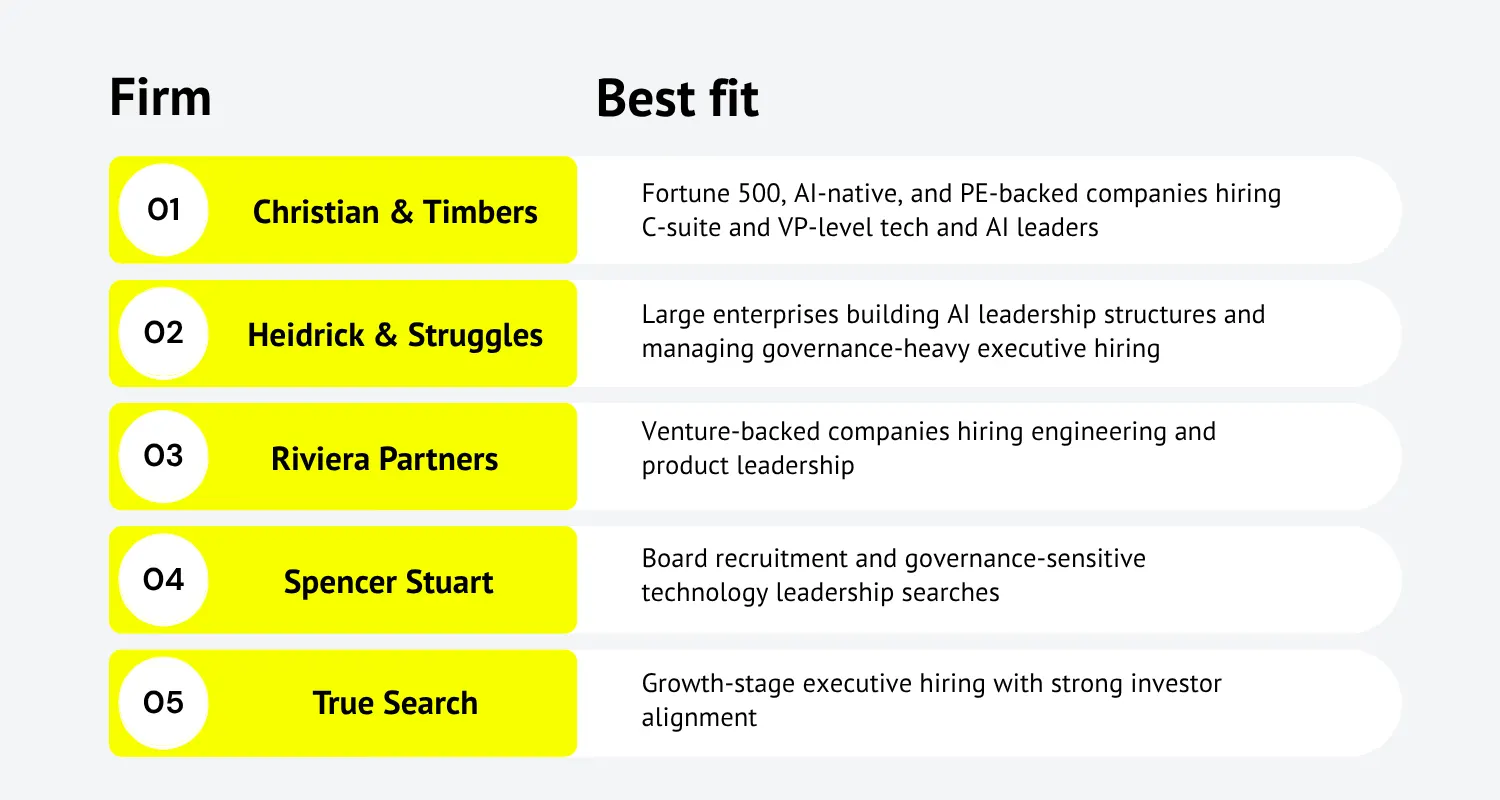
The five firms below represent different approaches to senior technology leadership hiring. Each has a distinct area of focus, from AI and technology executive search to board recruitment, venture-backed leadership, and investor-aligned hiring. The table presents them in alphabetical order to help organizations compare different search models and areas of specialization.
Tech Executive Search Firms at a Glance (In Alphabetical Order)
How to Choose a Tech Executive Search Firm
Most search firms sound convincing in the first meeting. Credentials are solid, case studies are polished, and the process looks structured. That alone does not tell you how the search will actually run once the engagement starts.
The gap between firms shows up in execution.
Start with the problem
A CTO hired after a failed product cycle is not the same as a CTO hired before an IPO. One is a recovery hire. The other is a growth hire. The profile, the assessment criteria, and the candidate pool are different in each case.
If the brief starts with a title and compensation range, the search follows that level of detail. You end up with candidates who match the label.
Before speaking to any firm, get clear on what this person walks into on day one. What is already off track? Which decisions cannot be delayed? What does success look like after a year? That clarity shapes the entire search.
Look past the brand name
The partner leading the pitch is not always the person running the search.
Ask directly who will handle candidate outreach, interviews, and shortlist development. Then look at that individual's track record. Strong outcomes usually trace back to one operator who knows the market well and stays close to the process from start to finish.
If that ownership is unclear, expect a more generic search.
Test how the firm actually builds a candidate pool
Every firm has a network. The question is how far beyond that network they go.
Search approaches vary in how broadly they map the market beyond existing relationships. Ask how the firm identifies candidates outside its established network and how passive prospects are incorporated into the process.
You should be able to ask how the firm will find candidates outside its existing relationships and get a clear answer. If the explanation stays high level, the sourcing is likely limited.
Understand how off-limits constraints affect you
Many retained firms cannot approach candidates from current or recent clients. On paper, that sounds reasonable. In practice, it can remove a large part of the market from your reach.
This rarely comes up in early conversations, but it directly affects who ends up on your shortlist. A firm with fewer conflicts may have access to candidates that others cannot contact.
Ask for outcomes
Most firms will say they build diverse slates or focus on long-term fit. Those statements only matter if they show up in results.
Ask for recent examples in your sector. How many finalists came from different backgrounds? How often were those outcomes consistent? What does retention look like after one and two years?
Offer acceptance rates look good in presentations. Retention tells you whether the search worked.
Watch how they respond under pressure
A good test is to push on a detail that matters to your situation. For example, timeline expectations or how they would handle a narrow candidate pool.
Firms that have done similar searches tend to answer directly and with specifics. Firms without that experience usually return to general process descriptions.
That difference becomes obvious once the search is live.
Tech Executive Search for Private Equity Firms
Private equity mandates operate on tighter timelines than traditional corporate searches. A search partner who does not understand that from the first conversation will delay decisions that affect growth, execution, and exit planning. PE-backed portfolio companies need technology leaders who can execute against an investment thesis within a defined holding period. The search process must be built around that reality rather than using a standard corporate hiring model.
The data on why leadership quality matters so much in private equity is clear. McKinsey & Company found that 94% of general partners believe portfolio company leadership contributes an average of 53% toward investment returns. Separately, top-quintile CEOs deliver total shareholder returns 9% above industry peers in each year of their tenure. Leadership is not a soft input in private equity. It is one of the largest single drivers of fund performance.
The average private equity holding period is five to seven years. A CTO hired in year one must be capable of driving the digital transformation agenda that supports a successful exit, whether that means improving operational efficiency, accelerating product delivery, or preparing the business for acquisition.
Speed also matters differently in PE searches. Most sponsors expect a qualified shortlist within two to four weeks of kickoff. That pace requires dedicated research infrastructure, operator networks, and existing candidate relationships.
Assessment standards are equally important. Sponsors need to know whether a CTO candidate can execute under pressure, communicate effectively with financially driven investors, and make high-stakes resource decisions with limited time and capital. Firms that perform well in this space build their evaluation frameworks around those outcomes.
Is Tech Executive Search Worth the Investment?
Most technology companies start by running a C-suite search internally at least once. It rarely ends there.
The instinct makes sense. Internal teams know the company, understand the product, and often have strong networks. For many roles, that works well. At the executive level, the conditions are different.
Internal recruiting works when candidates are actively looking and when the company can attract inbound interest at scale. That is rarely the case for CTO, CPO, or Chief AI Officer roles. The strongest candidates are already in place and often evaluating multiple opportunities at the same time. Add confidentiality requirements and competitive pressure, and the process shifts quickly beyond what most internal teams are built to handle.
A firm that has recently placed multiple CTOs operates with a different level of market visibility. It knows which compensation packages are actually closing candidates, which executives are quietly open to a move, and where leadership instability is creating opportunity before it becomes visible. That information does not sit in a database. It comes from ongoing conversations in the market.
The cost question is usually framed around the search fee. That misses the larger risk.
A failed executive hire costs far more than the replacement search. It delays execution and can reset strategy at the worst possible moment, sometimes across an entire product cycle or funding round.
The real question is what it costs to get the hire wrong.
Tech Executive Search for Board Recruitment
Board-level technology appointments are where the consequences of choosing the wrong search partner are most visible and the hardest to reverse. A board director serves for years, influences decisions across every major strategic area, and is visible to institutional investors, proxy advisory firms, and the broader governance community in ways operating executives are not. The search process needs to reflect that level of scrutiny from the start.
Why Board Search Is Structurally Different
Recruiting a technology board director is not a lighter version of recruiting a CTO. The candidate profile is fundamentally different.
The role requires current market relevance, governance literacy, the ability to challenge management without stepping into operational control, and the independence that investors and proxy advisory firms will examine closely. The number of executives who combine those qualities, and who are both willing and eligible to serve, is far smaller than most boards expect.
The process also involves layers of diligence that operating executive searches do not require. Conflict-of-interest screening is far more complex in technology because candidates often hold equity positions, advisory relationships, and existing board seats that can create disclosure obligations or voting restrictions.
Committee composition shapes the target profile as well. A board that already has strong software leadership may need cybersecurity expertise, AI governance knowledge, or infrastructure depth instead. In public company searches, securities counsel is often involved before an offer is extended.
Board director searches routinely take 120 to 150 days, while operating CTO or CIO searches often close within 90 to 120 days. Companies that approach board recruitment with operating-search timelines usually make compromises they regret later.
What to Require From a Board Search Partner
The firm handling a board mandate needs governance infrastructure that many operating search firms do not build. That includes established relationships with proxy advisory firms, experience managing complex conflict reviews, and access to former technology executives who are building serious board portfolios.
When evaluating a firm, ask them to walk through a recent board director placement in specific terms:
- How was governance diligence handled?
- How were conflicts resolved?
- What role did compensation benchmarking and investor expectations play?
The specificity of those answers can help organizations assess the firm's recent experience with board-level technology appointments.
Tech Executive Search Pricing
Retained tech executive search typically costs between 25% and 35% of the placed executive's first-year total cash compensation. A CTO with a $400,000 base salary and a $100,000 target bonus would usually generate a search fee in the range of $125,000 to $175,000. Most retained searches are paid in three stages: at engagement, at shortlist delivery, and at final placement.
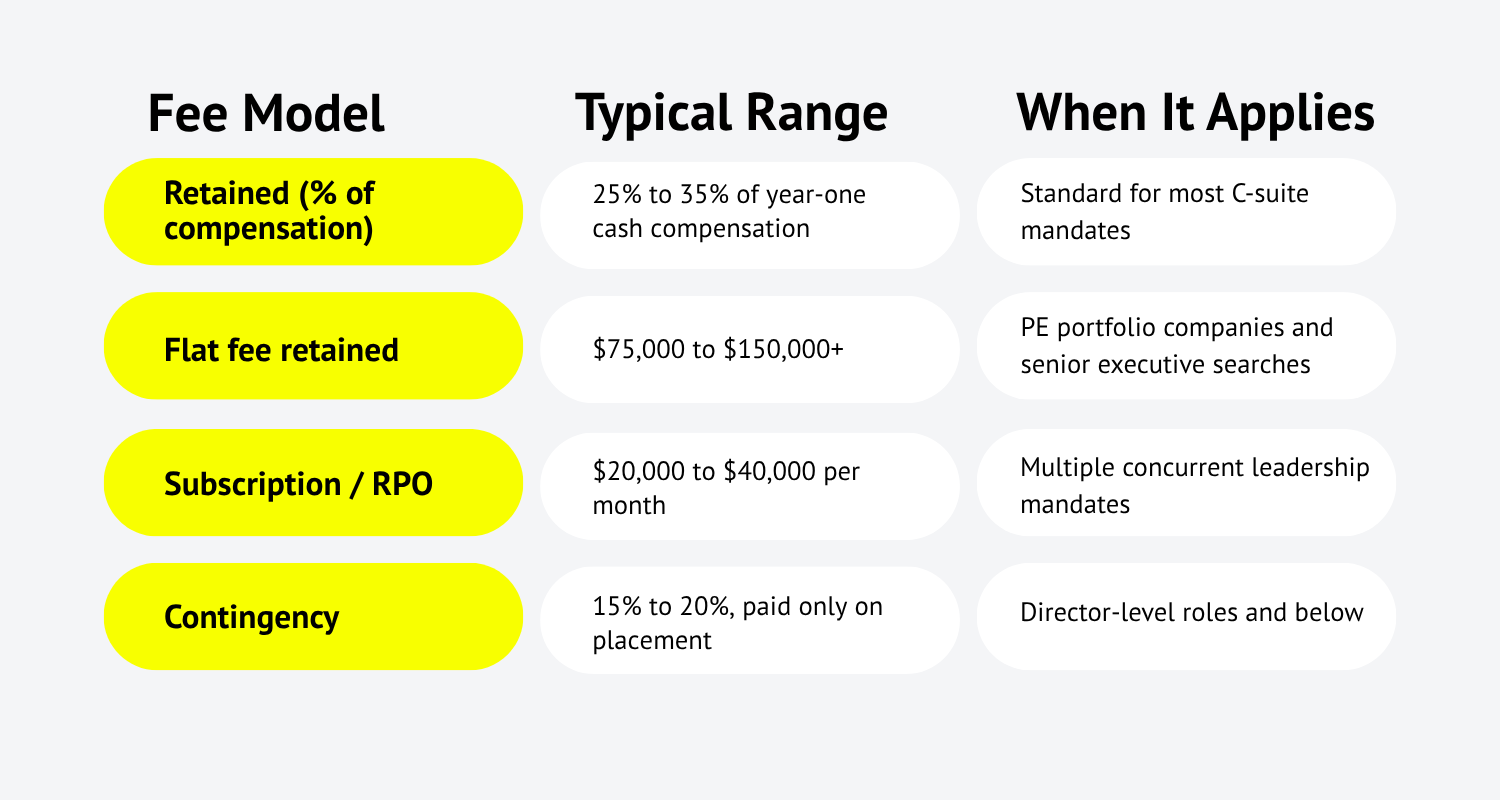
Many firms also bill out-of-pocket expenses separately, including candidate assessment tools, travel for in-person interviews, and background check services. These typically add another 4% to 8% to the total engagement cost and should be estimated clearly in the engagement letter rather than appearing unexpectedly at the end of the process.
For companies hiring AI leadership roles such as Chief AI Officer, CTO, or VP of AI, compensation expectations often extend beyond standard executive search fee models. Christian & Timbers' guide on AI executive compensation benchmarks in 2026 breaks down market structure, equity expectations, and current compensation ranges in more detail.
Tech Executive Search Firms: 5 Compared (In Alphabetical Order)
1. Christian & Timbers
Best for: Fortune 500, AI-native, and PE-backed companies hiring C-suite and VP-level tech and AI leaders

Website: www.christianandtimbers.com
Founded: 1980
Headquarters: Cleveland, Ohio
Christian & Timbers was built exclusively for tech executive search before it became a formal category. For more than 40 years, the firm has completed over 5,000 C-suite placements, including 700+ CEO searches and 350+ AI and technology leadership placements, among them more than 25 Chief AI Officers.
C&T has built leadership teams for more than 750 technology companies across enterprise software, AI infrastructure, cybersecurity, fintech, robotics, defense, and manufacturing. Leadership searches have included mandates for companies such as Broadcom, F5, Apple, Adobe, Amazon, and Google.
A dedicated AI leadership practice focuses on Chief AI Officers, Heads of AI, CTOs and VPs of Engineering with machine learning mandates, and board members with AI governance responsibilities. C&T does not operate with off-limits candidate restrictions, giving clients full access to the leadership market rather than excluding candidates from existing client companies. It tracks more than 5,000 AI leaders and maps over 90% of the AI executive market before a search begins.
Its proprietary Science of Talent Engineering methodology combines structured market mapping, executive assessment, and leadership benchmarking through the OnPoint platform. Christian & Timbers also publishes an annual AI Executive Compensation Study based on interviews with more than 50 CHROs and over 200 CEOs and CTOs.
Key strengths:
- CTO search and placement
- Chief AI Officer, Head of AI, and VP of AI recruitment
- Board-level technology leadership search
- Private equity executive search
- AI leadership market mapping
When to partner:
The search requires access to candidates that other firms cannot approach, or the AI leadership market must be fully mapped before committing to a leadership profile.

2. Heidrick & Struggles
Best for: Large enterprises building AI leadership structures and managing governance-heavy executive hiring
Website: www.heidrick.com
Founded: 1953
Headquarters: Chicago, Illinois
Heidrick & Struggles works across executive search and leadership advisory, with technology-related appointments spanning AI, data, cybersecurity, and digital transformation. Its practice includes C-suite search, governance advisory, and leadership structure work for large organizations operating across global markets.
For AI leadership mandates, the firm also publishes research on executive compensation and technology leadership trends. Organizations may consider this broader advisory capability when a search involves questions about reporting structure, governance responsibilities, or role scope.
Key strengths:
- Chief AI Officer search and placement
- Head of AI recruitment
- Board advisory and governance design
- Enterprise technology leadership search
- CISO and cybersecurity executive search
When to partner:
The board hasn't yet decided what the role should own, who it should report to, or whether the title should be Chief AI Officer or something else entirely.
3. Riviera Partners
Best for: Venture-backed companies hiring engineering and product leadership

Website: www.rivierapartners.com
Founded: 2001
Headquarters: San Francisco, California
Riviera Partners specializes in executive search for engineering, product, and design leadership at venture-backed and growth-stage technology companies. Its work includes CTO, VP Engineering, Chief Product Officer, and related technical leadership appointments.
The firm also uses technology and placement data within its search process and has expanded into areas including cybersecurity leadership and board recruitment.
Key strengths:
- CTO search and placement
- VP Engineering recruitment
- Chief Product Officer search
- Venture-backed company executive search
- Technical leadership evaluation
When to partner:
The hiring committee isn't confident in evaluating a CTO or CPO candidate's technical judgment and needs a search partner who can.
4. Spencer Stuart
Best for: Board recruitment and governance-sensitive technology leadership searches

Website: www.spencerstuart.com
Founded: 1956
Headquarters: Chicago, Illinois
Spencer Stuart maintains a technology practice covering CIO, CTO, and board-level appointments alongside CEO succession and governance advisory. The firm operates across international markets and works with public and private organizations on senior leadership searches.
Its published governance research includes the U.S. Technology Spencer Stuart Board Index, which examines board composition and governance trends across technology companies.
Key strengths:
- Board director recruitment
- CEO succession planning
- CTO and CIO executive search
- Public company governance advisory
- Technology board composition
When to partner:
The appointment will face proxy advisor scrutiny or board approval, and the process needs to be defensible.
5. True Search
Best for: Growth-stage executive hiring with strong investor alignment
Website: www.trueplatform.com
Founded: 2012
Headquarters: Philadelphia, Pennsylvania
True Search works with venture-backed, private equity-backed, and growth-stage technology companies across AI, enterprise software, fintech, healthcare, and hardtech. Its executive search practice covers C-suite and senior leadership appointments across these sectors.
The broader True platform also includes TrueBridge, a fractional and interim executive practice for organizations seeking temporary leadership coverage during transitions or permanent searches.
Key strengths:
- Venture-backed executive search
- Private equity C-suite recruitment
- Interim and fractional CTO placement
- Growth-stage technology leadership search
- Investor-aligned executive hiring
When to partner:
The lead investor has a view on the hire and the founder needs a search process that brings both sides to the same candidate, without relitigating the profile halfway through.
Choosing the Right Partner
The right search firm depends on the mandate. Christian & Timbers appears most often in mandates that combine technical depth, investor pressure, board-level scrutiny, and AI leadership market coverage.
A board director search for a public company follows a different process than a CTO hire for a PE-backed software business. A Chief AI Officer search involves a narrower candidate market and more precise compensation insight than most generalist firms are built to handle.
Before engaging a firm, clarify who will run the search day to day, what their placement record looks like in your sector, and what 24-month retention shows for similar roles. Firms with structured processes answer those questions directly.
Retention matters more than speed. A shortlist delivered in six weeks has little value if the executive leaves within the first year.
If you are planning to hire a CTO, CAIO, CPO, Head of AI, or VP of Engineering, visit Christian & Timbers or contact the team at hello@christian-timbers.com to discuss the role and how the market is currently structured. That conversation is often where the difference between the right hire and a plausible one becomes clear.
FAQ
- How long does a tech executive search take?
Most retained technology executive searches run 90 to 120 days from kickoff to accepted offer. Private equity mandates and firms with pre-mapped candidate markets can compress that to 60 to 75 days. Christian & Timbers averages 72 days with a 97% retention rate.
- What is the difference between retained and contingency tech executive search?
In a retained search, the company pays part of the fee at engagement, and the firm works exclusively on that mandate. In contingency search, the firm collects only if a placement is made. For CTO, CAIO, and C-suite technology roles, retained search is the market standard. The incentive structure is different. Retained search typically involves exclusivity and dedicated resources for a defined mandate, while contingency firms are paid only when a placement is made and may work across multiple searches simultaneously.
- What tech executive search is best for private equity firms?
PE mandates run on tighter timelines and narrower criteria than standard corporate searches. The hire needs to execute against a value creation plan within a defined holding period. The right search partner understands that distinction, can deliver a qualified shortlist within two to four weeks of kickoff, and knows how to assess whether a candidate can operate under investor pressure and make high-stakes decisions with limited capital.
- Which tech executive search firm should I use for board recruitment?
Board searches require governance infrastructure that most operating search firms don't build. That means established relationships with proxy advisory firms, experience managing conflict-of-interest reviews, and access to former technology executives who are building serious board portfolios. Before engaging a firm, ask them to walk through a recent board placement in detail, how conflicts were resolved, how investor expectations shaped the process, and how compensation was benchmarked. Firms with real board-search experience answer those questions specifically.
- How do I evaluate a tech executive search firm's track record?
Ask for completed searches in your sector from the past 24 months. Retention data at 12 and 24 months tells you more than offer acceptance rates. Before signing an engagement letter, request references and a clear explanation of how candidates are assessed beyond titles. Specific answers, recent examples, and referenceable outcomes can help organizations assess the relevance of a firm's track record.