



The CFO role has evolved substantially over the last decade. Financial stewardship remains the foundation, but boards and CEOs at US companies in 2026 expect their CFO to be a strategic partner in growth decisions, a communicator who can represent the business to investors and lenders, and increasingly a leader with working fluency in data infrastructure, AI-enabled financial modeling, and technology-driven operating models.
That expanded mandate changes how CFO searches should be scoped, what candidate profiles warrant serious consideration, and what a search partner needs to understand to identify genuinely qualified candidates rather than those who fit a historical template of the role.
This guide covers the full CFO executive search process for US organizations: market context, search model selection, process design, industry-specific requirements, and the criteria that separate search partners who add genuine strategic value from those that deliver a list of names.
Understanding CFO Executive Search in Today's Market
Current CFO market dynamics:
Demand for experienced CFOs at US companies is consistently high relative to supply. Korn Ferry research has estimated a global shortage of future finance leaders, and the specific combination of technical financial expertise, strategic business partnership capability, and digital fluency that defines the modern CFO is scarcer still. Senior finance executives with IPO experience, PE-backed company track records, or demonstrated success in technology-driven business models are actively recruited and typically evaluating multiple opportunities simultaneously.
Compensation for CFOs at US mid-market and enterprise companies in 2026 generally falls in the following ranges:
- Growth-stage and Series B/C companies: $250,000 to $400,000 base, with equity representing significant total compensation
- Mid-market private companies ($100M to $500M revenue): $300,000 to $500,000 base plus bonus
- Large enterprise and public companies: $450,000 to $700,000+ base, with substantial equity, bonus, and long-term incentive components
Total compensation including equity can exceed these figures significantly at high-growth or PE-backed companies. These figures are general US market observations; individual compensation structures vary materially by industry, company stage, and ownership structure.
Why traditional recruitment approaches fall short for CFO hiring:
Standard recruitment approaches, including job board postings, LinkedIn outreach, and contingency agency engagements, are structurally misaligned with CFO-level hiring for three reasons. First, the strongest CFO candidates are not responding to job postings; they are employed, visible in their industries, and receiving direct approaches through professional networks. Second, CFO candidate assessment requires domain knowledge that general recruiters typically lack: understanding the difference between a CFO who has led a successful IPO process and one who has managed private company financial reporting is not visible from a resume. Third, the confidentiality requirements of many CFO searches, whether involving the departure of a current CFO or a strategic move the company is not ready to announce publicly, are not compatible with broadcast recruitment approaches.
The strategic importance of CFO selection:
Research by McKinsey on CFO performance has consistently found that strong CFO-CEO partnerships are correlated with outperformance on shareholder returns and operational execution. The CFO's influence on capital allocation decisions, investor relationships, and financial planning quality makes this appointment one of the highest-leverage executive decisions a CEO and board will make. Organizations that approach CFO hiring as a tactical vacancy to fill rather than a strategic appointment to get right consistently underinvest in the search process relative to the stakes.
Types of CFO Search Solutions: Choosing the Right Approach
Retained executive search is the appropriate model for permanent CFO appointments at most organizations. The search firm receives a portion of its fee at engagement and the remainder through defined milestones, commits full research resources to the search, and is accountable for search quality throughout. Retained search firms reach passive candidates through proprietary networks and targeted outreach rather than relying on active job seekers.
Retained search is the right choice when: the CFO appointment is a significant strategic decision, the organization needs a confidential search, the role requires a specific and narrow candidate profile that demands genuine research capability, or previous contingency attempts have not produced qualified candidates.
Contingency recruitment pays the agency only on placement. For CFO-level roles, this model introduces incentive misalignment: the recruiter is rewarded for speed and placement, not for match quality or long-term success. Contingency firms also tend to work from active candidate pools rather than conducting targeted research, which means the candidate pool is systematically biased toward those who are actively looking, a minority of the best-qualified CFO candidates.
Contingency recruitment may be appropriate for lower-urgency, mid-level finance roles, but for CFO appointments it introduces risks that the fee savings do not justify.
Interim and fractional CFO solutions are appropriate in specific circumstances:
- Bridge period: a CFO has departed and the organization needs financial leadership continuity while a permanent search runs
- Transformation project: a specific initiative (ERP implementation, audit remediation, M&A integration) requires senior financial leadership for a defined period
- Stage-appropriate leadership: early-stage companies that need CFO-level input but cannot yet justify or afford a full-time permanent appointment
The quality of interim CFO networks varies considerably. Organizations that have not used interim financial executives before should ask specifically about the firm's placement track record for interim CFOs at comparable companies before engaging.
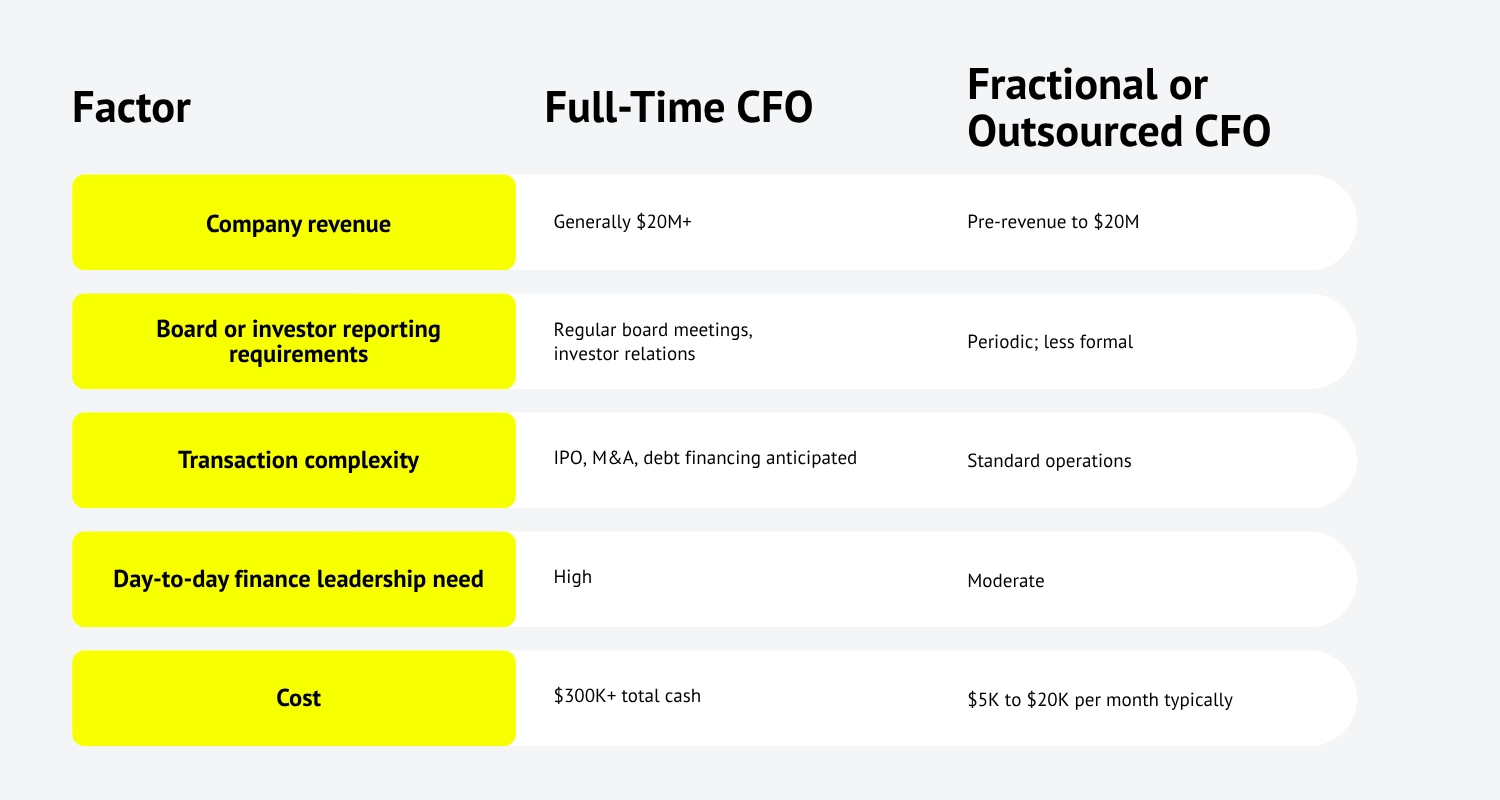
Full-time in-house versus outsourced CFO decision framework:
The Strategic CFO Search Process: What to Expect
Pre-search organizational assessment and role definition:
The most common cause of a CFO search that produces an inadequate shortlist is insufficient role definition before the search begins. The job description describes what the CFO will be responsible for. What is more important, and harder to articulate, is the context they will inherit: the state of the financial infrastructure, the maturity of the finance team, the relationships with investors and lenders that need to be maintained or built, and the strategic priorities the CEO and board expect the CFO to partner on in the first 12 to 24 months.
A well-scoped CFO search brief answers these questions explicitly: What specific financial challenges is the organization navigating? What has the previous CFO's relationship with the CEO and board looked like, and where did it succeed or fall short? What is the finance team's current capability, and is the CFO expected to build it or inherit it? Is a transaction (capital raise, IPO, M&A activity) anticipated within the search horizon?
Candidate sourcing and screening methodologies:
Retained executive search firms map the full qualified candidate population before outreach begins. For a CFO search, that research phase identifies every candidate who meets the defined criteria: revenue scale managed, industry experience, functional depth (capital markets, operational finance, FP&A, audit), and any required specialist experience such as public company reporting, PE board management, or international financial consolidation.
Screening conversations assess the candidate's background against the defined profile, their interest and motivation for a transition, and their preliminary fit with the organizational context. Firms that advance candidates to client interviews without this screening phase waste client time and degrade the quality of the process.
Interview processes and cultural fit assessment:
CFO interviews should assess three distinct dimensions that a single conversation rarely covers adequately:
Technical financial competency, including specific experience in the functional areas the role requires (treasury, investor relations, FP&A, technical accounting, M&A integration, and others depending on the company context).
Strategic partnership capability, assessed through questions about how the candidate has partnered with CEOs and boards on strategic decisions, not just how they have managed the finance function.
Cultural and leadership fit, evaluated through behavioral questions about management approach, communication style, conflict resolution, and decision-making under uncertainty.
A structured panel interview process with separate evaluators assessing each dimension produces more reliable candidate comparisons than a series of informal conversations that cover different ground with each candidate.
Industry-Specific CFO Requirements and Considerations
The skills and experience that make an exceptional CFO differ materially across industries. A CFO profile that works well in one context may be poorly suited to another. Search firms that understand these differences produce more accurate candidate profiles and stronger shortlists.
Technology and SaaS:
SaaS CFOs need fluency in recurring revenue metrics: ARR, NRR, churn, CAC payback, and LTV are the language of the business they are reporting on. Experience with equity raises and the financial modeling demands of investor reporting at growth-stage companies is often as important as general accounting proficiency. Many technology CFOs come from investment banking, FP&A-heavy backgrounds, or prior CFO roles at comparable companies rather than from traditional public accounting paths.
Manufacturing and industrial:
Manufacturing CFOs require depth in cost accounting, supply chain financial management, and capital expenditure planning. Companies with significant plant and equipment, inventory complexity, or contract manufacturing relationships need a CFO who can manage the financial implications of operational decisions that have no parallel in asset-light businesses.
Healthcare and life sciences:
Healthcare CFOs operate in a highly regulated environment with complex revenue recognition, reimbursement dynamics, and compliance requirements. Experience with healthcare-specific accounting standards, Medicare and Medicaid billing systems, or clinical trial financial management distinguishes genuinely qualified candidates from those with general finance backgrounds that do not translate to the sector's specific demands.
Financial services and regulated industries:
Regulated industry CFOs carry specific compliance responsibilities, including direct regulatory relationships in banking and insurance, that require familiarity with the regulatory framework as well as financial management capability. These CFOs also frequently carry more direct board and regulator interaction than CFOs in less regulated sectors.
PE-backed companies:
CFOs in PE-owned businesses operate under compressed reporting timelines, active board engagement, and value-creation mandates that are more operationally specific than those in comparable independent companies. Experience working with PE sponsors, managing through a secondary buyout or exit process, and producing the financial reporting quality that institutional investors require distinguishes PE-experienced CFO candidates from those whose background is exclusively in corporate environments.
Evaluating CFO Executive Search Firms
Key questions to ask potential search partners:
- How many CFO placements have you completed in the last 12 months at companies at a comparable stage and in a comparable industry?
- Who will personally lead this engagement, and what is their direct track record with CFO searches?
- How do you assess cultural fit and leadership style alignment, not just functional competency?
- What is your approach to confidential searches where the current CFO's departure cannot be communicated publicly?
- What is your off-limits policy, and which companies would be restricted as candidate sources for this engagement?
- What does your placement guarantee structure include, and what is your 12-month retention data for CFO-level placements?
Understanding search firm methodologies:
The most reliable indicator of a search firm's capability is specificity. Firms that can describe their candidate research methodology in concrete terms, name specific CFO placements at comparable companies, and articulate how they assess the difference between a technically qualified candidate and one who will succeed in the specific organizational context are demonstrating genuine expertise. Firms that respond with general process descriptions and brand credentials are not.
How Christian & Timbers differentiates through strategic partnership:
Christian & Timbers approaches CFO searches as a strategic engagement rather than a placement transaction. The firm's scoping process begins with an organizational assessment that goes beyond role definition to understand the financial infrastructure, team dynamics, and strategic context the incoming CFO will inherit. That context informs both the candidate profile and the way the opportunity is positioned to candidates in outreach.
Since 2025, Christian & Timbers has expanded into a broader executive search platform serving organizations across technology, AI, digital transformation, manufacturing, and other leadership-intensive sectors. Operating globally, the firm recruits senior executives for public companies, private equity portfolio companies, and growth-stage organizations.
The firm maintains active relationships with senior finance executives developed through decades of C-suite placement work in technology and adjacent sectors. For CFO searches specifically, that network includes professionals with PE-backed company experience, technology sector depth, and public company CFO backgrounds who are not accessible through reactive sourcing.
Christian & Timbers provides clients with market intelligence throughout the search, including how target candidates are evaluating the opportunity and what compensation and organizational factors are influencing their decision-making. That intelligence enables clients to position the role competitively and address candidate concerns before they become offer obstacles.
Post-placement, the firm's executive integration support reduces the early-tenure friction that causes first-year attrition at the CFO level.

Making the Final Decision: Beyond the Resume
Cultural fit assessment and leadership style alignment:
The CFO's relationship with the CEO is the most important working relationship in the executive team for most organizations. Misalignment in communication style, risk tolerance, decision-making approach, or strategic philosophy between CEO and CFO is consistently identified as the primary cause of CFO departures within the first two years. Assessing this alignment requires structured conversations between CEO and finalist candidates that go beyond competency questions into genuine strategic and interpersonal territory.
Structured reference conversations with people who have worked with the CFO candidate across different relationship types (former CEOs, board members, direct reports, and finance team members) produce more useful information than formal professional references, who are self-selected for positive response.
Reference checking and background verification:
For CFO appointments, reference conversations should include at least one current or former board member or audit committee chair who can speak to the candidate's financial reporting judgment and board communication quality. Direct reports provide the most accurate picture of leadership and management style. Former investment bankers or advisors who have worked with the candidate on transactions can assess competency in deal contexts.
Background verification for a CFO should include education and credential confirmation, employment history verification, and where applicable, checks for securities regulatory history, litigation involvement, and credit background. The scope and methodology of background verification should be confirmed with legal counsel before the process begins.
Onboarding strategies for new CFO success:
A CFO who joins without a structured onboarding plan faces avoidable early-tenure challenges. A 90-day plan should define: the key internal relationships to establish and in what sequence, the financial infrastructure review the CFO should conduct and what they should be expected to report back to the CEO and board, the external relationships (banking, audit, major investors) that need introduction, and the one or two early wins that will establish credibility with the finance team and broader organization.
The search firm that placed the CFO is well-positioned to support onboarding planning, having developed significant context on both the organization and the candidate through the search process. Christian & Timbers provides post-placement integration support as a standard element of its CFO search engagements.
Frequently Asked Questions: CFO Executive Search
How long does a CFO executive search typically take?A well-run retained CFO search takes 60 to 120 days from kickoff to offer acceptance. Searches for CFOs with highly specific experience requirements (pre-IPO SaaS, PE-backed manufacturing, regulated healthcare) run toward the longer end of that range due to narrower qualified candidate pools. Organizations that complete a thorough role scoping process before kickoff consistently experience shorter searches than those who refine the brief mid-engagement.
What is the difference between a CFO and a VP of Finance?A CFO is a C-suite executive with strategic accountability for the financial direction of the business, board-level responsibility for financial reporting, and typically a seat at the executive leadership table. A VP of Finance leads the finance function operationally and typically reports to the CFO or CEO without the same strategic mandate or board visibility. The right appointment depends on the organization's stage, investor and board requirements, and the complexity of its financial environment.
How much does a CFO executive search cost?Retained executive search fees for CFO roles typically run 25% to 33% of the placed candidate's first-year total compensation. For a CFO with total cash compensation of $400,000 to $600,000, that represents a fee range of $100,000 to $200,000. Fee structures vary by firm and engagement scope; some firms apply flat project fee models for earlier-stage companies. These are general US market observations; always confirm fee structure in writing before engagement.
Should we consider interim CFO candidates as permanent search candidates?Occasionally. Some interim CFOs are professionals who prefer project-based work and are not interested in permanent roles. Others use interim engagements as a way to evaluate a company before committing to a permanent position. If an interim CFO has performed well in a bridge role and expresses genuine interest in the permanent appointment, they deserve serious consideration, with the same structured assessment process applied to external candidates.
What red flags should we watch for in a CFO candidate?Candidates who cannot explain financial decisions clearly to a non-technical audience signal communication capability that may not serve board and investor relationship requirements. Candidates whose references are exclusively from people they selected, with no independent outreach to board members or direct reports, warrant additional scrutiny. Candidates who attribute organizational financial problems entirely to external factors without acknowledging their own decision-making role may lack the self-awareness that sustainable leadership requires. Any unexplained gaps in employment history or inconsistencies between resume claims and reference accounts should be investigated before an offer is extended.
To discuss a current or upcoming CFO search or request a market briefing on senior finance leadership talent in your sector, contact Christian & Timbers at christianandtimbers.com.