


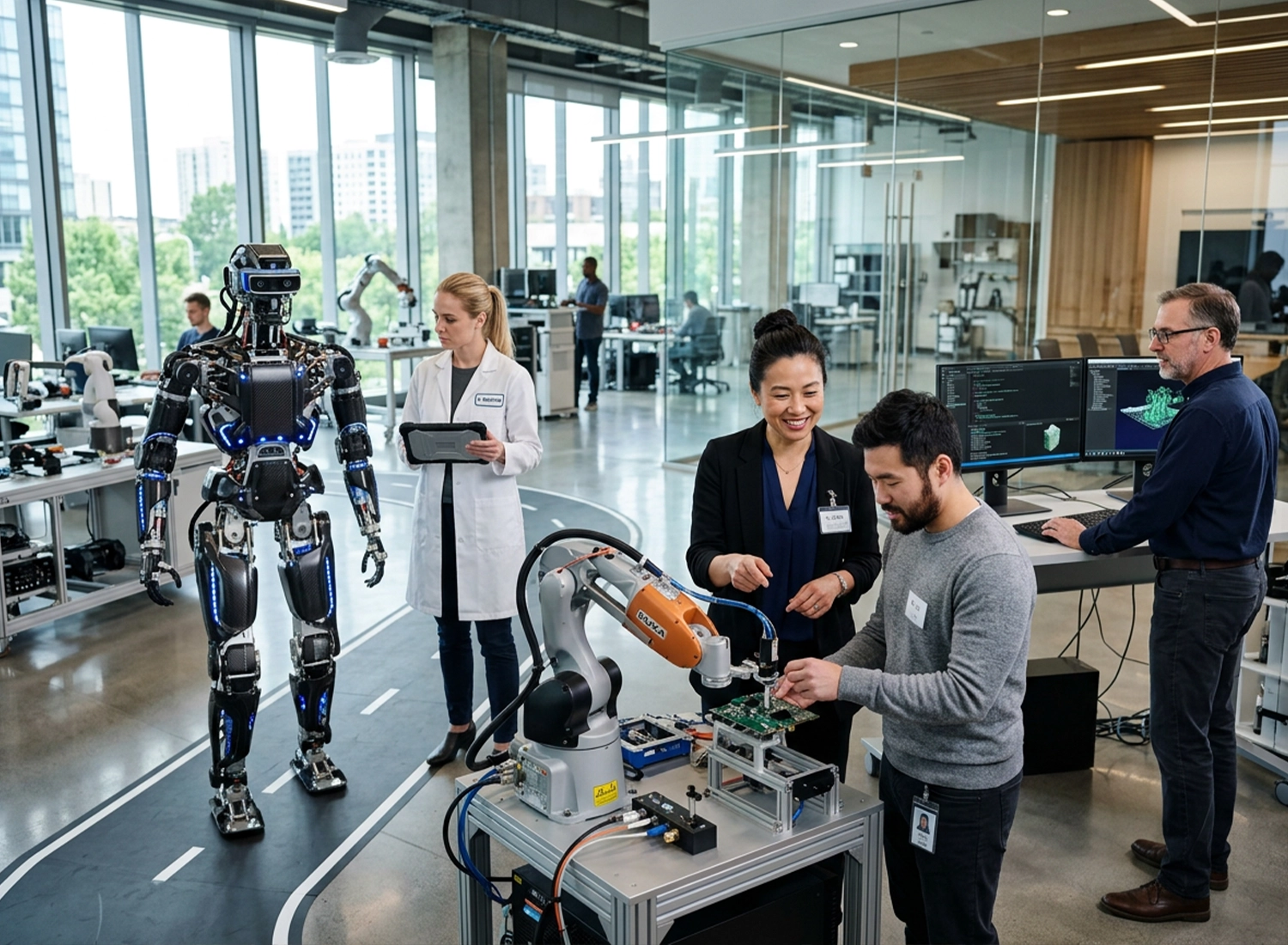
Physical AI is today a production reality with a talent problem attached to it.
The global physical AI market is valued at approximately $383 billion in 2026 and is projected to reach $3.26 trillion by 2040, according to Future Markets research published in April 2026. For organizations tracking the narrower segment of AI-native robotics platforms, MarketsandMarkets puts the figure at $1.50 billion in 2026, growing to $15.24 billion by 2032 at a compound annual growth rate of 47.2%. Grand View Research estimates the broader market at $81.64 billion in 2025, with a 36.1% CAGR through 2033.
The range in estimates reflects different scope definitions, not disagreement about direction. Every credible forecast points the same way: sustained double-digit growth, significant capital concentration, and accelerating demand for the leadership talent to build and run physical AI operations at scale.
The talent side of this equation is where most organizations are currently underprepared.
What Is Physical AI?
Physical AI refers to artificial intelligence systems embedded within robots and autonomous machines that perceive, decide, and act in the physical world. The defining characteristic is the integration of AI into hardware that interacts with real environments rather than processing data in isolation.
A software AI system produces recommendations, analyses, or content. A physical AI system takes physical action: it moves goods through a fulfillment center, performs a surgical procedure, assembles a component on a production line, or navigates an urban environment. The AI layer enables these systems to generalize across variable conditions rather than executing fixed preprogrammed sequences.
Three capabilities define the physical AI category: perception (interpreting sensor data from cameras, LIDAR, and other inputs to understand the environment), decision-making (choosing actions based on that interpretation, informed by learned models), and real-world interaction (executing physical actions with sufficient reliability to operate in production conditions). The combination of these three capabilities at production-grade reliability is what distinguishes physical AI from earlier generations of industrial automation.
How Large Is the Physical AI Market in 2026?
Market size estimates for physical AI vary by how broadly the category is defined, but all major research organizations agree on the growth trajectory.
At the broadest definition, encompassing all AI-enabled physical systems including industrial robots, autonomous vehicles, surgical robotics, defense autonomous systems, and smart infrastructure, the global market sits at approximately $383 billion in 2026 on track to $3.26 trillion by 2040. At the narrowest definition, focused specifically on the AI platform and software layer that runs physical robots, MarketsandMarkets estimates a $1.50 billion market in 2026 growing to $15.24 billion by 2032.
The industrial robotics segment is growing fastest within the physical AI market, with MarketsandMarkets projecting a 56.7% CAGR from 2026 to 2032. Advanced autonomy systems, operating at what researchers classify as Level 3 autonomous capability, are projected to grow at 60.8% annually over the same period.
Manufacturing accounts for the largest current deployment base, with AI-driven robotics embedded in automotive, semiconductor, consumer goods, and aerospace production environments. Figure AI's humanoid robots in BMW facilities and Agility Robotics' Digit in Amazon fulfillment centers represent the leading edge of what the manufacturing and logistics sector is beginning to scale.
Logistics is the second-largest sector by deployment volume, with Amazon's fleet of over one million conventional robots representing the current standard while humanoid and general-purpose robots begin filling higher-complexity roles.
Healthcare represents the fastest-growing sector by investment, driven by surgical robotics, rehabilitation systems, and AI-enabled diagnostic hardware. The combination of demographic pressure, clinical labor shortages, and improving AI capability in image interpretation and motor control is accelerating adoption.
Defense is a high-growth segment with unique talent requirements. Anduril, General Dynamics, and Lockheed Martin are all scaling physical AI programs with hiring concentrated in autonomous systems, perception engineering, and mission-critical AI governance.
What Is Driving Growth in Physical AI and Robotics Talent Demand?
Four forces are accelerating physical AI adoption simultaneously, each with direct implications for hiring.
Labor shortages across physical industries. The labor constraints that began reshaping manufacturing, logistics, and healthcare during and after the pandemic have not resolved. Physical AI represents the most viable productivity response for organizations managing persistent workforce gaps in roles that do not translate to remote work. The business case for physical AI investment strengthened as labor market tightness became structural rather than cyclical.
Advances in foundation models and sim-to-real transfer. The same generative AI breakthroughs that transformed software productivity are now enabling physical AI systems to generalize across environments with a speed and reliability that was not achievable three years ago. Vision-language-action models allow robots to interpret instructions and adapt behavior without task-specific programming. Digital twin simulation accelerates training by orders of magnitude. These advances have compressed the gap between research capability and production deployment.
Capital concentration at the frontier. Meta's acquisition of Assured Robot Intelligence in May 2026, Amazon's acquisition of Fauna Robotics, Tesla's Optimus production scale-up, and Figure AI's $700 million raise from Microsoft, NVIDIA, OpenAI, and Jeff Bezos collectively signal that the largest technology companies have concluded that physical AI is where the next platform competition will be fought. Capital concentration at this level draws talent from across the research and engineering ecosystem.
Regulatory pressure in key markets. The EU AI Act and the updated EU Machinery Regulation impose compliance deadlines in 2026 that require specialized safety and governance expertise. US defense contracts are increasingly including autonomous systems provisions. Organizations without executives who understand the regulatory environment for physical AI are facing compliance exposure alongside commercial pressure.
Where Is the Greatest Talent Shortage in Physical AI?
The talent gap in physical AI is acute at every level, and worst at the top.
Global AI talent demand outpaces supply by 3.2 to 1 in 2026. More than 1.6 million AI roles are posted globally while only 518,000 qualified candidates are available to fill them. In advanced automation specifically, employers fill only 36% of open positions. Average time-to-hire for robotics and automation roles has crossed five months, even at organizations with strong employer brands and established recruiting functions.
Executive and senior technical roles are the hardest to fill. The combination required for a VP of Robotics, Chief Robotics Officer, or Head of Physical AI is genuinely rare: deep technical knowledge of robotic systems, production AI deployment experience, cross-functional organizational leadership, and the ability to communicate physical AI strategy to boards and non-technical executives. Modern Chief Robotics Officers and VPs of Automation frequently report directly to the COO or Chief Supply Chain Officer, which means the role requires executive-level organizational capability alongside its technical depth.
The roles in highest demand across 3,100 active robotics postings in 2026 concentrate in ROS 2 expertise, edge AI deployment, sim-to-real transfer, perception engineering, and AI governance for physical systems. The executives who lead teams in these disciplines command compensation that reflects the scarcity: total packages at VP and C-suite level regularly exceed $600,000 at major technology and industrial employers.
How Organizations Should Prepare for the Robotics Talent Crunch
Organizations that wait for physical AI adoption to reach their industry before building leadership capability will face two problems simultaneously: the implementation challenge and the talent gap. The organizations positioned to capture the competitive advantage of physical AI are those building leadership capability now.
Start the executive search before the role is urgent. The five-month average time-to-hire for robotics roles reflects a market where passive candidate development is the primary channel. The physical AI executive population is small, networked, and largely not actively searching. Searches that begin after an immediate need has developed run into the full length of the market timeline. Organizations that begin relationship development before the urgency is acute consistently access better candidates and close faster.
Build academic and research institution relationships. CMU's Robotics Institute, MIT's Computer Science and Artificial Intelligence Laboratory, Stanford's AI Lab, Berkeley's BAIR, and ETH Zurich produce a disproportionate share of the physical AI talent pipeline. Organizations with established relationships at these institutions, through research partnerships, funding, guest lectures, or internship programs, access talent before it enters the open market.
Assess internal candidates against physical AI leadership criteria. Organizations with existing automation, engineering, or AI functions often have candidates closer to physical AI leadership readiness than their current roles indicate. A structured assessment of internal candidates against the physical AI executive profile, before opening an external search, identifies development paths and reduces external search dependency.
Define the mandate around outcomes, not titles. Physical AI executive searches that are defined around specific operational outcomes, what production capabilities will be built, at what reliability threshold, in what timeline, attract candidates motivated by execution. Searches defined around responsibilities and reporting structures attract a different and typically less competitive candidate population.
Frequently Asked Questions About Physical AI Talent
What types of companies are hiring for physical AI and robotics roles?The broadest hiring activity in physical AI is concentrated in manufacturing (automotive, semiconductor, consumer goods, aerospace), logistics and fulfillment, healthcare and surgical robotics, and defense and security systems. Technology infrastructure companies including NVIDIA, Qualcomm, and Intel are also scaling physical AI teams as the computing platforms for robotic systems require dedicated AI engineering capability. High-growth startups in humanoid robotics, including Figure AI, Agility Robotics, and Apptronik, are competing for talent alongside large established employers, often using equity-heavy packages to close compensation gaps with hyperscalers.
How fast is the job market for physical AI talent growing?Analysis of active robotics job postings shows manufacturing and logistics accounting for 45% of demand, with overall robotics hiring tracking ahead of broader technology hiring. The US is projected to reach approximately 172,300 robotics engineering roles by 2029, up significantly from current levels. AI-specific roles within physical AI organizations, including perception engineers, simulation engineers, and AI governance specialists, are growing faster than traditional robotics engineering roles as the software intelligence layer becomes the primary competitive differentiator.
What skills are most in demand for physical AI executives?At the technical level, the highest-demand competencies in 2026 are ROS 2 architecture, edge AI deployment, vision-language-action model implementation, sim-to-real transfer methodology, and AI safety and governance for autonomous physical systems. At the leadership level, organizations consistently prioritize candidates with production deployment track records, cross-functional organizational experience, and the ability to build and retain teams in a market where retention is itself a competitive challenge. Regulatory knowledge specific to the EU AI Act, US defense procurement standards, and sector-specific safety requirements is increasingly a differentiator for senior candidates.
The physical AI market is at the stage where the technology has been validated and the capital is committed. The constraint on how fast organizations capture the opportunity is leadership. For guidance on physical AI executive search and talent strategy, contact Christian & Timbers at christianandtimbers.com