


I am starting a series of articles for boards and CEOs focused on the executives actually building and operating AI inside modern enterprises.
In telecommunications, semiconductors, manufacturing, retail, and consumer packaged goods, the same question keeps coming up: who should own AI outcomes? Should that responsibility sit with the CIO, the CTO, a Chief AI Officer, or someone else?
Most searches start with a title before the mandate is clearly defined, and that is usually where the process breaks down. A better starting point is to understand where AI changes operating decisions and who owns the financial outcome.
Most boards start that conversation with the CIO, because operational AI ownership usually reaches the enterprise first through that role.
Boards often discover what they actually need from a CIO about halfway through the search.
They open the process believing they need a stronger technology operator, someone who can tighten governance and bring more discipline to IT spending. Then the conversations start. In many searches, the candidates who look right on paper turn out to be infrastructure managers with better vocabularies. The ones who actually understand how AI changes operating decisions are harder to find and are rarely active in the market.
That gap explains why so many CIO searches take longer than expected and why so many end in a hire that underdelivers.
In 2026, the CIO is increasingly responsible for decisions that shape revenue and long-term competitiveness. Companies expect CIOs to determine where automation creates measurable business value and which AI investments deserve executive backing. That is a different job from what the title meant five years ago.
The mistake I see most often is boards thinking they are hiring a stronger IT operator. By the time the search gets serious, they realize they are actually looking for someone who can decide where AI creates business value and own the result.
At Nestlé, the CIO reports directly to the CEO because the role now shapes operating decisions and financial outcomes. Walmart rebuilt its leadership structure around AI platforms because treating AI as a traditional IT function no longer works. I continue to see the same shift across every sector we work in.
The executives who can do this job have usually already operated AI systems tied to measurable business outcomes. Most boards discover how small that talent pool is only after the search begins.
What Is an AI-Native CIO?
An AI-native CIO is the executive accountable for how AI changes the way the business operates.
The scope includes automation strategy, enterprise data decisions, governance, procurement efficiency, and return on AI investment. The role is judged by business performance, with results tied directly to operating outcomes.
The practical question an AI-native CIO has to answer, the one the board actually cares about, is where AI creates a measurable financial impact and who owns that outcome. Many technology executives struggle to answer it clearly because their roles were not traditionally designed around business outcomes.
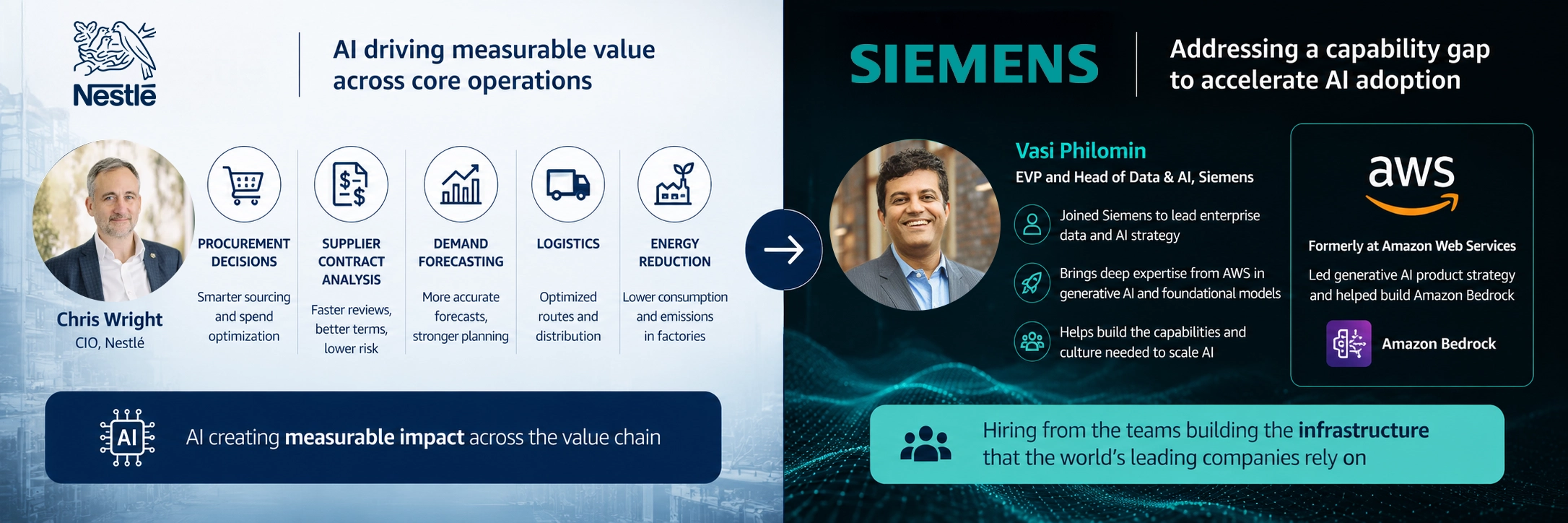
One of the clearest examples comes from Nestlé. CIO Chris Wright has described AI value through procurement decisions, supplier contract analysis, demand forecasting, logistics, and energy reduction inside factories.
The Siemens example highlights a different signal: a capability gap. Leadership accelerated AI adoption by hiring Vasi Philomin as EVP and Head of Data & AI. Philomin came directly from Amazon Web Services, where he led generative AI product strategy and helped build Amazon Bedrock. The search moved outside traditional industry boundaries and into the teams building the infrastructure that other companies depend on.
In the first 12 months, boards should expect an AI-native CIO to produce an investment framework that connects AI spending to operating outcomes. Governance needs to be defined early, before scale creates problems that decision structures were never built to handle. A productivity baseline should exist by month six, because without a way to measure progress, transformation language stays abstract and board confidence erodes.
Board-Level Signals That a Company Needs an AI-Native CIO
Companies rarely decide to upgrade the CIO role because someone recommends it. The need becomes visible when the current structure starts producing friction that leadership cannot resolve.
The most visible sign is AI activity spreading across the company with no clear owner. Teams are running pilots, vendors are introducing platforms, budgets are growing, and leadership still cannot point to financial outcomes or a clear executive owner.
The scorecard is another signal. The CIO role is still measured through uptime and system stability. The board is asking about productivity gains and margin improvement. Those two things have moved apart, and the gap usually widens before anyone addresses it.
Repeated internal debates about whether to create a Chief AI Officer often come from the same root problem. Leadership sees that AI decision-making is fragmented and assumes a new title will fix it. Sometimes that is the right answer, particularly when AI product development directly drives revenue. In most enterprise organizations, the better decision is expanding the CIO mandate and assigning one executive clear authority.
Competitive pressure makes the timing real. When peer companies restructure executive teams around AI and begin showing measurable results, internal planning accelerates. The Siemens decision to hire an EVP of Data and AI directly from the team that built Amazon Bedrock shows how far outside traditional industry boundaries the search has moved. Many companies now discover that the strongest AI experience sits in companies whose infrastructure they already depend on.
Compensation is often the final signal. Boards begin the search using traditional CIO benchmarks and discover late in the process that the market moved faster than their internal pay structures. When strong candidates step away because the role is framed too narrowly or paid like a traditional IT leadership position, the problem usually started with how the role was defined.
What Boards Look For When Hiring AI-Native Builders
I often hear boards start with the wrong question: who has the strongest technology background? The better question is who has already used AI to change how a business operates.
Technical credibility still matters. The evaluation should focus on evidence of deployment. The strongest candidates have led AI adoption across major business functions and owned the results. Many executives can describe an AI strategy. Far fewer have lived with the consequences after it goes into production.
Governance has become a central part of the assessment. AI expansion raises real questions about data quality and compliance before the company is ready to answer them. A strong AI-native CIO can explain where governance should sit and how risk should be managed before scale creates problems. In highly regulated sectors, especially, weak candidates get exposed.
Communication at the board level separates strong candidates from impressive resumes. The role requires someone who can move between a technical conversation and a board conversation without losing the thread. CIOs who cannot connect technology choices to operating outcomes lose influence quickly, and technical depth does not compensate for that gap.
At Nestlé, Chris Wright's public framing of AI value is a useful reference point. He speaks about procurement, supplier analysis, logistics, and factory energy reduction. That specificity reflects what boards are actually hiring for.
Some of the strongest candidates come from product or data leadership roles where AI adoption has already changed business performance. The title on the resume matters less than the evidence of ownership.
Compensation Changed Faster Than Most Boards Expected
Compensation is often where boards realize the market moved before their hiring process did.
Many companies begin an AI-native CIO search using benchmarks built for traditional IT leadership. Those numbers reflect infrastructure ownership and system stability.
AI and machine learning roles now command a 67% salary premium over traditional software engineering positions, which explains why traditional CIO compensation benchmarks often fail before the search is even fully defined. The title may still be CIO, but the compensation reflects AI scope and business accountability.
The Christian & Timbers 2026 Corporate AI Compensation Study found that 72% of employers globally report difficulty filling AI roles, and senior GenAI-specialized roles now average more than 54 days to fill. The shortage is not limited to technical positions. 94% of C-suite executives report AI-critical skill shortages across their organizations.
At the executive level, compensation has moved further. For public companies with 2,000 to 5,000 employees, AI-native CTO, CIO, and Chief Digital & Data Officer roles reporting to the CEO carry base salaries from $500,000 to $750,000, with bonus structures reaching 30% to 100% and annualized equity from $500,000 to $5 million.
Salary is only part of the decision. At senior levels, compensation is increasingly structured around ownership. 42% of senior AI specialists now receive more than half of their total compensation through equity. Standard four-year RSU structures are also losing relevance. VP-level AI leaders increasingly negotiate milestone-based grants, performance vesting, and larger sign-on packages.
Bonus structures are changing as well. Senior AI leaders are increasingly evaluated on automation ROI, AI-driven revenue contribution, deployment milestones, and measurable operating outcomes. Boards that still structure incentives around operational maintenance often lose finalists to companies treating the role as enterprise transformation leadership. This is especially visible when finalists are already leading AI adoption inside major public companies. They are comparing authority and strategic scope. The compensation package is part of that signal, but the role definition usually matters more.
Many failed searches begin with a compensation problem that leadership mistakes for a talent shortage. The market has candidates. The gap is usually between what the role actually requires and how the company chooses to define it.
Boards often discover compensation expectations too late, after strong candidates are already deep in the process. The 2026 Corporate AI Compensation Study breaks down how AI-native CIO, CTO, and Chief AI Officer compensation is changing across public companies, including salary ranges, bonus structures, equity expectations, and the points where companies most often lose final-round candidates.
Why Companies Mis-Hire This Role
The most common mistake is straightforward: companies change the job title without changing the job.
A traditional CIO role is being rewritten to include references to AI and automation. The reporting structure stays the same. Success is still measured through uptime and cost control. Several months later, leadership is frustrated because nothing has changed in how decisions were made or how accountability was measured.
Boards often search for someone who feels familiar. Candidates with strong enterprise IT backgrounds look safe, and the resume checks every expected box. Those candidates may be excellent operators, but many have never been asked to own business outcomes tied to AI adoption. Running stable systems and redesigning how the company operates require different instincts, and interviews built around traditional criteria will not surface that difference.
Separating strategy from execution is another mistake. One executive defines AI priorities while another is expected to deliver them. Accountability erodes, and every delay becomes a debate about ownership. The real issue is that nobody was given full responsibility at the start.
Timing creates additional pressure. Boards that wait until competitors have moved try to run the search under urgency, and the quality of the process shows. The strongest candidates are rarely available on short notice and rarely impressed by searches that feel reactive.
Mis-hiring in this role is expensive in ways that extend past the replacement search. It delays execution and pushes major investment decisions into the next budget cycle. In sectors where AI affects operating margin or product competitiveness, including manufacturing, retail, financial services, and healthcare, the cost compounds quickly.
The searches that go well usually begin by answering one question before any candidate is evaluated: what should this executive own, and how will that be measured in the first twelve months?
Without that answer, the process tends to reproduce the familiar version of a role that now requires something different.
CIO vs. CTO vs. Chief AI Officer
Many leadership teams spend months debating titles when the real issue is authority.
The question is where AI decision-making should sit, given how the business actually operates.
Sector context matters. In telecommunications, AI decisions often center around network operations and customer service automation. In semiconductor companies, the pressure moves toward product architecture and AI infrastructure. In retail and manufacturing, the focus is usually operational, where AI adoption affects margin and execution speed.
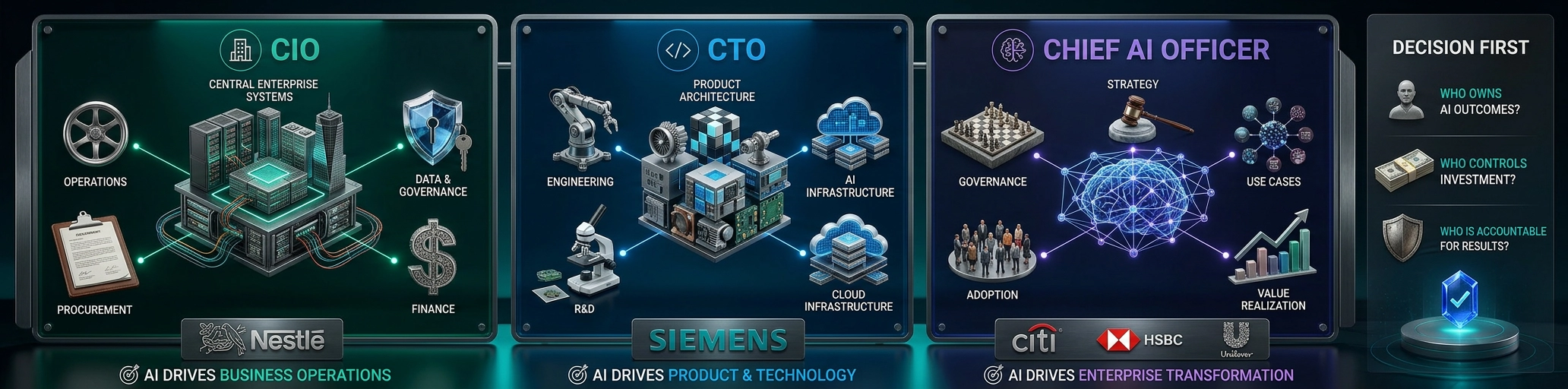
The CIO often carries the strongest position when enterprise AI shapes core business operations. The role already sits at the intersection of systems and operating discipline. Expanding that mandate tends to produce clearer accountability than adding another executive.
The responsibility usually moves to the CTO when AI is tied directly to product architecture or technical differentiation. This is most common in software, semiconductor, and product-led businesses. The Siemens decision to hire a dedicated EVP of Data and AI reporting to the CTO reflects how industrial companies are resolving this when the product itself is being rebuilt around AI.
A Chief AI Officer becomes the right answer when decision-making is genuinely fragmented across multiple functions and no existing executive has the authority to unify execution. This is common in large enterprises where AI adoption moved faster than the leadership structure. Some companies use the CAIO role temporarily while they decide which executive should carry long-term accountability.
The mistake is assuming a new title resolves a structural problem. It rarely does unless the ownership question was answered first.
The questions boards should be asking before the search begins:
- Who owns AI outcomes?
- Who controls investment decisions?
- Who carries responsibility when financial results do not appear?
In many organizations, working through those questions is where the broader conversation about AI Native C-Suite Search begins, because the answer often shapes more than one executive hire.
The Role Changed Before Most Hiring Processes Did
Many companies are still running CIO searches based on a version of the role that no longer exists.
The search starts with infrastructure and systems management in mind. Then the real need becomes clear: someone who can connect technology decisions to operating performance and financial outcomes across the business. AI changed what the role requires. Most hiring processes have not caught up.
That lag shows up in how companies define the role and what they pay for it. Most failed searches trace back to a mandate that was defined too narrowly at the start.
An AI-native CIO carries responsibility across transformation, governance, and measurable business results. The same shift is reshaping how companies hire AI-native operators across the C-suite, including CROs, CFOs, and COOs. The mandate is different for each role, but the underlying question is the same: who owns the outcome when AI drives the decision? In telecommunications, semiconductor, retail, and industrial manufacturing, the searches that are moving fastest share one thing: the mandate was defined before the first candidate was contacted.
Boards working through that decision often start with the AI Native C-Suite Search practice at Christian & Timbers, where the mandate is defined before the search formally begins.
FAQ
- What is an AI-native CIO?
An AI-native CIO is an executive responsible for how artificial intelligence changes the way a company operates. The role covers automation strategy, enterprise data decisions, governance, and measurable return on AI investment. The focus extends well beyond infrastructure management.
- How is an AI-native CIO different from a traditional CIO?
Traditional CIOs were primarily measured by system stability, cybersecurity, and enterprise technology operations. AI-native CIOs are evaluated through business outcomes, including productivity gains, operating margin improvement, and executive ownership of AI transformation across the company.
- When should a company hire an AI-native CIO instead of a Chief AI Officer?
An AI-native CIO is often the stronger choice when enterprise AI affects finance, procurement, supply chain, and internal productivity. A Chief AI Officer becomes more relevant when ownership is fragmented across functions or when no existing executive has enough authority to lead adoption at scale.
- What compensation should boards expect for an AI-native CIO?
Compensation depends on company size and the scope of responsibility. In public companies, AI-native CIO compensation typically starts well above traditional CIO benchmarks and includes significant bonus and equity structures tied to operating results.
- Why do companies mis-hire AI-native CIOs?
The most common mistake is keeping a traditional CIO structure and adding AI language to the role description. Nothing changes in how the role is measured or who it reports to, and six months later, leadership is frustrated.