


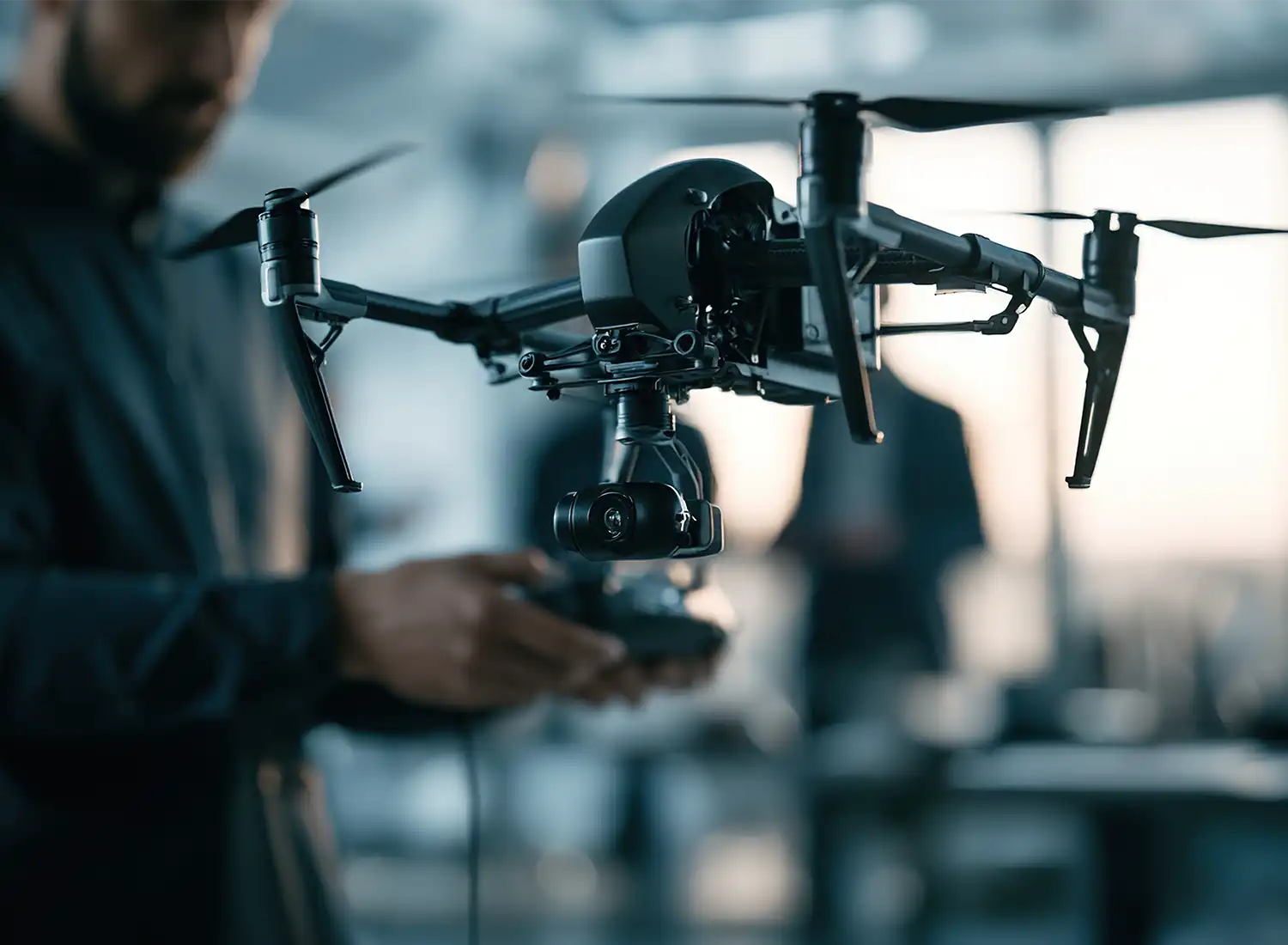
Drone companies are finding executives in adjacent sectors because the industry has not had enough time to produce a deep bench of repeat drone leaders. The candidate pool extends across robotics, autonomy, aerospace and defense, and enterprise technology.
In our drone and aerospace searches, we're seeing the consequences of that shortage firsthand. A company hiring its first VP of Engineering may have no deep list of candidates who have already held the same role at two or three drone companies. The search has to reach further and evaluate which experience from adjacent sectors will transfer.
The global drone market is projected to grow from $83.8 billion in 2025 to $96.4 billion in 2026, on its way to $182.4 billion by 2033. That growth is changing drone recruiting at the executive level, putting greater weight on the operating experience candidates have built across drone and adjacent sectors.
Key Takeaways
- Drone company leadership hiring is a different problem than technical hiring. The market is scaling faster than the sector has been able to develop a deep bench of executives with repeat experience running drone engineering or operations functions.
- Rising defense budgets, including more than $70 billion in the Pentagon's fiscal 2027 request across autonomy, drone platforms, counter-drone technologies, and related programs, are increasing competition for relevant leadership experience.
- Commercial and defense drone leadership require different operating experience. Procurement cycles, clearance requirements, and customer relationships diverge sharply between the two.
- Drone companies are drawing leadership from adjacent industries. Shield AI, Zipline, and others have hired executives from software, autonomous vehicles, and logistics as they build their leadership teams.
- The right search depends on the mandate. Regulatory fluency in FAA Part 107 and BVLOS pathways may carry significant weight for certain roles. Proven judgment running a complex organization can drive the specification for broader leadership mandates.
No One Has Done This Job Three Times
In mature industries, a VP of Engineering candidate usually arrives with a track record: two prior stints in similar roles, experience scaling a team through a comparable growth stage, evidence of handling difficult operating problems, and references who can speak to the decisions they made under pressure. Drone leadership candidates rarely come with that history, because the roles themselves haven't existed at scale long enough to generate repeat tenures.
The search therefore has to examine comparable scope in adjacent sectors: an engineering leader who managed hardware-software integration under regulatory scrutiny, or a program lead who owned a certification timeline with real consequences attached. The candidate's title may understate the scope they already carry.
When the resume doesn't give you two previous drone leadership roles to compare, you have to get underneath the title. We look at the size of the program the candidate owned and what was at stake if it failed. For technical leaders, we want to know how much responsibility they carried across hardware and software. Certification experience can matter heavily for some mandates. So can having built the team that actually delivered the program.
Together, these signals show whether a candidate has already done the underlying work the drone role will demand, even when that experience was gained in another industry.
Defense Money Is Changing the Competition for Leaders
The Pentagon's fiscal 2027 budget request includes $53.6 billion for autonomy, drone platforms and contested logistics, along with $21 billion for munitions, counter-drone technologies and advanced systems. That's a sharp increase from the $13.4 billion and $3.1 billion requested for comparable categories in fiscal 2026.
Competition intensifies as more well-funded programs pursue the same narrow set of qualified candidates at the same time.
For executive search, the effect is a broader set of employers competing for overlapping experience. Drone manufacturers, counter-UAS companies, defense technology firms, and established contractors can all reach into portions of the same leadership market as funding moves into new programs. Companies cannot develop executives with comparable operating experience at the same speed that new programs can receive funding.
Commercial and Defense Drone Companies Need Different Leadership Profiles
The candidate pools overlap, but the operating experience required on each side can be very different. A general manager running a commercial inspection or logistics drone business answers to enterprise customers on quarterly timelines and competes on unit economics. A GM running a counter-UAS defense program works within government procurement cycles, security clearance requirements, and contract vehicles that can take years to close.
A commercial GM who has never worked through government procurement enters a defense-facing role with a meaningful experience gap. A defense leader moving into a commercial business may face a different gap around enterprise sales and unit economics.
The specification for a VP of Engineering shifts along the same lines. Commercial businesses can place greater weight on iteration speed and unit economics as products move toward repeatable deployment. Defense programs add requirements around traceability, documentation, and compliance throughout the engineering process. Dual-use companies have to operate across both environments, which narrows the number of leaders who arrive with relevant experience on each side.
Where Drone Companies Are Finding Their Leadership Bench
Since drone-specific leadership tenure is scarce, the more productive search often extends into adjacent sectors. Recent executive moves show how broadly some drone companies are already looking. Shield AI brought in Gary Steele as CEO in 2025 after he ran Splunk and held a go-to-market role at Cisco. Zipline has built out its leadership team with Kevin Vosen, who spent nearly seven years as chief legal officer at Waymo, and Allen Penn, who previously ran global operations at Uber Eats and now serves as Zipline's Head of Commercial.
The relevant adjacent market depends on the mandate. A technical search may lead into robotics and autonomy, particularly for leaders who have worked across control systems and hardware-software integration. Defense-facing roles can lead back toward aerospace companies and primes, where executives have already operated inside regulated hardware programs. For a commercialization mandate, the search can reach much further outside aerospace, including into enterprise technology.
The mandate determines how much weight to give drone-specific regulatory experience. Familiarity with FAA Part 107 requirements and the pathways for BVLOS operations may be essential for some roles. Proven judgment running a complex organization at scale can carry greater weight in roles centered on organizational leadership.
For a broader perspective on aerospace and defense recruiting, JC Christian and I discuss competition for SpaceX talent and the challenges of hiring professionals with security clearances in this episode of the AI Builders Podcast.
How Christian & Timbers Approaches Drone Leadership Searches
We apply the same thinking here that guides our broader aerospace and defense executive searches: scope and decision authority matter more than whether a candidate already holds the exact title the org chart calls for. For drone executive search, that means evaluating VP of Engineering, VP of AI, Chief Robotics Officer, general manager, and program leadership candidates who've carried real responsibility in adjacent industries, including executives whose careers were built outside the drone sector.
Before sourcing begins, the specification has to answer four questions in order.
- What operating environment will the leader work inside?
- Which experience is mandatory on day one?
- Which capabilities can reasonably be developed after hire?
- Which adjacent markets produce candidates with the required experience?
Answering those questions early keeps the search focused on candidates whose experience matches the actual mandate.
If your organization needs to build out drone leadership before the market has produced an obvious slate of candidates, talk with our team.

FAQ
- How do drone companies find experienced executives?
Drone companies often extend executive searches into adjacent sectors because repeat drone-specific leadership experience remains scarce. The search should focus on comparable operating scope, including experience with regulated hardware programs, hardware-software integration, organizational scaling, or the commercial requirements of the mandate.
- How is defense investment changing drone leadership hiring?
Rising defense budgets across autonomy, drone platforms, counter-drone technologies, and related programs are creating more well-funded programs competing for a small pool of qualified engineering and operational leaders.
- Are commercial and defense drone companies looking for different executives?
The candidate pools overlap, but the operating experience differs. A commercial drone GM answers to enterprise customers and unit economics. A defense-facing GM works within government procurement cycles and clearance requirements. Companies that source both roles against the same generic profile often end up with a mismatch on one side.
- What should companies look for in a drone executive search firm?
Look for experience assessing executive-level scope across drone and adjacent sectors, along with a clear understanding of how commercial and defense mandates produce different candidate requirements.