

A new Physical AI hiring gap will emerge as robots enter production. Companies will need leaders for deployment integration, functional safety, fleet operations, field service, and workforce transition, roles that determine if systems remain safe, available, and economically useful.
Key Takeaways
- The next Physical AI hiring constraint will appear when companies move from one pilot to sustained production.
- Autonomy rate, intervention demand, system uptime, and recovery speed will expose gaps in the operating organization.
- Deployment integration and functional safety leadership should be in place before robots begin live operation.
- Fleet operations and field service become more important as deployments expand across shifts and facilities.
Physical AI systems are beginning to generate operating records that reveal what companies must manage after installation. Figure reported that Figure 02 operated in 10-hour shifts at BMW Group Plant Spartanburg, loaded more than 90,000 parts, and contributed to the production of more than 30,000 vehicles over 11 months. Agility Robotics reported that Digit moved more than 100,000 totes at GXO.
Every production milestone carries an operating workload behind it. Someone must monitor human interventions, coordinate recovery after failures, maintain the equipment, and decide when performance falls below an acceptable threshold.
Companies often assign those responsibilities to the technical team that built the pilot. That approach becomes difficult to sustain as deployments extend across shifts or facilities. Production then exposes a talent gap that was largely invisible during development.
Production creates a second Physical AI talent market
NVIDIA organizes physical AI development around three computing environments: DGX for training, Omniverse and Cosmos for simulation, and Jetson Thor for inference on the robot. The roles supporting those layers are becoming easier to identify. The production organization remains less standardized.
A model can perform well in simulation and still struggle with changing light, unexpected objects, worn equipment, irregular materials, or workers moving through the environment. A robot can complete its assigned task and still produce a poor return if it sits idle for most of the day. A successful pilot can remain impossible to scale because every failure requires intervention from the engineering team that built it.
These demands create a second group of Physical AI hires centered on deployment performance. The titles vary across companies, but five functions become important as the installed fleet grows.
The hiring profile also changes depending on which side of the market the company occupies. Robotics vendors need people who improve models and machines. Companies deploying those systems need leaders who can select the right tasks, integrate the technology into existing operations, and keep it productive after installation.
For boards hiring a Head of Physical AI, these functions also provide an assessment test. Candidates should be able to explain when each role becomes necessary, where it should report, and which operating measure it will own.
1. Physical AI deployment architect or solutions integrator
The physical AI deployment architect or solutions integrator determines where a robot or autonomous system can create measurable value and what must change around it for live use.
This person begins with the operating environment. Which tasks are repetitive enough to automate? Where does variability enter the workflow? What data already exists? Which equipment and facility systems must exchange information with the robot?
The role resembles a Forward Deployed Engineer mandate applied to physical operations. Christian & Timbers estimates that fewer than 2,000 U.S. Forward Deployed Engineers have repeatedly connected enterprise AI deployments to measurable business value. For Physical AI searches, that deployment experience must also extend to hardware, facility constraints, and real-world safety.
The role combines technical judgment with responsibility for use-case selection and integration. A deployment architect should be willing to reject an impressive use case when the economics, facility conditions, or available data make production success unlikely.
Strong candidates may come from industrial automation, systems integration, autonomous vehicles, or customer deployment teams inside robotics companies. The best evidence is a record of turning a loosely defined automation objective into a live system with clear operating measures.
During an interview, ask the candidate to select the first robotic use case inside a hypothetical facility. Then ask what information could change that decision. A strong answer should address process variability, integration requirements, safety constraints, and expected utilization.
Example operating measure: realized payback against the approved business case.
2. Functional safety leader
Physical AI changes the consequence of an error. A software failure may produce an incorrect result. A robotic failure can damage equipment or place someone at risk.
Safety responsibility therefore needs a clear organizational owner. The functional safety leader defines operating limits, oversees risk assessments, guides certification, and has authority to stop a deployment when evidence does not support safe operation.
The discipline extends beyond checking compliance at the end of development. ISO 10218-1:2025 addresses safety requirements for industrial robots, while ISO 10218-2:2025 covers robot applications and cells, including integration, commissioning, operation, and maintenance. That distinction mirrors the hiring problem: designing the robot and approving its use inside a live facility require related but different expertise.
Relevant candidates can come from industrial robotics, automotive systems, aerospace, or medical devices. Knowledge of the relevant standards is only one part of the mandate. The leader must also decide how safety evidence should affect technical priorities and deployment schedules.
References should confirm that the candidate had genuine decision authority. Someone who participated in safety reviews may have a very different profile from the person accountable for approving live operation.
Example operating measure: number of open high-severity safety actions before live operation.
3. Robot fleet operations leader
Once a company moves beyond one robot or one shift, it needs someone responsible for the fleet as an operating system.
The fleet operations leader owns uptime, intervention queues, recovery procedures, software rollout coordination, and escalation when performance moves outside agreed thresholds. The role turns individual machines into a managed service that the business can depend on.
Autonomy rate should be one of this leader's central measures. A robot may complete thousands of cycles while still requiring frequent human intervention. That difference affects labor requirements and payback. Companies should track how often a robot completes its work without assistance, why interventions occur, and whether the rate improves as the system learns.
Candidates may come from autonomous vehicle operations, logistics networks, aviation, or industrial equipment services. Look for experience managing distributed physical assets where downtime has a measurable cost.
Interview questions should move past aggregate uptime. Ask how the candidate classifies an intervention, handles recurring exceptions, and decides whether a problem belongs with engineering, site operations, or the technology vendor.
Example operating measure: autonomy rate, including the percentage of cycles completed without human intervention.
4. Field service and site operations leader
Production robotics creates a local support requirement. Equipment needs preventive maintenance. Failed components need replacement. Operators need training, and every shift needs a defined process for responding when a system stops.
The field service and site operations leader builds that capability. The mandate includes staffing coverage, maintenance procedures, spare-parts planning, site readiness, and coordination with the central engineering organization.
This position becomes especially important for a Robots-as-a-Service business. Customers are buying a productive outcome over time. Their experience depends on recovery speed and operating consistency after installation.
The candidate profile often sits outside the usual AI search. Industrial equipment manufacturers, warehouse automation providers, medical-device companies, and aerospace maintenance organizations can produce leaders who understand how to support complex hardware across multiple locations.
Companies should examine whether the candidate has converted engineering knowledge into repeatable field procedures. A service organization that depends on its most senior engineers for every repair will struggle to scale with the installed base.
Example operating measure: mean time to recovery after a system failure.
5. Workforce transition leader
Physical AI changes work before it changes total headcount. Employees may begin supervising robots, resolving exceptions, collecting demonstration data, or maintaining equipment. Managers must decide which responsibilities remain human and how performance will be measured in the redesigned workflow.
The workforce transition leader connects deployment plans with job design. This person identifies new skills, develops training paths, and prepares frontline managers for changes in staffing and accountability.
The mandate also covers hiring avoidance, an effect that can be difficult to see in conventional employment reporting. A company may expand output without opening positions it once expected to add. Workforce plans need to capture that change alongside direct reductions or newly created technical roles.
Candidates can come from manufacturing transformation, workforce planning, labor strategy, or large operational change programs. They need credibility with the technical team and the employees whose work will change.
The strongest candidates treat workforce design as part of deployment architecture. If human intervention remains necessary, those responsibilities need defined staffing levels and training requirements before production begins.
Example operating measure: percentage of affected employees qualified for redesigned roles before launch.
When each production role becomes necessary
The hiring sequence should follow the deployment stage.
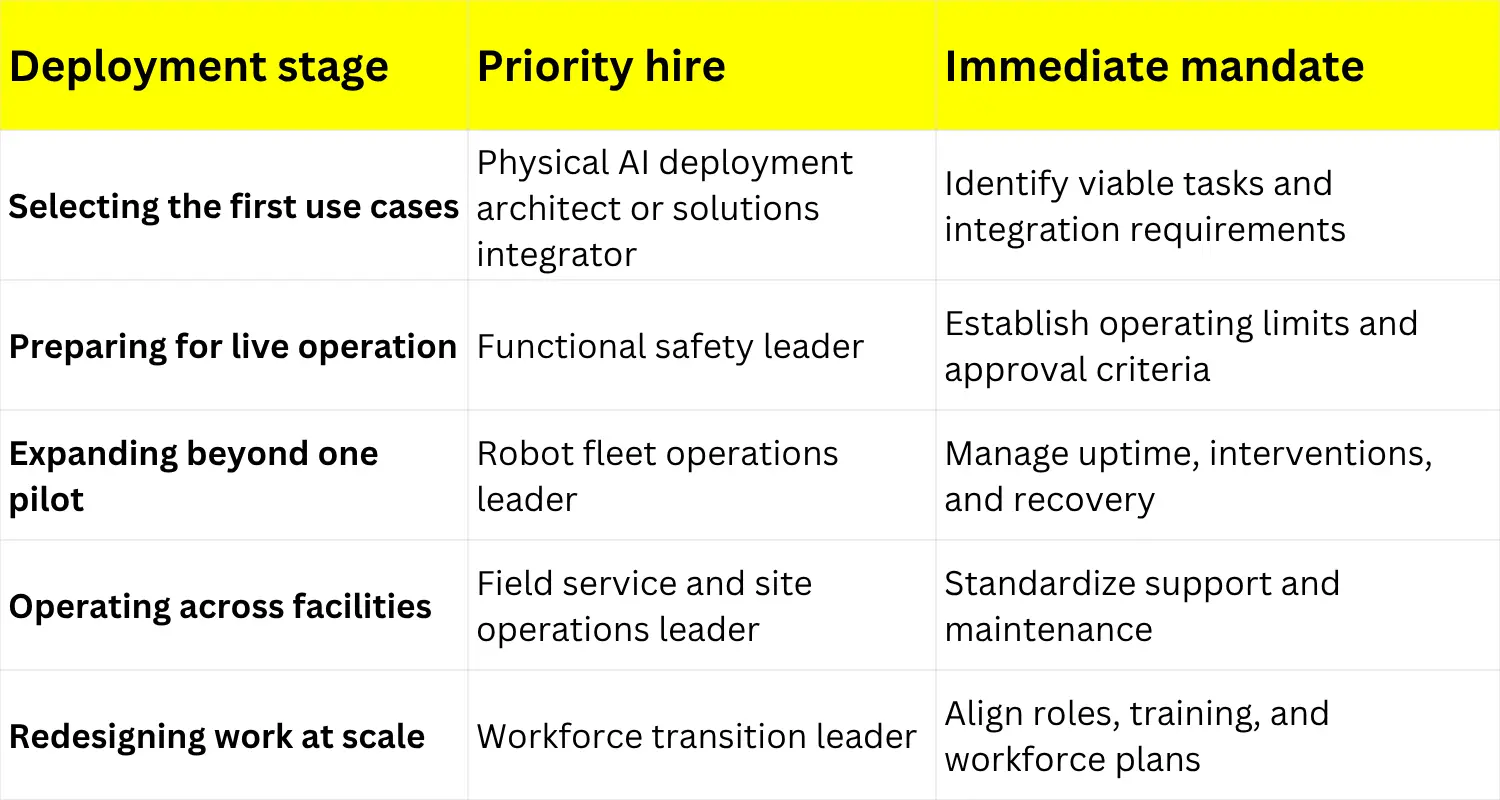
A Head of Physical AI, Chief Robotics Officer, or VP of Automation may oversee these functions. As deployments expand, that executive will need leaders with enough authority to challenge decisions involving safety, system availability, and site operations.
Reporting lines will vary. A robotics vendor may place these functions under a chief technology or operating officer. A manufacturer deploying outside systems may assign the mandate to operations, with technical governance shared across the CTO and COO organizations. The deciding factor is ownership of production outcomes.
What boards should ask before approving expansion
Before moving a physical AI program into additional facilities, boards and executive teams should ask:
- Who owns the autonomy rate and the cost of human intervention?
- Who can stop a deployment when safety evidence is incomplete?
- How quickly can a failed system return to service?
- How will staffing requirements change as utilization grows?
- Which operational data will the company retain from the deployment?
The answers reveal whether the company has built an operating organization or remains dependent on a small technical team to keep the pilot alive.
The next Physical AI talent shortage will become visible through operating performance. Low autonomy, recurring interventions, slow recovery, and weak utilization will often point to missing leadership rather than a single technical failure.
Companies that define these five functions before expanding deployment will have clearer accountability for safety and financial performance. They will also give the Head of Physical AI an organization capable of carrying the system beyond its first successful pilot.
Christian & Timbers recruits executives across physical AI, robotics, autonomous systems, and advanced manufacturing. We help clients define new leadership mandates, assess experience from adjacent sectors, and recruit the executives required to move Physical AI from pilot programs into production.

Frequently Asked Questions
- Which roles are required for physical AI deployment?
The required organization depends on the use case and deployment stage. Common needs include physical AI deployment architecture, functional safety, fleet operations, field service, and workforce transition leadership. These functions connect technical performance with daily operation.
- What does a robot fleet operations leader do?
A robot fleet operations leader manages system availability after deployment. The role typically owns uptime, human interventions, recovery procedures, software rollout coordination, and escalation across engineering and site operations.
- Why do physical AI companies need functional safety leaders?
Robots and autonomous systems interact with people, equipment, and physical environments. A functional safety leader establishes operating limits, oversees risk assessment, and confirms that the evidence supports deployment under defined conditions.
- Where can companies recruit physical AI deployment talent?
Relevant candidates can come from robotics companies, industrial automation, autonomous vehicles, aerospace, medical devices, and logistics technology. The best source depends on the operating environment and the risk profile of the system.
- When should a company build a field service organization?
Field service capability should develop before the deployment expands beyond the engineering team's ability to support it directly. Companies planning multiple sites, extended shifts, or Robots-as-a-Service contracts need repeatable maintenance and recovery processes early.