



A VP of Deployment owns the path from signed contract to a working production system. That includes implementation planning, technical integration, deployment capacity, and accountability for the business outcome promised to the customer. Companies create the role when deployments become too complex or numerous for engineering and customer success to manage between them.
Gartner forecasts worldwide AI spending will reach $2.59 trillion in 2026, up 47% from the previous year. That scale increases pressure on AI companies to connect commercial demand with working production deployments.
Key Takeaways
- A VP of Deployment owns the path from signed contract to a working production system, including accountability for the customer outcome.
- RAND Corporation reports that, by some estimates, more than 80% of AI projects fail, twice the failure rate of non-AI IT projects.
- Forward deployed engineering roles grew 42-fold between 2023 and 2025, while job postings increased 729% year over year by April 2026.
- Of the roughly 17,000 FDEs working in the United States, only about 2,000 have repeatedly connected enterprise AI deployments to measurable business value, according to Christian & Timbers research.
What Does a VP of Deployment Own?
The VP of Deployment takes responsibility when a commercial commitment becomes a technical delivery obligation. By the time that happens, sales has already defined what the customer expects, and engineering has already built the underlying product. Deployment owns what comes next: making the product work inside an environment the vendor does not fully control.
That work begins with scoping. The deployment leader determines which integrations are required, which customer data is usable, and which internal teams must participate. From there, the role assigns technical resources, sets milestones, and identifies the conditions that must be met before the system enters production.
The mandate continues after launch. A system can be technically operational without producing the result used to justify the purchase, so the VP of Deployment tracks adoption and financial performance alongside conventional delivery measures such as time to production.
In practice, the role controls deployment planning, integration strategy, resource allocation, and the operating measures used across the customer portfolio.
Why AI Companies Are Creating the Role
Enterprise AI sales create a separate delivery obligation inside each customer environment. Many companies reach that stage without an executive who owns the complete production outcome. RAND Corporation research points to why: by some estimates, more than 80% of AI projects never deliver, at a failure rate RAND puts at double what conventional IT projects see.
These projects rarely fail because a model cannot produce an answer. Problems emerge when the system encounters incomplete data, legacy infrastructure, internal resistance, or a workflow that was poorly defined before implementation began. Each obstacle crosses departmental boundaries. Engineering can resolve technical defects, and customer success can manage communication, but neither function usually owns the complete production outcome.
Early-stage AI companies often manage this work through founders and a small group of FDEs. That arrangement can succeed while deployments remain limited. It starts to break when several customers require senior technical attention at the same time. Decisions become reactive, experienced engineers get spread thin across accounts, and lessons from one implementation fail to change the next.
The VP of Deployment introduces a repeatable operating system. The leader determines how deployments are staffed, when an implementation should be escalated, and which customer commitments the company can realistically support.
The hiring data backs up how fast this workforce is expanding. LinkedIn's 2026 Labor Market Report found that forward deployed engineering roles grew 42-fold between 2023 and 2025, compared with 13-fold growth for AI engineer roles generally. Indeed data shared with Business Insider showed forward deployed engineer listings up roughly 729% year over year by April 2026. A recent Christian & Timbers study found that supply has not caught up. Of the roughly 17,000 FDEs working in the United States, only about 2,000 have repeatedly connected enterprise AI deployments to measurable business value.
Large technology companies are also formalizing deployment as a dedicated organization. In June 2026, AWS committed $1 billion to a Forward Deployed Engineering unit designed to embed thousands of engineers with customers. The size of that commitment shows how much technical capacity is moving closer to implementation and production accountability.
When Does a Company Need a VP of Deployment?
The first signal usually appears when the CEO or CTO becomes the escalation point for every important customer deployment. Their involvement can keep a small number of implementations moving, but it also hides the absence of a functioning deployment organization.
The next sign is inconsistency. One customer reaches production in six weeks while another remains in implementation for six months, with no clear explanation for the difference. Staffing decisions depend on whichever account is making the most noise, and sales keeps promising timelines without an accurate view of deployment capacity.
A dedicated executive becomes necessary once the company has enough simultaneous implementations to require portfolio-level decisions. The VP must decide where experienced FDEs are assigned, which deployments need intervention, and when a project should be paused. Companies should make the hire before weak delivery starts affecting renewals or future sales.
Where the Role Sits in the Leadership Team
VP of Deployment vs. VP of Customer Success
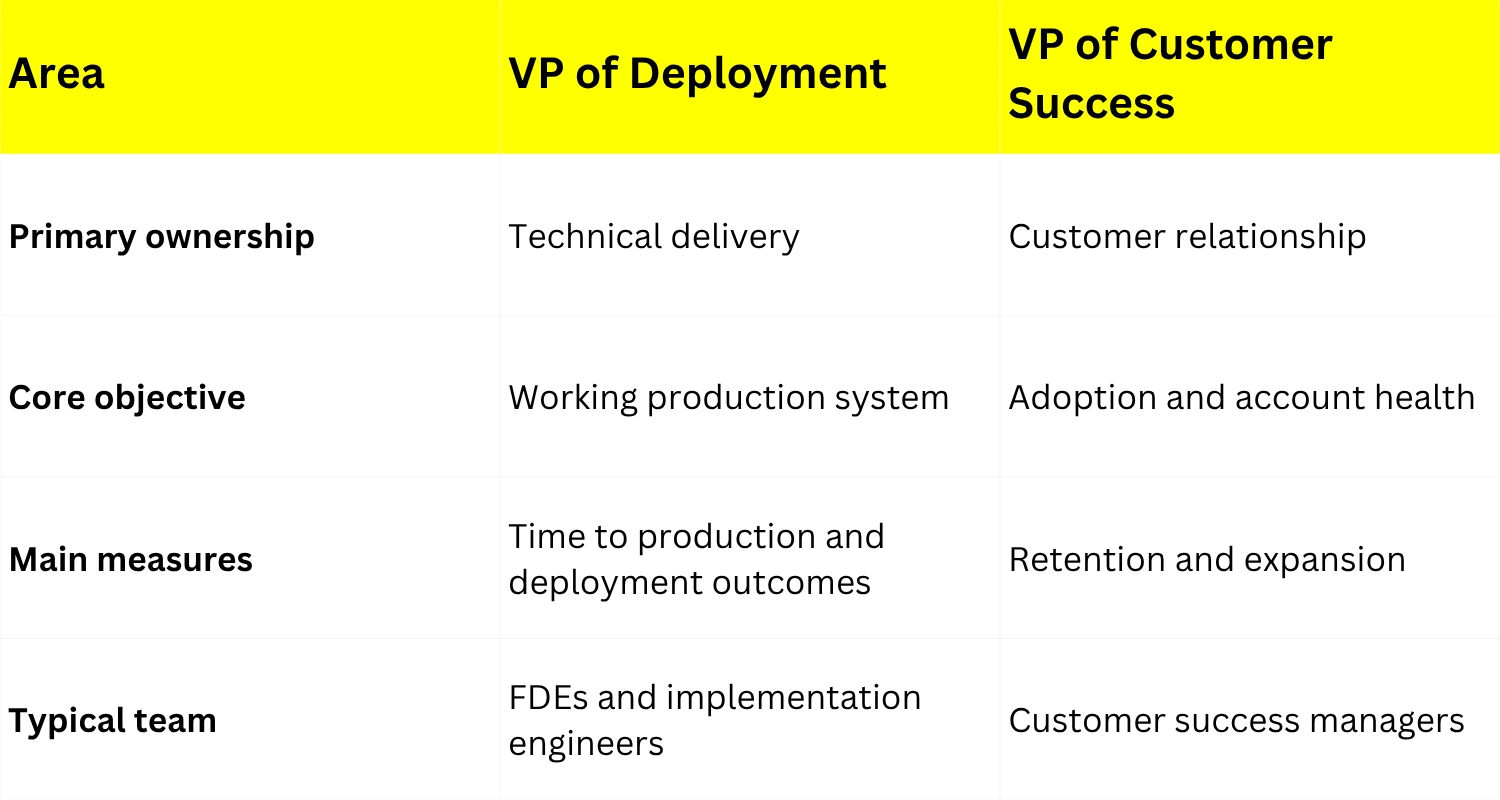
Both leaders remain involved after the contract is signed. Their accountability differs. Customer success maintains the commercial relationship, while deployment controls the work required to make the system operational. In some companies, customer success assumes primary ownership once production criteria have been met.
Physical AI companies often maintain a longer deployment mandate because installation is only the beginning. Robotics and autonomous systems can require commissioning, safety validation, and ongoing adaptation to real-world conditions.
VP of Deployment vs. VP of Engineering
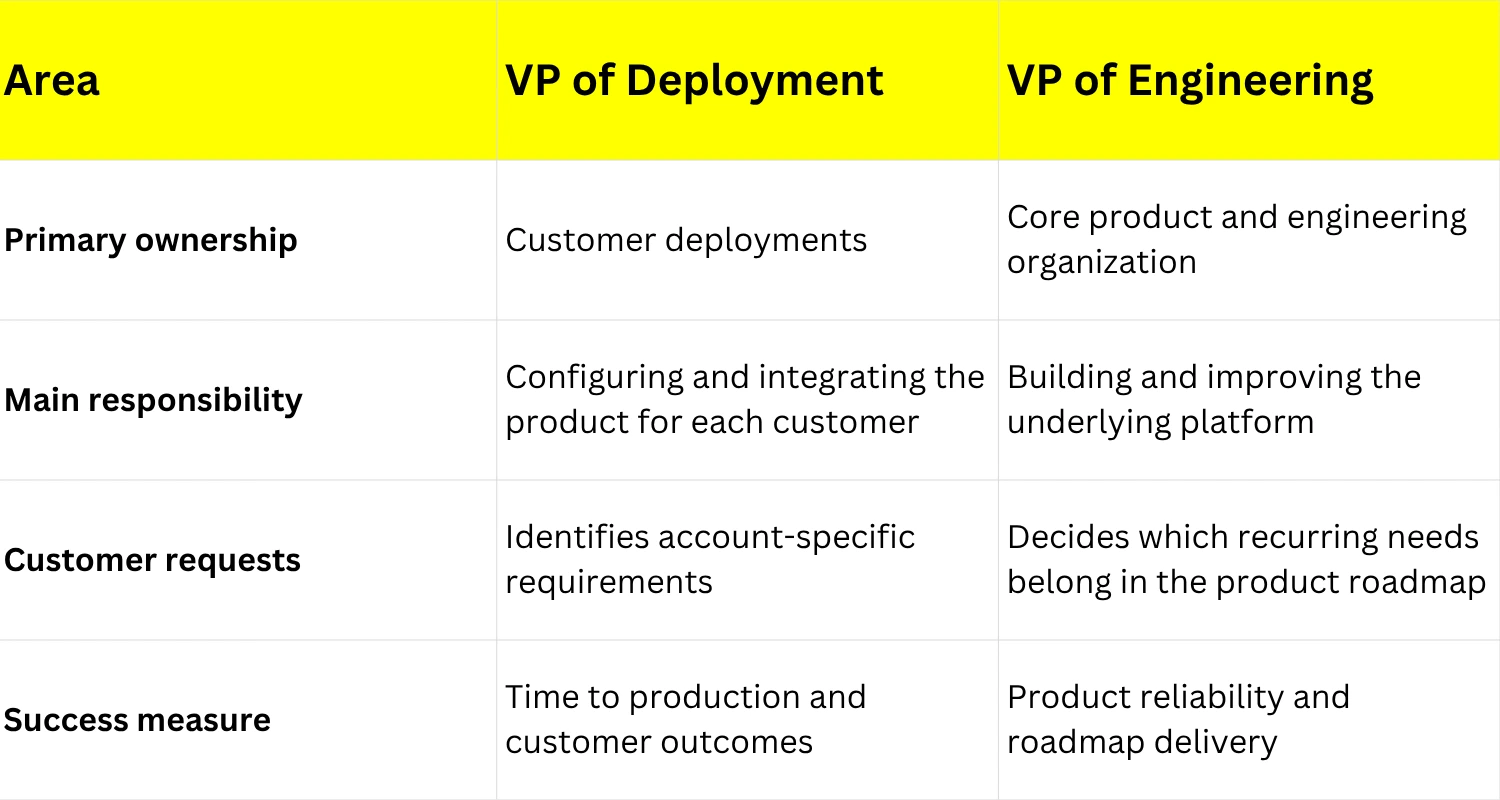
The VP of Engineering owns the product and the technical organization that builds it. The VP of Deployment owns how that product is configured and integrated for individual customers.
The boundary gets difficult when customer requests require changes to the core platform. A strong deployment executive separates reusable product needs from account-specific work. Without that discipline, engineering roadmaps become dominated by custom requests, while deployment teams wait for features that apply to only one implementation.
The two executives should share an escalation process. Deployment brings recurring field problems into product planning, and engineering determines which solutions belong in the platform.
What Should Companies Look for in a VP of Deployment?
Repeated Production Deployments
One successful implementation provides limited evidence. It could reflect an unusually prepared customer or direct founder involvement rather than the candidate's own skill. Look for candidates who have delivered across different customer environments and can explain why their approach changed between accounts.
Ask for dates, team size, deployment duration, and the criteria used to declare the system production-ready. Candidates should distinguish a technical launch from sustained customer use.
Measurable Customer Outcomes
The candidate should connect implementation decisions to a business result. Revenue generated by the customer, operating costs removed, or cycle time reduced provides stronger evidence than adoption language alone.
Interviewers should also establish who calculated the result. A number verified by finance or documented in a renewal carries more weight than an estimate the deployment team produced on its own.
Technical Credibility
The VP does not need to be the strongest engineer in the organization. The role does require enough technical depth to challenge architecture choices, recognize integration risk, and determine when a proposed solution cannot hold up under real customer load.
This credibility matters internally. Experienced FDEs are unlikely to follow a leader who treats every deployment problem as a project-management issue.
Ability to Build the Deployment System
Some candidates are excellent at rescuing individual accounts. A VP-level hire has to turn those interventions into a system that works without constant executive involvement.
Look for evidence that the candidate has designed team structures, established stage gates, and created rules for allocating scarce technical resources. They should also have hired or developed leaders beneath them.
Where Strong Candidates Come From
The most direct candidates come from forward deployed engineering organizations where they have managed multiple production implementations. Enterprise implementation leaders can also transfer well when their experience includes complex technical systems and accountability beyond installation.
Physical AI and robotics companies offer candidates accustomed to deployments that combine software with real operating environments. Technical professional services groups can produce capable leaders too, though companies should examine whether the candidate owned customer outcomes or primarily delivered against a predefined statement of work.
Titles are inconsistent across this market. Relevant candidates may currently be called Head of Deployment, VP of Professional Services, Head of Forward Deployed Engineering, or VP of Customer Engineering. Search strategy should follow the mandate rather than one exact title.
How Should a VP of Deployment Be Measured?
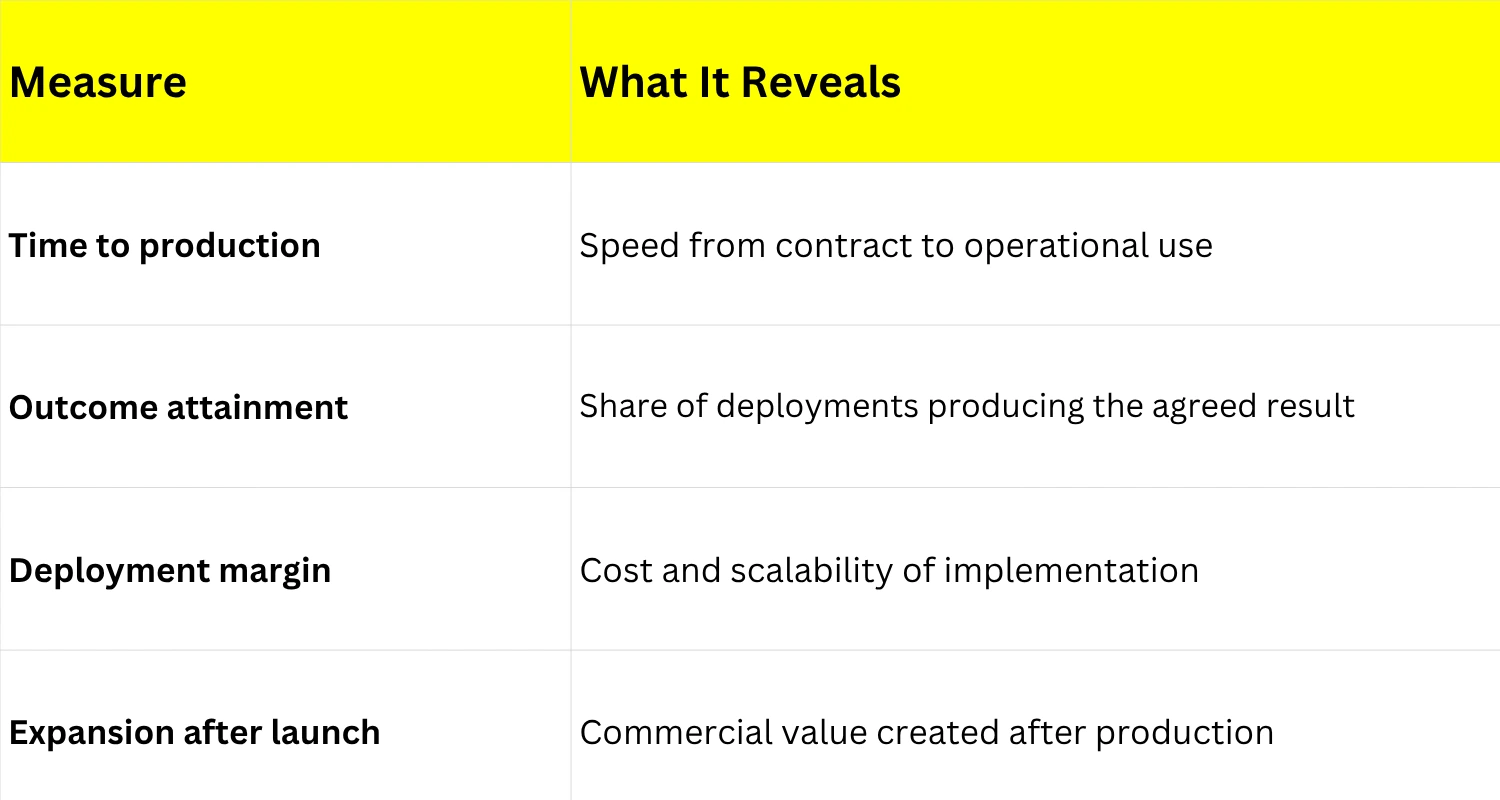
Time to production is the clearest operating measure, but speed alone can push teams to declare success too early. The company also needs a definition of production that includes sustained use and an agreed customer outcome.
Portfolio measures reveal whether the executive has built a function that can grow. Deployment margin shows how much custom effort each account consumes. Resource utilization indicates whether specialized engineers are concentrated on the work that needs them most.
How Christian & Timbers Recruits VP of Deployment Leaders
A VP of Deployment search requires evidence that extends beyond title history. Christian & Timbers evaluates candidates against completed production deployments, documented customer outcomes, and the operating systems they have built around technical delivery.
The search also reaches beyond executives already carrying the VP of Deployment title. Relevant leaders can sit inside FDE organizations, physical AI companies, enterprise implementation groups, or technical services teams. Christian & Timbers maps that broader market and tests which candidates have moved from managing individual deployments to leading an entire portfolio.
This approach draws on the firm's own research into the U.S. FDE market, which found roughly 17,000 FDEs in the United States, with about 2,000 meeting Christian & Timbers' criteria for repeatedly connecting enterprise AI deployments to measurable business value. TechCrunch covered the study exclusively in July 2026.
The mandate sits alongside the rest of Christian & Timbers' technical leadership practice, which runs searches for CPO, CTO, CPTO, VP of Engineering, VP of AI, Head of AI, Chief Robotics Officer, VP of AI Transformation, and board-level roles. A company hiring its first VP of Deployment is often building out that same leadership layer at the same time.

FAQ
- Is VP of Deployment an executive role?
At companies with meaningful implementation volume, it usually sits at the VP or SVP level with direct accountability for deployment outcomes across the customer portfolio.
- Who does a VP of Deployment report to?
Reporting lines vary. Companies where deployment is closer to the commercial side often place it under the CEO or COO; companies where it is closer to the technical platform often place it under the CTO.
- What is the difference between deployment and implementation?
Implementation is the technical work of getting a system running in a customer's environment. Deployment is the broader function that owns implementation plus the timeline, the team, and the outcome tied to it.
- How much does a VP of Deployment earn?
Public compensation data remains limited because companies use several titles for this mandate. A recent Teleo opening for a VP of Deployment and Customer Operations advertised annual pay of $200,000 to $275,000. Actual packages vary according to company stage, organizational scope, and equity.