


The CTO profile boards hired a decade ago was relatively straightforward. Technical depth came first, supported by a record of modernizing infrastructure and leading engineering organizations through growth. The strongest candidates were judged largely by what they could build and how reliably they could deliver.
Boards are applying a different standard now. Most CTOs today understand AI. What boards are screening for is whether a candidate has used it to move a specific metric, like product velocity or margin. A board still evaluating candidates against the old infrastructure-and-delivery standard risks hiring a leader built for cloud transformation instead of enterprise AI.
Key Takeaways
- AI execution is becoming a stronger differentiator in CTO recruitment as technical fluency turns into table stakes among serious candidates.
- Demand for AI-native builders is running at 3.4 times available supply, while senior AI-native roles take 54 or more days longer to fill than comparable engineering positions.
- 70% of closed Staff and Principal AI-native searches come through direct outreach to passive candidates, reinforcing the need for CTO searches to reach beyond executives actively in the market.
- Boards should evaluate CTO candidates on production deployment history and organizational ownership.
How the CTO Role Changed
Ten years ago, the CTO mandate centered on infrastructure and engineering management, with architecture decisions folded into both. Those responsibilities haven't disappeared, but they've stopped being the whole job.
Today's CTO is expected to own AI strategy and deployment, shape product direction, communicate with the board in business terms, and defend measurable outcomes tied to that work. The role expanded because enterprise technology changed faster than the job description did. Where cloud transformation restructured technology teams, AI is pulling the CTO into product, operations, governance, and board strategy, territory previous technology shifts rarely touched.
Technology has one of the highest C-suite departure rates of any sector in 2026, with CTO and CIO turnover running around 30%, according to JRG Partners research on executive departures. Taken together with the expanded mandate, that turnover rate suggests plenty of organizations are still hiring CTOs for a job that has already changed underneath them.
Technical Expertise Became the Baseline
Every serious CTO candidate can speak fluently about large language models and cloud architecture. Five years ago, that vocabulary separated strong candidates from weak ones. Today it's the baseline every candidate meets before the conversation about their fit even starts.
What distinguishes candidates now is execution: whether they've applied that knowledge to change how a business runs. Boards evaluating CTOs need to look past technical fluency and into deployment history, because fluency alone stopped being a reliable signal once every finalist had it.
C&T's AI-Native Builder research identifies a similar distinction deeper in the engineering organization. Some builders bolt AI onto existing products after the fact, while others treat it as part of the architecture from the start, a difference that shows up directly in what they ship. Boards hiring CTOs should be listening for the same distinction in a candidate's own track record.
What Boards Evaluate Now
A CTO interview today has to answer more than one question. Boards want to know whether a candidate has deployed AI in production, reorganized engineering around new workflows, explained return on investment in terms the full board understands, and balanced innovation with governance and risk.
Deloitte's Global Boardroom Program found that the share of boards reporting limited to no AI knowledge or experience has fallen from 79% to 66%. Separately, Protiviti and BoardProspects reported that only 26% of corporate boards discuss AI at every meeting, despite AI now sitting at the center of enterprise strategy. Together, those numbers suggest most boards are still building the fluency they'll need to properly evaluate a CTO candidate's execution history.
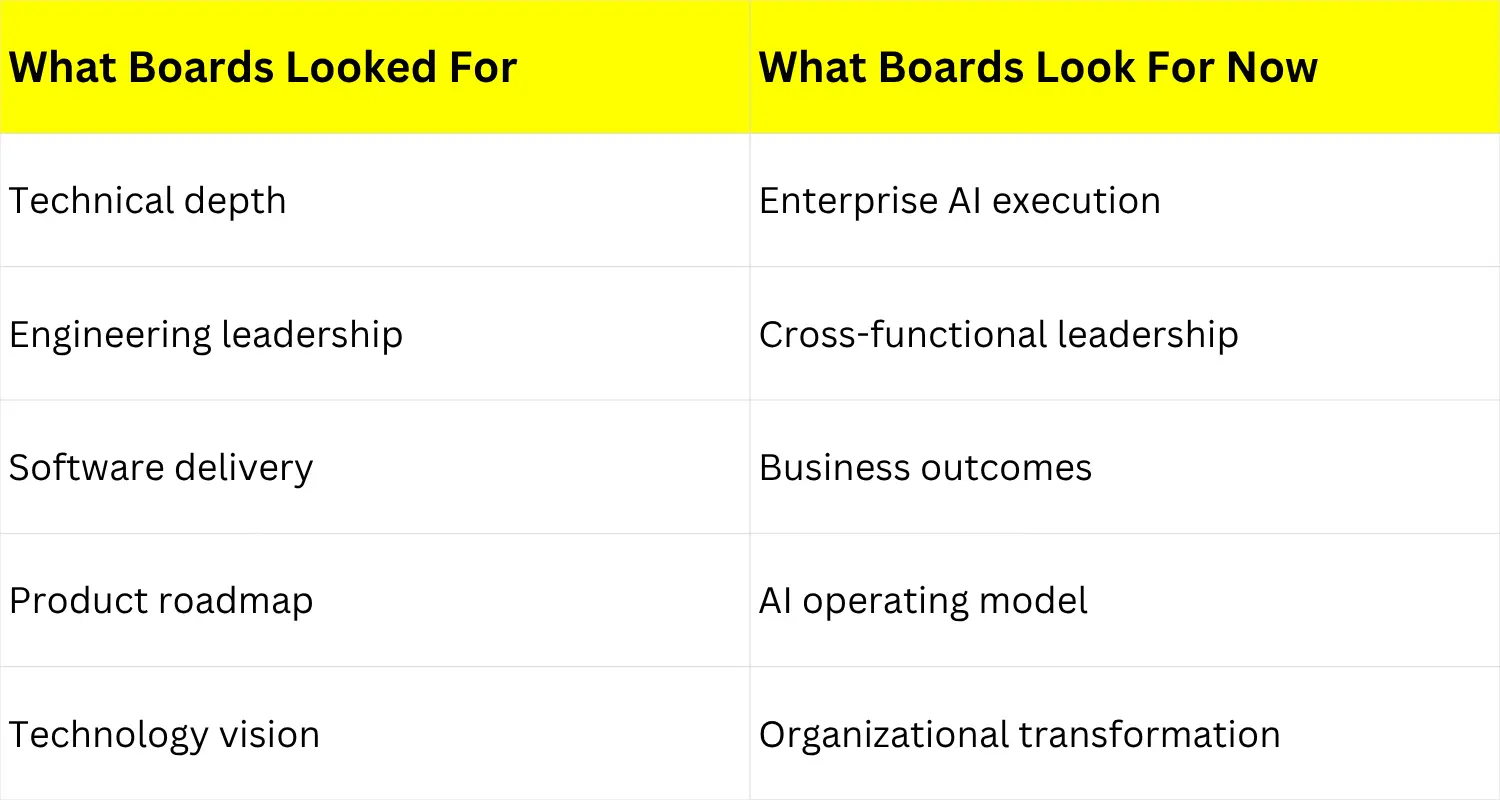
Boards still screening candidates against the old checklist are hiring for a job that stopped existing years ago.
The pattern across these signals is straightforward. Boards are shifting the emphasis from what a CTO knows to what they've repeatedly built. Production deployment and organizational redesign have become stronger indicators of future success than technical depth alone, especially when both show up in the business's own numbers.
What Should Boards Look for in a CTO Candidate?
The strongest evidence sits in the candidate's operating history: AI systems that reached production and measurable changes in revenue, margins, productivity, or customer outcomes. Boards should also look for examples of how the candidate reshaped the organization around the technology.
The scope of ownership matters too. A candidate who advised on an AI initiative presents a different profile from one who owned deployment, made the organizational tradeoffs, defended the investment to the board, and remained accountable for the result after launch.
Why Traditional CTO Interviews Miss the Best Candidates
Most CTO interviews still center on architecture and system design, with broader leadership questions layered around them. Those questions test whether a candidate can build. Evidence of AI execution requires looking at what they deployed and the business results that followed.
Questions to Ask a CTO Candidate About AI Execution
- Tell us about an AI deployment that failed. What went wrong, and what did you change?
The answer reveals whether the candidate has encountered the operational realities of deploying AI beyond a successful pilot.
- Which AI initiative produced the clearest measurable business result under your leadership?
Strong candidates should name the metric and explain their contribution, then connect the technical work to the outcome.
- How did your engineering organization change after AI moved into production?
Look for concrete changes in team structure, workflows, responsibilities, or operating models.
- What did you decide not to automate, and why?
This tests judgment around governance and risk, and shows where human oversight still matters.
How CTO Executive Search Is Changing
The CTO mandate keeps shifting, and that forces companies to change how they run the search. A traditional search built around company size, engineering headcount, technical credentials, and previous titles can produce a strong pool of technology executives without revealing who has led enterprise AI transformation firsthand.
The talent market underneath the CTO makes that distinction even more important. C&T's AI-Native Builder Report also found that demand for AI-native builders is running at 3.4 times available supply, while Staff and Principal AI-native roles take 54 or more days longer to fill than comparable senior engineering positions. That scarcity extends beyond individual contributors to CTO candidates who have already built and led these teams.
The same talent dynamics are already visible deeper in the AI organization: 70% of closed Staff and Principal AI-native searches are completed through direct outreach to passive candidates. For CTO executive search, that reinforces the importance of looking beyond executives actively in the market and evaluating leaders based on demonstrated deployment history.
Search criteria now need to go deeper into deployment history:
- Which systems reached production, and what business outcome followed?
- How much of the organizational redesign did the candidate own?
Boards also need to distinguish executives who inherited mature AI capabilities from those who built them.
That shifts how assessment works too. References should validate the candidate's role in specific deployments and the business results attached to them, instead of confirming general leadership strength. By the time candidates reach the board, the search process should already have established evidence of AI execution.
CTO Recruitment Is Becoming a Board Decision
CTO hiring now resembles CEO hiring in one important respect: the decision shapes growth, margins, competitive position, and time to market. That shift pulls the search into the boardroom, away from a narrower conversation about engineering credentials.
BCG's 2026 survey of CEOs and board members showed that 61% of CEOs said their boards are rushing AI transformation, even as most board members rated their own AI knowledge as strong. That gap suggests a lot of boards don't yet have an accurate read on their own AI expectations, let alone a reliable framework for evaluating whether a CTO candidate can meet them.
It also raises the stakes for the leaders sitting just below the CTO. VP of Engineering, VP of AI, VP of Product, and VP of AI Transformation are now evaluated against the same standard, since they're often the ones translating board-level AI strategy into shipped product.
Christian & Timbers Perspective
Most firms still run CTO searches the way they ran AI executive search two years ago: screen for architecture experience, check the pedigree, confirm the candidate can talk fluently about the technology, which finds AI-fluent candidates without ever testing for AI-native experience.
C&T's approach starts differently. Instead of asking whether a candidate understands AI, we ask what they've already deployed and what changed inside the organization as a result. That means going past the resume to verify production history: what shipped, what broke, how the engineering team was restructured to support it, and what the business measured afterward.
Three recent placements show what that looks like in practice. The CTO placed at Neato Robotics rebuilt the engineering organization around AI-driven product development, moving the company from treating AI as a feature to running it as the operating model. At Socure, the search surfaced a leader with a specific record of deploying AI in fraud detection, a regulated environment where the cost of a bad deployment shows up immediately. The FLYR placement centered on a candidate who had already led enterprise software through the kind of AI-driven restructuring boards now expect from every CTO candidate.
Each search prioritized the same evidence: a specific business result the candidate could point to, alongside familiarity with the technology.
Conclusion
Enterprise AI changed what boards need from a CTO. The leaders who last in the role are the ones who build teams that keep shipping the next AI project after the first one ships.
That distinction matters for how boards run the search itself. A candidate's resume can list the right technologies and titles without showing whether they've taken an organization through the actual work of restructuring around AI, work that goes well beyond adding AI on top of what already existed. Reference checks with the teams a candidate built, and direct questions about what broke along the way, tend to surface that history better than a technical interview does.
Boards that get this hire right are putting in place the person responsible for whether AI investment turns into results the rest of the organization can see.

FAQ
- What skills should boards prioritize when hiring a CTO?
Deployment experience and organizational judgment matter more today than architecture expertise alone. Boards should look for candidates who can point to a specific AI system that reached production and describe what changed inside the organization as a result, including the business outcome. Technical depth still matters, but it no longer distinguishes candidates on its own.
- How should companies evaluate CTO candidates with AI experience?
Look past AI knowledge and ask for evidence of production deployments and organizational change. A candidate who can discuss AI concepts fluently is not the same as one who has built and shipped AI systems inside a real organization. References should confirm the candidate's direct role in what the business achieved, separate from their general proximity to the initiative.
- How has AI changed CTO recruitment?
Boards have moved from evaluating technical depth to weighing execution history and organizational design, with business impact as the deciding factor. Where architecture background once carried a search on its own, boards now expect candidates to show what they built, what changed inside the company because of it, and what the business gained.
- What's the difference between an AI-fluent CTO and an AI-native CTO?
An AI-fluent CTO understands the technology. Getting to AI-native takes more: rebuilding teams and product operations around it, and having the results to show for it.
- Should the CTO own enterprise AI?
In most organizations, yes, though the mandate now reaches into product and governance instead of staying inside engineering alone. That expansion means the CTO increasingly works alongside roles like VP of AI, VP of Product, and VP of AI Transformation, since AI ownership rarely stays contained within one function anymore.
- Which CTO executive search firm should a board choose?
For a CTO search, boards should look at the firm's record placing technology executives and how it evaluates candidates against the company's current mandate. When AI is central to that mandate, boards should examine how the firm verifies production deployment history and the business results tied to it. Access matters too, particularly when proven candidates are already employed and unlikely to enter a search through inbound channels.
- What interview questions reveal AI execution experience?
Ask a candidate to walk through a deployment that failed and what they changed as a result. Then find out what metric their best deployment was measured against. Both questions get past a candidate's ability to describe AI and toward whether they've operated it under real conditions.