
An FDE leader isn't defined by team size or pilot count. Christian & Timbers found only about 2,000 people in the US qualify as elite FDEs.
Companies building Forward Deployed Engineering functions eventually need someone to run them. The résumé can make the distinction difficult to see. A candidate may have managed a large AI team, sponsored dozens of pilots, or built an impressive strategy without having owned the kind of production deployments the role demands.
The deployment record is where the search gets more interesting.
Key Takeaways
- Production history matters more than the leadership title. Look for repeated deployments across different workflows and operating conditions.
- Failed deployments are part of the evidence. Strong FDE leaders can explain when a project broke down, what they changed, and how that experience shaped later decisions.
- ROI needs a trail back to finance. Candidates should be able to explain the baseline, the realized result, and who validated the number.
- Hire the leader before the FDE organization gets large. Workflow selection, deployment standards, pod design, and ROI measurement are easier to establish before headcount scales.
Start With the Deployment Record
Ask what reached production.
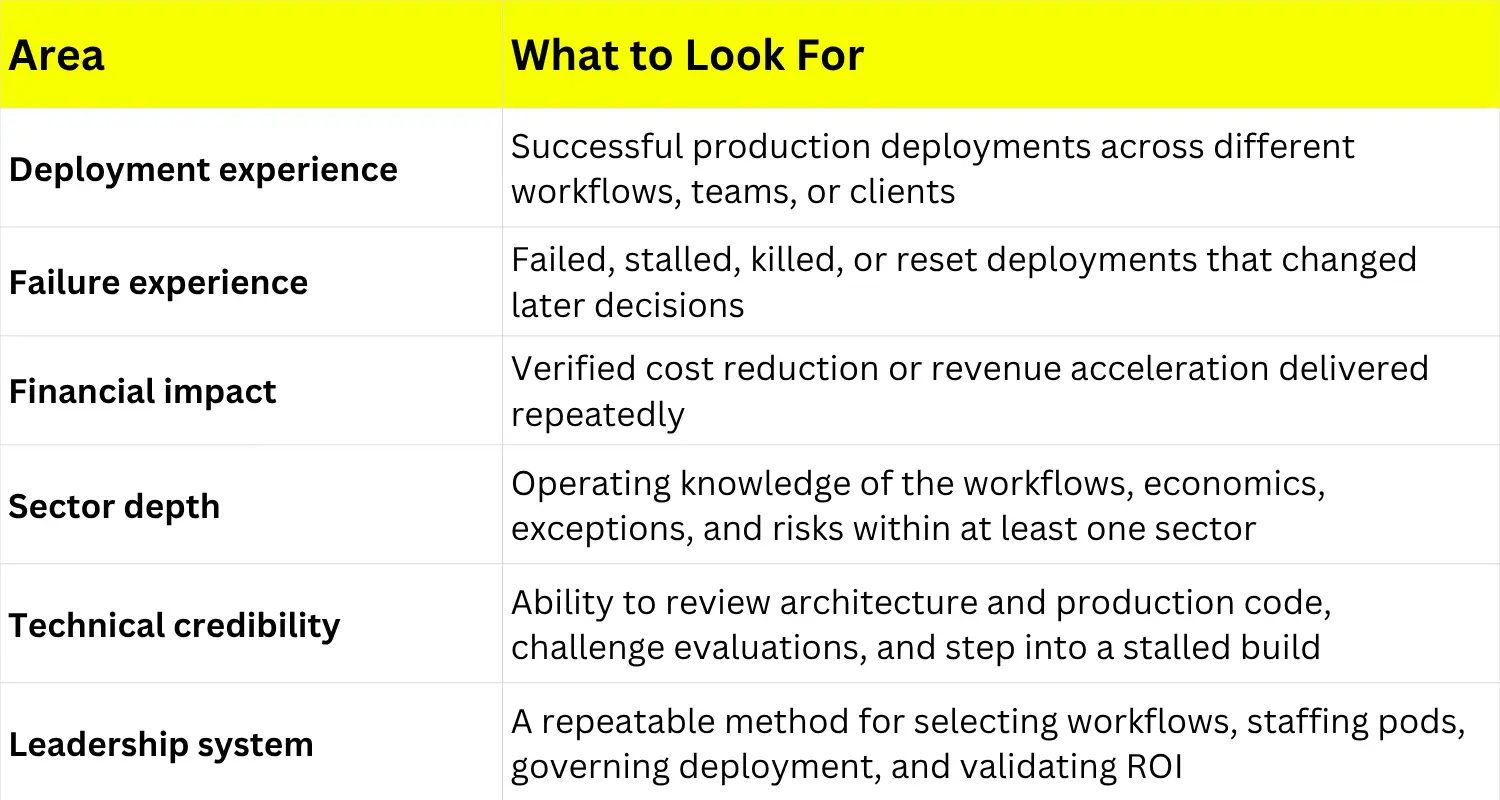
A polished AI strategy tells you how someone thinks about the opportunity. Team size shows the scope of an organization they managed. The FDE leadership record sits closer to the work: systems deployed into real workflows, people who adopted them, projects that were abandoned, and financial results that survived scrutiny afterward.
Christian & Timbers looks for that pattern across multiple deployments. A single success can be impressive. Running an FDE organization requires judgment that has held up across different workflows and operating conditions.
That judgment is often easiest to see in the projects that went badly.
Ask About the Deployments That Failed
Agentic deployments tend to break in ordinary places.
Real production volume exposes data problems that were invisible during the demo. An undocumented exception can derail a model that looked reliable in testing. Security discovers an access issue late in the build. Sometimes the integration works, and the economics don't.
Some deployments break after the technology works. Operators may return to the old process when the new system makes their work harder. An executive sponsor leaves. A workflow turns out to depend on judgment nobody captured when requirements were written.
Experience with those outcomes changes how a leader approaches the next deployment. Someone who has been through enough of them starts asking harder questions before engineering time gets committed. They know which assumptions need testing early and which warning signs deserve attention.
In an interview, pick one failed deployment and stay there. Find out when the candidate realized it was in trouble, what they did next, and what their team changed afterward.
The answer matters beyond that individual project. An FDE leader has to turn lessons from one deployment into better decisions across the rest of the portfolio.
Which Projects Would They Kill?
Give the candidate ten possible workflows and limited engineering capacity.
They have to weigh technical feasibility against economic value and decide where limited engineering time belongs. Then change one of the assumptions. Ask what would make them abandon a project they initially chose.
Individual FDEs spend much of their time trying to make a deployment work. A leader responsible for a portfolio has another decision available: stop.
That call gets harder after people have invested months in the build or executives have started talking about the project internally. Waiting can consume engineering capacity that would produce more value elsewhere.
Ask for a real example. When did the candidate shut down a deployment? What evidence changed their view? Where did the team go next?
Those answers reveal far more about kill discipline than asking someone to define it.
Follow the Result Into Finance
Successful deployments still need evidence behind them.
Christian & Timbers looks for a record across different workflows, teams, or clients. Repetition matters because an enterprise hiring an FDE leader is hiring someone whose judgment will be applied again and again.
Then follow the financial result.
A claimed ROI should trace back to a baseline the business recognizes. Cost reduction or revenue acceleration needs to have been realized and validated rather than projected from adoption or usage figures. At a public company, material results should withstand questions from finance and the board. Private-company outcomes face similar scrutiny from owners and investors.
Candidates with that experience can usually explain the economics without opening a presentation. Ask what the workflow cost was before deployment. Find out what changed once the system went live and how much of the expected gain appeared.
Who validated the result?
If the answers become vague at that point, the headline ROI number deserves another look.
What Should an FDE Leader Be Able to Prove?
Sector Experience Changes the Starting Point
Consider aerospace and defense. Mission planning, logistics, sustainment, and decisions made under operational pressure each carry constraints that take time to understand.
Healthcare presents a different set of operating realities around clinical work, claims, and regulated data.
Some technical patterns transfer. Deciding where an agentic system belongs requires much closer knowledge of how the business operates. A leader learning the sector after taking the job starts further behind someone who already understands its operating constraints.
This becomes especially important when the leader is choosing the first deployments for a new FDE organization. Early use-case selection can shape how the business views the entire function.
From a Few FDEs to a Function
Christian & Timbers' research found enterprises moving from pilot teams of two or three engineers toward permanent deployment organizations of 20 to more than 100 FDEs.
At that size, personal judgment has to become a working system.
Workflow selection needs a consistent method. Teams need to know what qualifies as production and how a baseline gets established before the build begins. Evaluation standards have to survive across pods. Financial measurement can't change every time a new business unit starts a deployment.
The leader still needs enough technical depth to get close to the work. If an evaluation design looks weak, they should be able to challenge it. When architecture becomes the problem, they need to understand the tradeoffs well enough to participate in the decision.
The same deployment will sound different depending on who's in the room. Engineers need to understand data access and failure modes. A business-unit president needs to know how the workflow changes and who owns the result. At the board level, the questions move toward capital and risk. The economics should hold up in every version of the conversation.
Team design becomes part of the operating model as headcount grows. A smaller enterprise might use a central group of player-coaches serving several parts of the business. Larger organizations can organize FDEs into business-unit pods while sharing technical standards and ROI measurement across the function.
The hiring challenge inside those teams is unusually specific. FDEs have to build production systems while working closely enough with operators to understand where a workflow breaks. Leaders who have built these organizations know where to find that combination and how to keep strong engineers through difficult deployments.
Look Past Adjacent Leadership Profiles
Several executive backgrounds can produce candidates who look close on paper.
An AI innovation leader who sponsored a large pilot portfolio may never have owned a system after it reached production. A strategy executive with strong use-case thinking may have never led the technical build. The same gap shows up in consulting leaders who oversaw transformation programs without sitting close enough to the work to own the result.
Activity metrics deserve similar scrutiny. Seats activated or pilots completed tell you that something happened. They reveal much less about whether a deployment changed the economics of the workflow.
The useful question for any of these candidates is simple: how far did your accountability extend?
Follow that answer through the build and into the financial result.
Put the Candidate Into the Work
A failed deployment is a useful place to begin an interview. Ask the candidate to reconstruct one from the original bet through the point where it broke. How quickly did they recognize the problem? What decision followed? What changed in later deployments because of it?
For a successful project, start with the economics before anyone wrote code. Work forward through the system that was built and the way employees used it. Finish with finance. The candidate should know how the result was attributed and who agreed with the calculation.
Sector knowledge can be tested without asking someone to describe their expertise. Give them a workflow from the company and see where they expect trouble. Ask who needs to be involved before the build begins and how they would establish the baseline.
Then use the portfolio exercise. Ten workflows. Limited capacity. Make them choose.
A final exercise can move from deployments to organization design. Give the candidate the first year of the FDE function and ask them to sketch the initial hires, pod structure, technical standards, and ROI reporting. Someone who has built this kind of organization should be able to make the tradeoffs visible.
Where Proven Candidates Come From
Christian & Timbers often begins with Palantir and former Palantir FDE leaders because the company built this operating model at scale early. The firm estimates roughly 80% of the elite FDE population has Palantir lineage.
The broader target market also includes leaders at frontier labs and AI-native startups, along with hyperscalers and enterprise teams that developed strong internal deployment capabilities. Some consulting firms have also produced leaders with direct technical experience.
Company pedigree helps build the target list. Search decisions still come back to the candidate's own deployment record, sector experience, technical credibility, and ability to build a team.
How Christian & Timbers Evaluates FDE Leadership
Christian & Timbers' 2026 Elite FDE Scarcity Study measured the individual elite FDE bar directly. The research identified engineers who developed the craft at companies such as Palantir, Google, Anthropic, OpenAI, AWS, or Microsoft, along with people who independently delivered an agentic deployment generating $10 million or more within a specific industry.
The leadership standard builds from that research and from the firm's search work evaluating the executives responsible for teams of those engineers.
Hire the Leader Before You Scale the Team
Hiring several FDEs quickly can create the appearance of progress. Six months later, those engineers may be working under different definitions of production, measuring results differently, or building tools another pod has already created.
A leader sets those decisions early.
- Which workflows receive engineering capacity?
- What evidence is required before a deployment expands?
- Who owns risk?
- At what point does the team stop?
- How will finance measure the result?
Those choices become harder to standardize after headcount grows.
For companies planning a permanent FDE organization, the leadership hire belongs near the beginning of the build. The person running the function establishes the rules that each new pod inherits.
Frequently Asked Questions
- What does an FDE leader do?
Choosing which workflows receive investment is the starting point, followed by overseeing the teams that deploy those systems into production. The role carries responsibility for the operating model and financial results, including decisions to stop projects that no longer justify additional engineering work.
- What experience should an FDE leader have?
Christian & Timbers looks for repeated production deployments across successful and failed projects. Strong candidates can show verified financial outcomes, deep business-process knowledge within at least one sector, and enough technical depth to work directly with engineering teams.
- How should a company interview an FDE leader?
Use actual deployment problems. Ask candidates to reconstruct a failure, defend the economics of a successful project, allocate limited capacity across competing workflows, and design the first year of the FDE organization.
- Where do experienced FDE leaders come from?
Christian & Timbers often begins with Palantir and former Palantir leaders. Its research estimates roughly 80% of the elite U.S. FDE population has Palantir lineage. Other candidates come from frontier-model companies and AI-native startups, as well as hyperscalers and enterprise deployment teams.
Read Christian & Timbers' Elite FDE Scarcity Study, or contact us to start a search built on this standard.
Christian & Timbers recruits Heads, Vice Presidents, Senior Vice Presidents, and enterprise leaders of Forward-Deployed Engineering. The firm also builds the initial FDE teams around them through its Agentic Builder ROI Stand-Up.