

Across aerospace and defense, companies are asking where AI can reduce manual work and improve output. There is another question that gets less attention: what happens to the experience that work used to build?
Some of the work being compressed, including research, documentation, reporting, and administrative processes, has traditionally belonged to junior employees. When that work moves to AI, some of the experience they gained by doing it can disappear.
Companies that redesign work around AI are also changing how early-career employees develop into senior engineers, program leaders, manufacturing executives, and general managers. Talent development is part of the AI transformation conversation, whether or not a company has framed it that way yet.
I recently discussed this shift on the AI Builders Podcast, including what it means for how aerospace and defense companies develop the next generation of leaders.
Watch the full conversation: What Executive Search Sees in Aerospace & Defense.
Key Takeaways From This Article
- AI is compressing work that historically gave early-career A&D talent exposure to how experienced people analyze problems and make decisions.
- When a task is automated, companies still need another way for early-career talent to build the judgment that once came from doing it.
- Aerospace and defense depends heavily on program and operating experience that takes years to accumulate, making changes at the entry level relevant to future succession.
- Future A&D leaders will need to develop AI fluency alongside customer, mission, technical, and operating judgment rather than acquire it only after reaching senior roles.
The Work AI Is Taking On Was Also Training
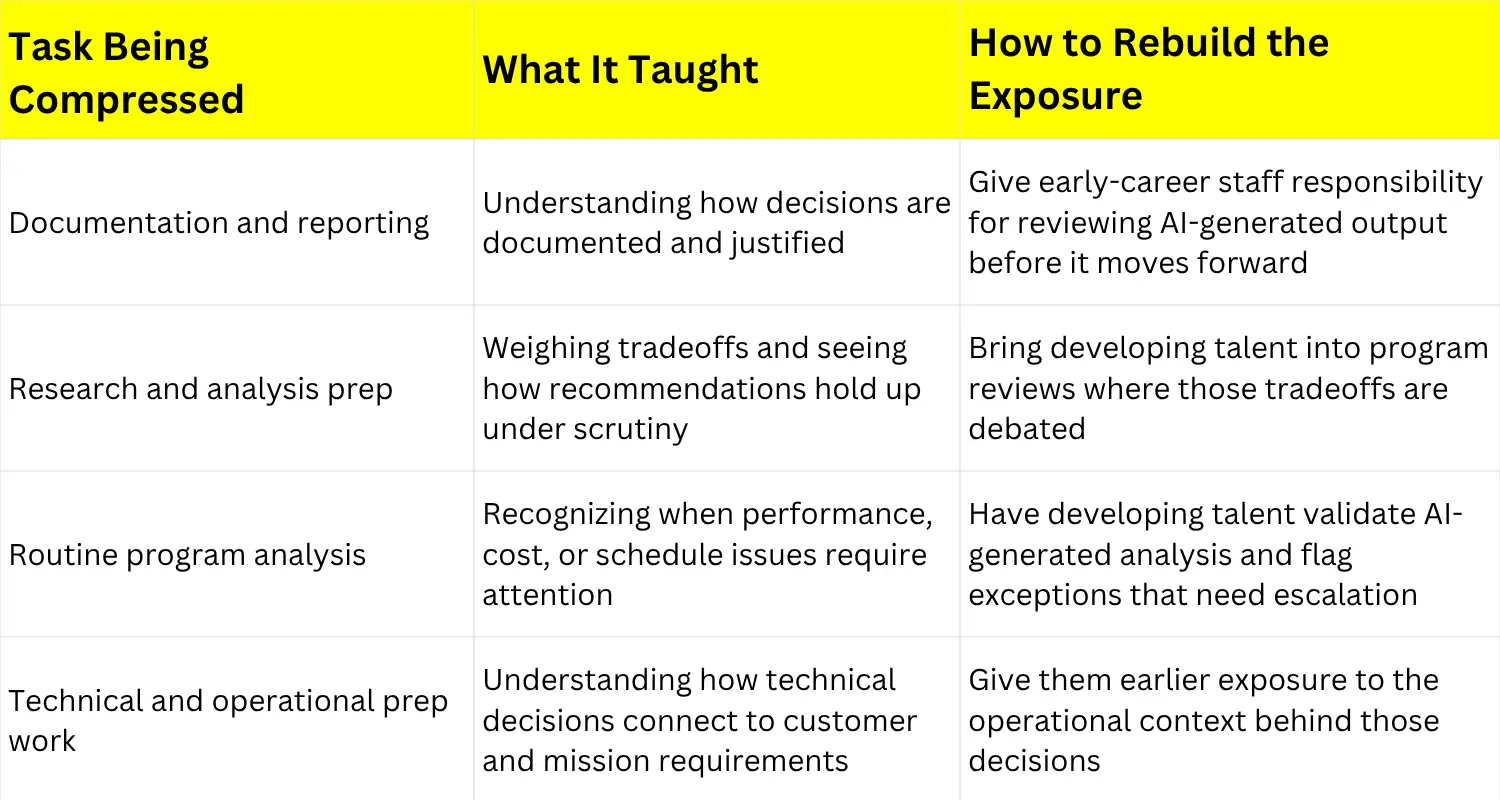
Much of entry-level work serves two purposes at once. It gets a task done, and it gives the person doing it exposure to how experienced people evaluate information, catch problems, weigh tradeoffs, and see how one decision affects the rest of a program.
As AI starts taking over work junior people used to learn on, companies need to think deliberately about how they build judgment in the next generation. That applies directly to engineering, manufacturing, professional services, and corporate functions.
Companies evaluating a task for automation should also consider what employees were learning by doing it. The efficiency case may be clear, but the developmental value of that work can be easy to overlook.
Why the Leadership Pipeline Matters in Aerospace and Defense
Senior aerospace and defense roles require experience that takes years to build. A strong program leader has to manage the customer, the technical teams, the schedule, the cost, the risk, and the internal alignment at the same time. People who have done this well across a full program are already difficult to find.
If fewer people accumulate that kind of experience early in their careers, companies risk a thinner leadership bench years later, when they need experienced leaders ready to step into larger program and operating roles.
That delay makes this a succession issue as much as a workforce design issue. A decision made this year about which tasks to automate can shape the leadership bench five to ten years from now.
Companies Need to Separate Automatable Work From Developmental Experience
Companies don't need to preserve manual work just because people used to learn from it. The better approach is automating where AI is effective, while building a plan for how employees gain that experience another way.
If AI now handles more of the analysis or documentation, developing talent still needs opportunities to understand why a recommendation changed and how a senior leader weighed the tradeoff behind it. Those opportunities have to be created once the task that used to provide them is gone.
That may mean moving early-career employees earlier into program reviews and giving them responsibility for validating AI-generated analysis. It can also mean exposing them to the customer and operational context behind a decision instead of limiting them to producing the underlying documentation.
The World Economic Forum has reached a similar conclusion looking at entry-level hiring broadly. Its research found that entry-level postings in the US have dropped 35% over the past 18 months, driven in large part by AI, and warned that cutting junior talent for short-term efficiency risks weakening succession plans and stalling the transfer of institutional knowledge. Removing a task without replacing the development attached to it carries the same risk inside aerospace and defense.
What AI-Native Experience Requires From the Pipeline
Aerospace and defense is approaching a point where AI-native experience will carry more weight in AI leadership decisions. Tomorrow's leaders will need experience working with AI throughout their development, building that capability alongside the judgment required for senior management.
Deloitte's 2026 Aerospace and Defense Industry Outlook describes a similar shift in its own research: the industry's focus is expected to move from hiring individual AI specialists toward embedding AI fluency across the entire workforce, built in part through deeper partnerships with educational institutions. That points to pipeline development starting well before someone reaches a senior title.
Today's Work Design Shapes Tomorrow's Executive Bench
Succession planning usually starts with the people already visible in the leadership pipeline. AI creates an earlier question: what experiences are those people accumulating before they ever enter the succession conversation?
Aerospace and defense needs leaders who understand the customer, the mission, the regulatory environment, and the discipline to deliver, while also bringing new thinking from software, autonomy, AI, and advanced manufacturing without losing the operating rigor the industry requires.
Leadership teams need to consider whether the people they are developing today are gaining the experience they will need for larger roles, especially as the entry-level work that once provided some of that experience changes.
AI Strategy Needs a Talent Development Strategy
AI can remove work from an organization faster than that organization can rebuild the experience the work once created. As aerospace and defense companies adopt AI, talent development needs to change alongside the work. Otherwise, some of today's productivity gains could leave fewer people with the experience required for leadership later.
Frequently Asked Questions About AI and the A&D Talent Pipeline
- Does AI reduce the need for early-career talent in aerospace and defense?
No. Companies still need people early in their careers; what's changing is the work available to them. Research, documentation, reporting, and administrative tasks are being compressed by AI, including work junior staff traditionally learned from. Companies will need other ways to provide that experience.
- Why is this particularly important in aerospace and defense?
Because A&D leadership takes years to build. Program leaders develop experience across customer management, technical execution, cost, and risk over long program cycles. When that development is disrupted early, the consequences may not become visible until years later, when companies need people ready for larger leadership roles.
- How can companies rebuild the judgment that automated tasks used to teach?
Start by asking what a task actually taught before automating it. Then rebuild that exposure on purpose: put junior staff in program reviews, have them validate AI-generated analysis, or give them earlier access to the customer and operational context behind decisions.
- Is this primarily a hiring problem or a talent development problem?
It's a talent development problem first. Hiring can't fix a pipeline that isn't producing people with the right experience. By the time it shows up as a hiring gap, the real problem started years earlier, in how the work itself was designed.
How Christian & Timbers Approaches Leadership Pipeline Risk
Christian & Timbers works with aerospace and defense boards and executive teams on leadership searches across general management, programs, manufacturing, engineering, and emerging AI leadership roles. Assessing readiness requires looking beyond the positions someone has held to understand the experiences that built their judgment and prepared them for greater leadership responsibility. That same lens applies internally: boards need to understand whether the experiences their organization creates today will produce the executives they need five or ten years from now.