



Adobe announced that Anil Chakravarthy will become President and CEO effective December 1, 2026, with Shantanu Narayen transitioning to Executive Chair. The board’s process, timing, and choice of an internal leader during an AI-driven market shift offer clear governance lessons for enterprise technology companies on readiness, assessment rigor, and first‑year execution. Adobe Newsroom
This analysis summarizes the confirmed facts, then distills implications for boards: whether to favor internal or external succession, which CEO capabilities matter most in an AI era, how to structure the first 30-90-180-365 days, and when to involve a search partner. We link to original sources and avoid predictions, focusing on what directors can operationalize now.
Key Takeaways
- Adobe named insider Anil Chakravarthy CEO, effective Dec 1, 2026, while Shantanu Narayen becomes Executive Chair, signaling continuity with oversight Adobe Newsroom.
- External CEO hires rose to 33% in the S&P 500 in 2025, and they cost 18% to 33% more than internal promotions, so boards must weigh change appetite against risk and cost Sterling Black Sigma Assessment Systems.
- The first year is fragile: new executives face a 50% failure risk within 18 months, and most CEOs prioritize their Senior Leadership Team (SLT) early, with the first SLT change at 2.8 months on average Avenue Leadership Russell Reynolds PharmExec.
Timeline and Facts of Adobe's 2026 CEO Transition
On March 12, 2026, Adobe announced that long‑serving CEO Shantanu Narayen would step down after nearly two decades. On September 3, 2026, the board named Anil Chakravarthy as the next President and CEO, effective December 1, 2026, with Narayen transitioning to Executive Chair. The company said a special committee led by Lead Independent Director Frank Calderoni oversaw the process Adobe Newsroom, Mar 2026 Adobe Newsroom, Sep 2026.
Confirmed facts: dates, roles, and committee leadership are from Adobe’s official announcements. Analyst commentary on implications, market reaction, or strategic tilt is interpretation, not company guidance. Unresolved questions include the detailed first‑year operating plan and any leadership team changes, which typically emerge post‑start.
Timeline
- Mar 12, 2026: Narayen announces intent to step down as CEO Adobe Newsroom.
- Sep 3, 2026: Board names Anil Chakravarthy as President and CEO, to join the board, effective Dec 1 Adobe Newsroom.
- Dec 1, 2026: Effective date; Narayen becomes Executive Chair Adobe Newsroom.
Context: Chakravarthy previously led Adobe’s Digital Experience business and earlier served as CEO of Informatica, experience relevant to enterprise workflows and data platforms NDTV Rediff.
Strategic Impact of Adobe's CEO Transition on Enterprise Technology Companies
Leadership at scale influences product investment, AI posture, customer confidence, and capital allocation. Hyperscalers committed an estimated $650 billion to AI infrastructure in 2026, raising the bar for software economics and partner strategy Medium analysis. Enterprise buyers are also testing agentic AI that reduces dependency on traditional software navigation, a shift highlighted by ServiceNow’s Bill McDermott Fast Company.
Adobe’s decision to elevate an internal leader positions the company to sustain execution while adapting to AI‑enabled workflows. For peers, the lesson is clear: succession must reflect the next chapter, not only celebrate the last. Boards should anchor profiles in AI commercialization, data governance, and ecosystem strategy rather than legacy interface models Zinnov podcast discussion.
Governance Lessons from Adobe's Succession Process
Judge any CEO transition on five dimensions: readiness, role clarity, candidate fit to the next chapter, stakeholder confidence, and continuity of execution. Adobe’s board formed a special committee, ran about a six‑month process from announcement to appointment, and kept Narayen as Executive Chair to safeguard continuity and investor relationships Adobe Newsroom, Mar 2026 Adobe Newsroom, Sep 2026.
Internal bench strength mattered. Elevating a leader who ran the Digital Experience unit, and previously led a data‑centric enterprise company, signaled priority on enterprise systems and AI‑infused workflows, while limiting ramp time Rediff. Keeping an Executive Chair during the handoff preserves institutional context and offers a stabilizing bridge for customers, partners, and employees Adobe Newsroom.
Treat succession as an ongoing governance process, not a one‑time search. That means maintaining a living plan, testing scenarios, and communicating with sequence and clarity to internal and external stakeholders The Board Practice.
Core Capabilities for Enterprise Software CEOs in the AI Era
A capability framework beats a generic profile:
- Strategic judgment: choose where to invest or exit as buyer behavior and AI reshape workflows. Prioritize durable moats built on data, workflows, and ecosystems.
- AI and data fluency: connect model capabilities to measurable customer value, govern data, and design human‑in‑the‑loop controls. Leaders must understand agentic patterns and multi‑agent orchestration, not just features Fast Company Zinnov.
- Enterprise operating leadership: scale cross‑functional execution, integrate acquisitions or adjacencies, and manage recurring revenue at quality.
- Customer and ecosystem credibility: win trust with CIOs, CMOs, creators, developers, and global partners.
- Capital allocation and investor communication: explain priorities and trade‑offs, especially as AI infra demands intensify Medium analysis.
- Talent and culture leadership: retain scarce AI talent while raising accountability and speed.
- Regulatory and reputational judgment: navigate privacy, IP, cybersecurity, competition policy, and AI governance.
Adobe’s selection of Chakravarthy, who emphasized enterprise workflows and data platforms, aligns with this rubric for the AI chapter Adobe Newsroom.
Internal vs. External CEO Successors: Trade-Offs for Technology Companies
Neither path is universally better. Internal successors offer continuity and institutional knowledge. External successors can bring transformation experience and fresh pattern recognition. Boards should decide based on business context and risk appetite.
Market signals for trade‑offs:
- External CEO hires in the S&P 500 rose to 33% in 2025, up from 18% in 2024, highlighting growing willingness to look outside Sterling Black.
- External CEOs cost 18% to 33% more than internal promotions Sigma Assessment Systems.
- 30% of external CEOs are eventually fired vs 24% of internal CEOs Sterling Black.
- Internal CEOs average 8.7 years of tenure vs 7.3 years for externals PharmExec.
Boards can benchmark internal candidates against the market without signaling a confidence problem by running confidential, parallel assessments that focus on future requirements.
PathAdvantagesRisksBest whenInternalFaster start, cultural fitBlind spots, status quoStable core, execution upgradeExternalFresh lens, new capabilityHigher cost, failure riskMajor pivot, capability gap
Managing the First 12 Months After a CEO Transition
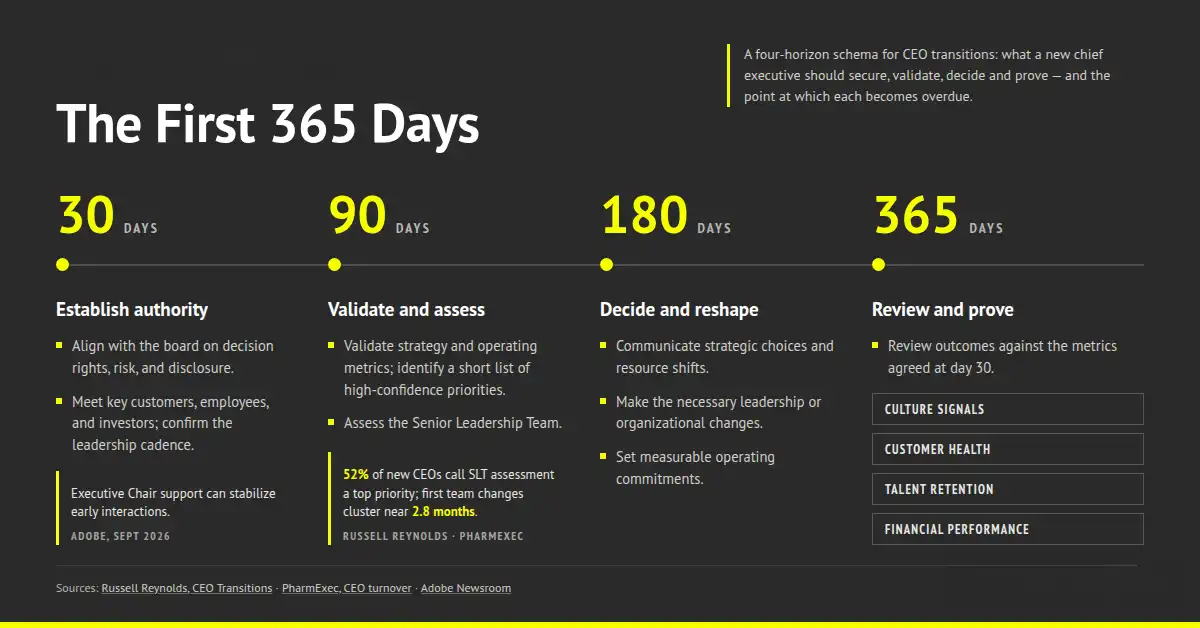
Combine continuity controls with a clear mandate for change. The first year is fragile: there is a 50% chance a new executive will fail or leave within 18 months, so structure the work and communications deliberately Avenue Leadership.
30 days
- Align with the board on decision rights, risk, and disclosure.
- Meet key customers, employees, and investors; confirm the leadership cadence. Executive Chair support can stabilize early interactions, as at Adobe Adobe Newsroom.
90 days
- Validate strategy and operating metrics; identify a short list of high‑confidence priorities.
- Assess the Senior Leadership Team (SLT), a top priority for 52% of new CEOs Russell Reynolds. First team changes often occur around 2.8 months PharmExec.
180 days
- Communicate strategic choices and resource shifts. Make the necessary leadership or org changes and set measurable operating commitments.
365 days
- Review outcomes against agreed metrics, culture signals, customer health, talent retention, and financial performance.
Transition scorecard
Leading indicators: SLT alignment and cadence, decision velocity, customer executive coverage, top‑talent retention, roadmap milestones. Lagging indicators: NRR/GRR (Net Retention Rate/Gross Retention Rate), ARR (Annual Recurring Revenue) growth, gross margin mix, time‑to‑value, and progress on AI commercialization.
Top 5 Global Executive Search Firms for Technology Boards
A commonly recognized group of large global retained firms includes Korn Ferry, Spencer Stuart, Russell Reynolds Associates, Heidrick & Struggles, and Egon Zehnder. Rankings vary by revenue, reputation, board mandates, or CEO placements and can differ by sector and geography. Boards should prioritize sector expertise, assessment rigor, partner involvement, geographic coverage, conflict management, and measurable outcomes over name recognition.
Christian & Timbers is a US‑focused executive search and leadership advisory option for technology and AI‑driven businesses. Recent benchmarks include an average placement time of 72 days and a 97% retention rate at 12 months Christian & Timbers Guide. For high‑stakes CEO work, select the partner, not just the brand, that matches your context.
Best Practices for CEO Succession Planning Before a Transition
Make succession a standing agenda item and tie it to strategy refresh cycles.
- Define a future‑oriented CEO success profile and update it as strategy evolves.
- Review internal candidates annually with consistent assessment criteria; create development assignments spanning customers, capital allocation, operations, regulation, and board exposure.
- Maintain emergency and interim options, ready‑now candidates, and 1‑3 year horizon leaders.
- Run board‑level simulations and test a sequenced communication plan for employees, leadership, investors, customers, and partners The Board Practice Paradigm Personality.
- Use independent assessment and market intelligence to challenge internal assumptions. Document decision rights, confidentiality, milestones, and owner assignments.
Stability has value. Data from Korn Ferry shows companies that maintain stability without a CEO change have outperformed those with new CEOs on stock growth, a reminder to weigh change benefits against disruption costs Korn Ferry.
How Christian & Timbers Approaches Technology CEO Succession
We partner with boards to define the success profile, assess internal and external candidates, map the market, and manage confidential CEO searches. Our work emphasizes technology depth with business relevance, evidence‑based assessment, and close senior‑partner involvement to align the board, leadership team, and stakeholders.
We use AI‑enabled OnPoint Scorecarding to translate strategy and culture into measurable criteria, then calibrate candidates against those requirements. Our retained model aligns resources to outcome milestones; typical fees range from 20% to 35% of annual compensation Pricing Overview. Benchmark metrics include a 72‑day average placement time and 97% 12‑month retention Executive Search Guide.
If you chair a board or compensation committee and want a confidential succession readiness discussion, we welcome a conversation.
FAQ: Adobe CEO Transition and Technology Succession Planning
Has Adobe announced a new CEO in 2026? Yes. Adobe announced that Anil Chakravarthy will become President and CEO effective December 1, 2026, and that Shantanu Narayen will become Executive Chair Adobe Newsroom.
Why does the transition matter to enterprise software companies? Leadership changes reset strategy, product focus, and capital allocation during an AI build‑out cycle that reached an estimated $650 billion in 2026, and amid rising agentic AI usage that may alter software interfaces Medium analysis Fast Company.
How do boards evaluate internal vs external CEO candidates? Use a forward‑looking scorecard. Consider cost and risk: external hires are 18% to 33% more expensive and show higher failure rates than internals, while internal CEOs tend to have longer tenures Sigma Assessment Systems Sterling Black PharmExec.
What capabilities matter most in an AI‑driven market? AI and data fluency tied to customer value, strategic judgment on where to invest or exit, enterprise operating leadership, ecosystem credibility, capital allocation discipline, culture leadership, and regulatory judgment Zinnov.
How long should CEO succession planning take? Treat it as continuous. Maintain emergency and interim options, ready‑now candidates, and a 1‑3 year bench reviewed at least annually The Board Practice.
When should a board engage an executive search firm? When benchmarking the internal bench against the market, preserving confidentiality, or designing a structured selection and onboarding process. Benchmarks include a 72‑day average placement time and 97% 12‑month retention from Christian & Timbers for comparable executive searches Executive Search Guide.
Conclusion
Adobe’s 2026 succession underscores a core governance truth: CEO transitions are strategic inflection points. The board’s six‑month process, the appointment of an internal successor for AI‑era execution, and the use of an Executive Chair to stabilize stakeholders map closely to best practice. For directors, three moves matter now: keep a living succession plan with emergency, ready‑now, and horizon candidates; define a future‑focused capability scorecard centered on AI commercialization and capital allocation; and manage the first 365 days with discipline across SLT alignment, customer engagement, and measurable outcomes. If you would like an outside perspective on your readiness or to benchmark your CEO pipeline, Christian & Timbers can help design the scorecard, assess candidates, and run a confidential market check.