



Forward Deployed Engineer used to describe a fairly specific kind of engineer. Now the title is being applied to roles that might previously have been called solutions engineer or machine learning engineer.
A company can believe it built a Forward Deployed Engineering function when it mostly renamed an existing one.
That distinction matters because the economic expectations around these teams are rising fast. Fewer than one in five companies report achieving meaningful ROI from their AI deployments, and only about one percent have deployed a system that generated or protected more than $100 million in value. Christian & Timbers projects demand for Forward Deployed Engineers to grow 2,100% by the end of 2026.
What an FDE Really Owns
Strip the title away, and the job comes down to one behavior: a hands-on engineer works directly with the people running a workflow, builds a production system around it, drives adoption, and can sit with finance afterward and explain what changed in dollars.
The job requires software engineering and applied AI skills, along with an understanding of workflow design and financial accountability. Technical depth and business fluency get someone in the room. What keeps them there is credibility that holds up with a frontline operator on Monday and the board on Friday.
The word carrying the weight in the title isn't "engineer." It's "deployed." OpenAI describes its own FDEs as owners of the full deployment lifecycle, from discovery through production rollout and measured impact. Anthropic makes the same point about its own enterprise strategy: putting a frontier model into core operations takes hands-on engineering and a working knowledge of how the business really runs.
A working demo says very little about what happens next. An integration gets blocked by security, or the requirements turn out to have missed half the exceptions that only show up once real users touch the thing. The FDE is still responsible for getting the system through those problems and into use, then showing what changed economically.
Why the Definition Matters Now
Capital is already flowing into enterprise deployment. Anthropic announced an enterprise AI services venture, reported by the Wall Street Journal to be valued at $1.5 billion, backed by Blackstone, Hellman & Friedman, Goldman Sachs, and other investors. OpenAI's Deployment Company was reported to be raising $4 billion at a $10 billion valuation. Both are investing in the people and infrastructure needed to deploy frontier models inside enterprises.
Companies aren't just experimenting with this model at the edges anymore. They're starting to institutionalize it. Christian & Timbers' 2026 study, America's Most Wanted Enterprise AI Talent, shared exclusively with TechCrunch, found companies moving from pilot teams of two or three engineers toward permanent deployment organizations of 20 to more than 100 FDEs. That changes the cost of getting the definition wrong. Misclassifying one hire is a hiring mistake. Building a 50-person FDE function around the wrong profile is an operating-model problem.
The same study put a number on the supply side: roughly 17,000 people sit in the broader U.S. FDE market, and only about 2,000 have repeatedly translated enterprise AI deployments into documented business value. Washington Technology later cited Christian & Timbers’ findings in its coverage of the FDE talent shortage.
"Companies don't have an AI problem. They have a talent problem," said Jeff Christian, founder of Christian & Timbers, after the firm spoke with more than 250 C-suite executives and 300 AI engineers over six months. "There are only about 2,000 people in America who've repeatedly proven they can walk into an enterprise, deploy AI into production, and deliver measurable ROI."
The market is expanding faster than companies are agreeing on what counts as an FDE.
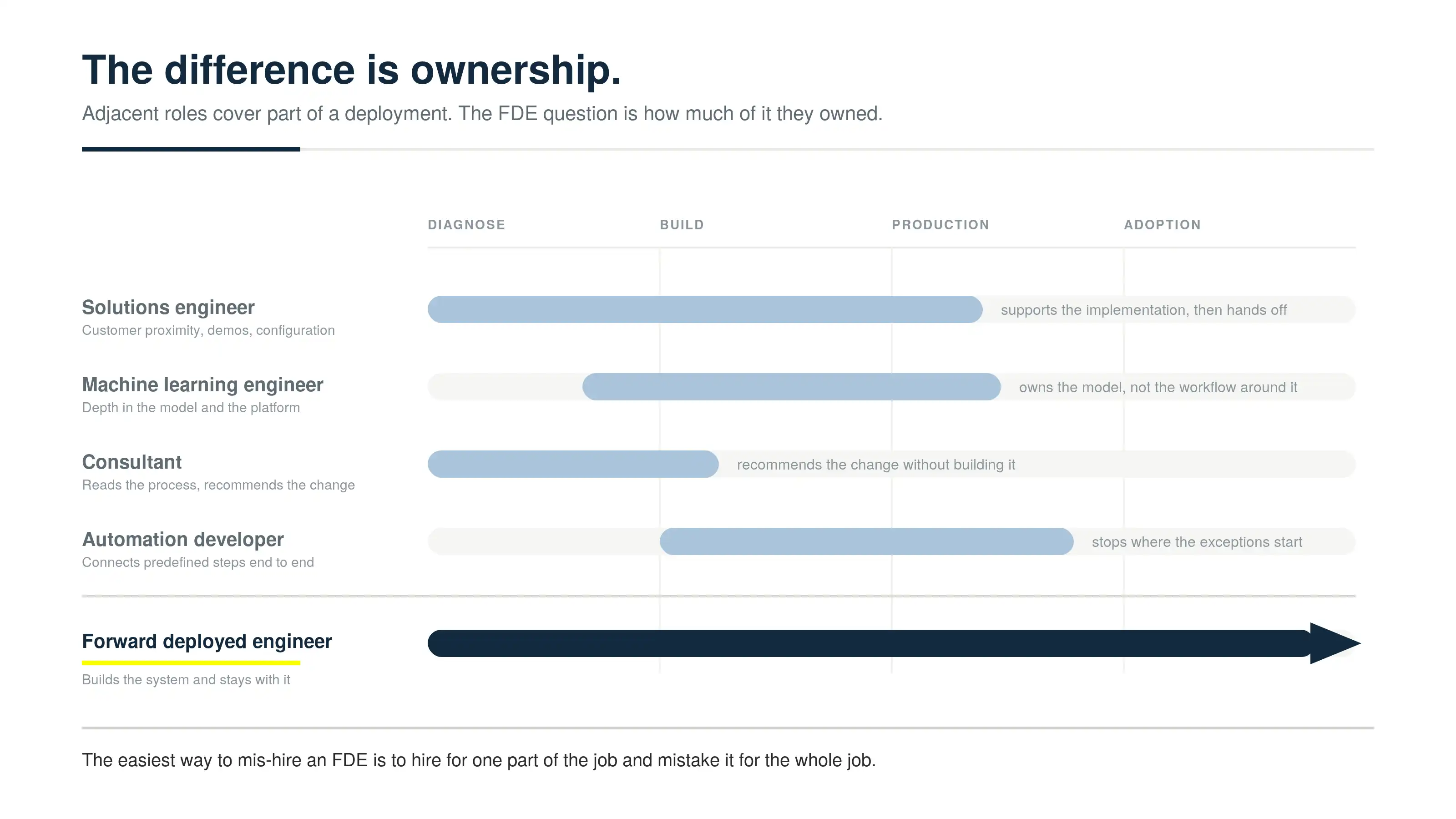
FDE vs. Adjacent Roles: The Difference Is Ownership
The easiest way to mis-hire an FDE is to hire for one part of the job and mistake it for the whole job.
Solutions engineers bring customer proximity and may support technical sales, demonstrations, configuration, or implementation. The FDE distinction is continued ownership through production and adoption.
Machine learning engineers bring technical depth of a different kind. Their work may center on the model or platform, while an FDE works directly with the operators using it and takes responsibility for how that technology changes the workflow.
Consultants know how to read a process. They can diagnose a workflow and recommend how it should change, but an FDE has to build the system that changes it and remain accountable once it reaches production.
Automation developers may connect predefined steps across a process. FDE work extends into the exceptions, judgment calls, evaluations, controls, and adoption problems that show up once a complex workflow goes live.
The question is less about which adjacent role a candidate came from and more about how much of the deployment they owned.
The Title Is a Weak Hiring Signal
Some of the strongest FDE candidates never carried the title. They were Applied AI Engineers, Deployment Strategists, Founding Engineers, or Field Engineers. The assessment has to start with what they did.
Ask what workflow the person changed and what they personally built. Then follow the system into production:
- What failed along the way?
- Who adopted it?
- How did finance measure the result afterward?
A candidate who can describe the architecture but can't explain who adopted the system probably didn't own the full deployment. The same is true of someone who can describe adoption but can't explain what they personally built. And if the financial outcome exists only as an estimate, that tells you something different from a result finance has validated.
That's why title matching is particularly unreliable in this market. The evidence has to connect the technical work to the operating change and the economic result.
Why Sector Depth Changes the Outcome
Complex agentic workflows don't transfer cleanly across industries. A healthcare FDE needs to understand how clinical and administrative work moves through the organization. In financial services, the relevant workflow might sit in underwriting or fraud. In manufacturing, it could be maintenance, quality, or plant operations.
Some of the technical patterns transfer from one industry to another. The workflow knowledge usually doesn't, which is why a generalist FDE and a sector-fluent FDE aren't interchangeable even when their resumes look similar.
Why Internal FDE Teams Are Hard to Build
External deployment firms can compress the early learning curve while a company figures out where models create value. For a growing number of enterprises, the next step is bringing that deployment capability inside the company.
That's where the definition of an FDE starts to matter even more. Hiring generalist AI engineers and giving the team an FDE title doesn't reproduce the operating model. The company needs people who can work inside the workflow and build through production and adoption. Then they need to carry the result back to an economic baseline that finance can validate.
An internal team has an advantage when it works: workflow knowledge stays inside the company, and lessons from one deployment can carry into the next. But those benefits depend on building the right capability in the first place.
How We Evaluate FDE Talent
At Christian & Timbers, we start with production evidence. Has the candidate personally built complex AI systems and stayed with them through deployment and adoption?
We look for repeated examples rather than one successful project, and for depth that goes beyond the code. Do they know the business processes of their sector well enough to see where a workflow will break before it shows up in production?
They also have to hold up in the room, first with engineers and operating leaders, then in VP and C-suite conversations.
None of that means much without the numbers behind it. A candidate should be able to explain the baseline, what changed after deployment, how the result was attributed, and what that change was worth.
The market doesn't need more people with FDE in their title. Companies need engineers who can show what they deployed, who used it, what changed, and what it was worth.
Read Christian & Timbers' Elite FDE Scarcity Study, or contact us about building an internal FDE function.