

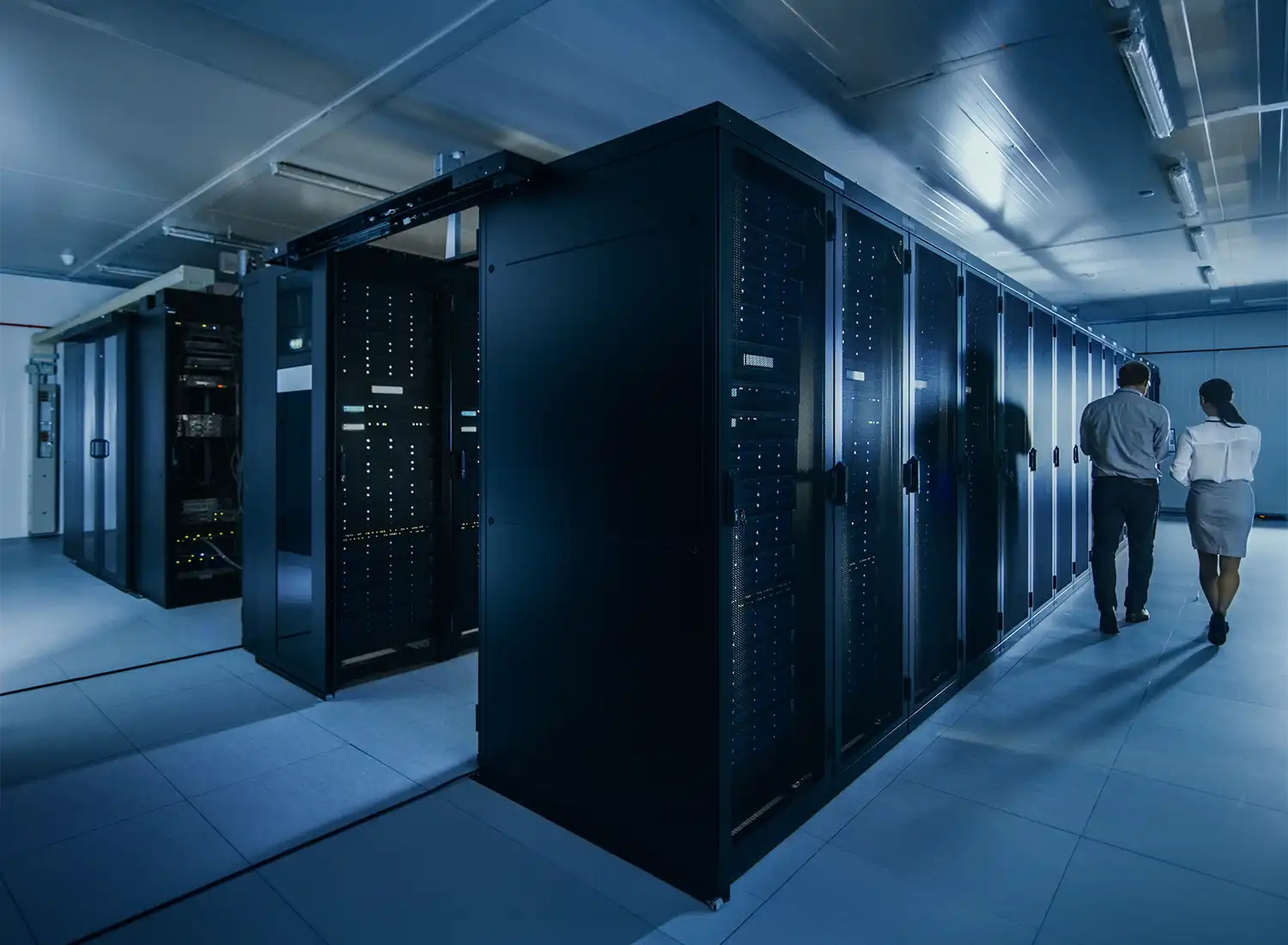
Data centers power the technology we use every day, including artificial intelligence, cloud computing, online services, and businesses around the world.
From 2026 to 2033, the demand for AI is expected to grow at a 30.6% CAGR.
As demand for AI continues to grow exponentially, companies are building larger and more complex data centers to meet the growing needs.
To meet those growing needs, companies also need experienced leaders who can manage construction, secure power, control costs, protect operations, and plan for growth.
Finding the right leadership can dictate whether a company experiences a successful expansion or an expensive setback.
This guide explains:
- Key leadership roles in the data center industry
- Skills executives need
- Challenges they face
- How companies can build leadership teams prepared for the future.
What Is Data Center Leadership?
Data center leadership is the executive management of the people, technology, facilities, and business operations that keep data centers running.
Data center executive leaders oversee everything, from daily operations and equipment maintenance to major construction projects and long-term business growth.
Their work often includes:
- Keeping facilities running without unexpected downtime
- Managing electricity, cooling, and other critical systems
- Planning new data center construction and expansion
- Protecting facilities and information from security threats
- Managing budgets, investments, and operating costs
- Hiring and developing technical and management teams
- Meeting customer needs and business goals
Every company is different, so the data center leadership structure depends on the company. For example, a small data center operator may have executives who manage several functions. On the other hand, a large hyperscale provider may need separate leaders for construction, engineering, operations, technology, and finance.
The most effective data center leadership teams will bring all of these areas together so the company can grow without putting reliability or financial performance at risk.
Why Data Center Leadership Matters in the Age of AI
Artificial intelligence has changed how data centers need to support companies.
AI systems often require powerful processors, advanced cooling, reliable electricity, and large amounts of computing capacity. To be able to building and operate the facilities that support these systems requires major investments and careful planning.
This creates new set of challenges for data center executives.
- Power availability. Leaders need to work with utilities, plan for future energy demand, and make decisions about where to build.
- Construction speed. Delays in permits, equipment, and construction can prevent companies from bringing new capacity online.
- Operating costs. Electricity, cooling, maintenance, and staffing affect profitability.
- Reliability. Short interruptions can disrupt customers and create financial losses.
- Technology changes. Know when invest in new infrastructure, including advanced cooling and high-density computing systems.
- Talent shortages. There are not enough talent who understands these complex environments.
These challenges make leadership decisions especially important for boards and investors.
A company may have the capital to build new facilities, but without the right data center leadership to turn investmentsinto reliable, profitable operations, capital doesn’t matter.
Key Data Center Executive Leadership Roles
A strong data center leadership team connects business, technology, engineering, operations, and financial experience in a synergisic way that brings increased profit.
The following are some of the most important executive roles in data center leadership:
Chief Executive Officer (CEO)
The CEO leads the company's overall business strategy.
In a data center company, the CEO may be responsible for:
- Securing investment
- Entering new markets
- Managing major customer relationships
- Deciding how quickly the company should expand
Successful data center CEOs need strong business judgment and an understanding of the industry's technical and financial challenges.
Experience managing large investments and complex operations can be especially valuable for business expanding rapidly.
Learn more about CEO executive search.
Chief Operating Officer (COO)
The COO oversees business operations and ensures facilities operate safely, reliably, and efficiently.
Data center COO responsibilities may include managing:
- Multiple sites
- Improving operating procedures
- Reducing downtime
- Coordinating teams across different locations
A strong COO understands expands operations without losing control of quality, safety, or costs.
Chief Technology Officer (CTO)
The data center CTO guides the company's technology strategy.
Depending on the business, this may include:
- Computing infrastructure
- Networking
- AI workloads
- Automation
- Technology investments
AI continues to change and affect data center requirements. So CTOs increasingly need to understand how new hardware and computing demands affect infrastructure decisions.
The best CTO candidates connect technical decisions to business goals.
Chief Financial Officer (CFO)
A lot of capital is required for data center development.
The CFO oversees:
- Financing
- Budgets
- Investment planning
- Financial reporting
- Financial risks of expansion
They help companies evaluate construction costs, operating expenses, debt, and expected returns.
When finding an executive for private equity-backed companies, the CFO reports to investors and creates long-term value.
Chief Information Security Officer (CISO)
The CISO leads cybersecurity and information security strategy, and it’s a very important role.
Data centers must protect systems, customer information, and critical infrastructure against security threats.
A CISO:
- Establishes security policies
- Manages risk
- Prepares for incidents
- Meets customer and regulatory requirements
Chief Commercial Officer (CCO) or Chief Revenue Officer (CRO)
Commercial leaders, like the CCO and CRO, are responsible for customer growth and revenue.
They oversee:
- Sales
- Customer relationships
- Pricing
- Partnerships
- Long-term contract
These data center leaders help turn available capacity into revenue.
VP of Data Center Operations
The VP of Data Center Operations manages the performance of one or more facilities.
This leader focuses on:
- Uptime
- Maintenance
- Safety
- Staffing
- Emergency response
- Consistent operating standards
Companies expanding across multiple locations need operations executives who can effectively manage larger teams while maintaining reliable service.
VP of Engineering and Infrastructure
Engineering leaders oversee the technical systems that support data center operations.
Their responsibilities may include:
- Electrical systems
- Cooling
- Mechanical infrastructure
- Equipment upgrades
- Facility design
As computing demands increase, experience with high-density systems and advanced cooling becomes more important.
VP of Data Center Development and Construction
Development and construction leaders oversee the planning and delivery of all new facilities.
They manage:
- Site selection
- Permitting
- Contractors
- Construction schedules
- Equipment suppliers
- Project budgets.
This role directly affects how quickly the business begins serving customers which clearly affect profitability.
Essential Skills Every Data Center Leader Needs
Data center executives need to make decisions that protect the business and support long-term growth, while also having technical experience.
1. Operational Reliability
Reliable operations are essential to the data center business. Leaders need to understand how to prevent equipment failures, prepare for emergencies, and respond when problems occur. Having experience with maintenance programs, incident response, and critical systems is especially valuable.
2. Power and Energy Management
Electricity is one of the most important factors in data center operations.
Leaders must understand power availability, energy costs, utility relationships, and long-term capacity planning.
And for companies developing new sites, access to power can be just as important as access to land.
3. Financial Management
Data center leaders often make decisions that involve large investments.
Always keeping in mind budgets, operating costs, financing, and the financial impact of delays is essential.
Executives need to be able to clearly explain how their decisions affect profitability and long-term business value.
4. Technical Knowledge
Data center executives do not all need to be engineers, but they must understand the tech and systems that affect their role and responsibilities.
Tech and systems include include electrical infrastructure, cooling, networking, cybersecurity, automation, and AI computing requirements.
5. Team Leadership
An experienced team of people are what makes a data center successful. Successful executives know how to hire strong teams, train employees, set clear expectations, and develop future leaders which is critical for long-term success..
They also know how to manage teams across different departments and locations.
6. Strategic Planning
Data center leaders must always be planning for growth while also managing present-day needs. Because growth is inevitable and will continue.
Data center leaders need to anticipate customer demand, changing technology, construction requirements, and future investments.
Good planning helps companies avoid expensive mistakes while prepare for new opportunities.
How Data Center Leadership Changes as Companies Grow
A company's leadership needs change as it moves from development to large-scale operations.
[Table 1]
Keep in mind that these stages are not fixed rules, they are a planning framework. For example, a company may need specialized executives earlier at an early stage because of its customers, technology, or ownership structure.
The key is to hire for the problems the company will face next.
The Biggest Challenges Facing Data Center Leaders
- Securing Enough Electricity
Data centers require dependable electricity. AI infrastructure can place additional pressure on power systems. So data center executives must work with energy providers, understand grid limitations, and make decisions about future power needs.
Even when a company has funding and customer demand, power constraints and delay projects which prevents growth. Good leader know how to avoid this.
Building Facilities Fast Enough
Data center construction involves land, permits, specialized equipment, contractors, and utility connections. Problems in any one of these areas can delay an entire project and prevent profitability. Data center leadership should understand how to manage these risks and keep construction moving.
Managing Cooling and Higher Computing Demands
Powerful computing systems produce significant heat, so understanding how cooling affects reliability, energy use, and facility design is extremely important.
For companies building infrastructure to support advanced AI workloads, this is especially important.
Finding Qualified Leaders
The data center industry needs executives with a rare combination of technical knowledge, operational experience, and business leadership.
Finding people with all three can be difficult. Christian & Timbers finds executives with this rare combination of skills and experience.
Companies may need to look beyond traditional data center operators to identify candidates who are qualified. There are more candidates out there if you know what to look for.
Balancing Growth With Reliability
Rapid expansion creates opportunities, but also puts pressure on existing teams.
Executives must make sure new facilities, employees, and processes meet the same standards as established operations as growth is happening.
Growth should never come at the expense of safety, customer trust, or reliability.
How to Build a Strong Data Center Leadership Team
Building a data center leadership team starts with understanding the company's business goals.
Step 1: Identify the Company's Biggest Challenges
Determine what the company needs that person to accomplish.
Is the business:
- Building new facilities?
- Expanding internationally?
- Improving operations?
- Raising capital?
- Preparing for an acquisition?
Different challenges require different leadership experience.
Step 2: Define the Responsibilities of Each Role
Data center companies often have overlapping responsibilities across operations, technology, engineering, and development.
Defining the responsibilities of each role clearly helps executives make decisions faster and avoid confusion.
Before recruiting, determine who will own each major business function and how leaders will work together.
Step 3: Look Beyond Traditional Data Center Companies
Some of the strongest job candidates may come from related or similar industries.
For example, energy, telecommunications, cloud infrastructure, semiconductors, and advanced manufacturing all develop leaders with useful experience.
But previous industry doesn’t determine future success. The right background depends on the position and the problems the company needs to solve.
Step 4: Evaluate Results, Not Just Job Titles
A candidate's previous job title does not tell the full story.
Companies need to thoroughly examine what executives have actually previously accomplished.
Have they brought facilities online? Managed large budgets? Improved reliability? Led expansion? Built successful teams?
Specific, proven results provide a clearer picture of leadership ability.
Step 5: Plan for Future Leadership Needs
Ultimately, executive hiring needs to support the company's long-term strategy.
For example, a company planning major expansion may need to develop its next generation of operations, engineering, and regional leaders before new facilities open.
Succession planning for tech companies ahead reduces hiring pressure and improves continuity.
How to Evaluate Data Center Executive Candidates
An effective executive hiring process should measure a candidate's experience against the company's actual needs.
Use a consistent scorecard so every candidate is evaluated against the same requirements.
[Table 2]
Interview Questions for Data Center Leadership Candidates
Boards and hiring managers should ask questions that reveal how executives make decisions.
- What is the most complex data center project or operation you have led?
- How have you managed a major equipment failure or service disruption?
- What steps have you taken to improve operating efficiency?
- How would you handle a construction delay caused by limited power availability?
- How do you decide when a new technology is worth the investment?
- How have you built and retained technical leadership teams?
- What would your priorities be during your first 90 days?
Strong candidates should provide specific examples, explain their decisions, and describe measurable outcomes.
Where Can Companies Find Data Center Leadership Talent?
Companies should look for executives with experience that matches the business's needs. Sometimesthat experience comes from outside the data center industry.
Potential talent sources include:
Cloud and hyperscale infrastructure: Leaders experienced in large computing environments, reliability, and technical operations.
Energy and utilities: Executives who understand electricity supply, infrastructure planning, and relationships with energy providers.
Telecommunications: Leaders with experience in networks, distributed infrastructure, and reliable service delivery.
Semiconductors and advanced manufacturing: Executives familiar with complex technology, capital-intensive operations, and large engineering teams.
Construction and industrial infrastructure: Leaders who have delivered major projects involving complex equipment, contractors, and schedules.
Not every executive from these industries will be a good fit.
Companies must evaluate whether data center leadership candidates can apply their experience to the specific technical, financial, and operational demands of a data center business.
Data Center Leadership Succession Planning
Hiring the right type of data center leadership executive is important. And then preparing for that person's eventual departure is just as important for a seamless transition.
Data center companies depend on experienced leaders who understand their facilities, customers, and operating risks.
When a key executive leaves unexpectedly, the company faces delays, uncertainty, and additional pressure on remaining employees.
A strong succession plan should:
- Identify roles that are critical to business continuity.
- Develop internal candidates for future leadership positions.
- Document important responsibilities and decision-making processes.
- Review leadership needs as the company expands.
- Prepare for both planned transitions and unexpected departures.
Boards should review succession plans regularly, especially when companies are building new facilities or entering new markets.
How Christian & Timbers Helps Companies Recruit Data Center Leaders
Finding qualified data center executives requires a deep understanding of both technology and business leadership.
Christian & Timbers is an executive search firm, that specializes in tech and AI, and has more than 40 years of experience recruiting senior leaders.
The firm has completed more than 5,000 C-suite searches and placed more than 700 CEOs across its broader executive search work.
Christian & Timbers works with companies across artificial intelligence, technology, and private equity, helping organizations identify leaders who can manage complex operations and support business growth.
Its data center executive search practice supports organizations across hyperscale infrastructure, AI data centers, colocation, cloud infrastructure, and data center development.
Read about Christian & Timbers approach to executive search
Frequently Asked Questions About Data Center Leadership
What is data center leadership?
Data center leadership is the management of the people, technology, facilities, and business operations that support data centers. Leaders oversee reliability, engineering, construction, security, finances, and growth.
What are the most important leadership roles in a data center?
Important roles include the CEO, COO, CTO, CFO, CISO, VP of Data Center Operations, VP of Engineering, and VP of Data Center Development. The right leadership structure depends on the company's size, business model, and growth plans.
What skills do data center leaders need?
Data center leaders need strong decision-making, team management, financial judgment, and an understanding of critical infrastructure. Depending on their role, they may also need expertise in electrical systems, cooling, construction, cybersecurity, or AI computing.
How is AI changing data center leadership?
AI is increasing demand for computing capacity, electricity, and advanced cooling. Data center executives must plan for these needs while managing construction costs, reliability, and long-term business growth.
Why is data center leadership recruitment challenging?
Qualified executives need a rare combination of technical, operational, and business experience. Rapid industry expansion increases competition for candidates who have successfully managed complex facilities and large investments.
Can data center executives come from other industries?
Yes. Leaders from cloud computing, energy, telecommunications, semiconductors, and advanced manufacturing may have relevant experience. Companies should evaluate their actual accomplishments and ability to adapt to data center operations.
How should companies choose a data center executive?
Companies should first define the problems the executive must solve. Then they should evaluate candidates based on relevant experience, measurable results, leadership ability, and their approach to managing business risk.
How can companies improve data center leadership retention?
Companies can improve retention by offering competitive compensation, clear responsibilities, career development, realistic performance goals, and opportunities for growth. Strong succession planning also helps maintain leadership continuity.
Build Your Data Center Leadership Team With Christian & Timbers
Data center companies are getting more opportunities at a rapid pace with the growth of AI and digital infrastructure. They need leaders who manage complex tech, build reliable operations, protect investments, and prepare for growth.
Christian & Timbers identifies and recruits executives with the experience needed for rapid data center growth.