



Key Takeaways
- Enterprise AI is pushing data center leadership beyond facilities management. Power procurement and capital allocation now shape how quickly organizations can scale AI infrastructure.
- AI-native infrastructure leaders connect capacity decisions with enterprise AI deployment. Boards are looking for executives who can manage complex operating environments while helping AI initiatives move into production and expand across the business.
Artificial intelligence has changed what it takes to lead a modern data center. Every new hyperscale campus requires executives who can secure power contracts and align infrastructure investment with rapidly evolving AI workloads. Boards that once evaluated data center leaders primarily on uptime and operational efficiency now expect fluency in energy markets and long-term capital planning. As the role has shifted from operations management to infrastructure strategy, executive search has had to evolve alongside it.
The pace of investment reflects that transformation. Global data center capital expenditure is on pace to exceed $1 trillion in 2026, driven by hyperscale AI deployment, according to Dell'Oro Group. BloombergNEF estimates that the world's largest data center developers will invest nearly $750 billion this year, with more than 23 gigawatts of capacity under construction worldwide.
Why Executive Hiring Has Changed
Unlike previous data center expansion cycles, AI infrastructure requires much higher power density and closer coordination with semiconductor supply chains. Those changes have expanded the responsibilities of infrastructure leaders well beyond traditional facilities management.
Traditional data center leadership centered on reliability: servers running, contracts renewed, maintenance on schedule. AI workloads introduce a different set of constraints. Power density per rack has climbed as GPU clusters replace conventional servers, and energy access now determines where a facility can be built at all. Chip refresh cycles that once ran on multi-year timelines now shift with each new accelerator generation. Leaders must plan procurement and depreciation against a moving target.
Goldman Sachs estimates the AI infrastructure build will require close to $7.6 trillion in capital between 2026 and 2031 across compute, data centers, and power, according to the Goldman Sachs Global Institute. A leader managing that scope needs fluency in energy markets and capital allocation. Boards are discovering that the skill set built for the pre-AI data center era does not always transfer cleanly to this one.
The constraint is already visible in practice. Microsoft disclosed an $80 billion backlog of Azure orders it cannot fulfill due to power availability, not demand, according to Futurum. When the largest cloud provider in the world cannot build fast enough because of power, not capital or chips, the argument for power-fluent infrastructure leadership stops being theoretical.
AI-Native Infrastructure Leadership
Some organizations are creating a dedicated Chief Infrastructure Officer role, while others are expanding the mandate of an existing CTO or COO to encompass compute capacity and construction timelines, rather than splitting those responsibilities across facilities, IT, and real estate functions. Around this shift, companies are also building out VP of Infrastructure and VP of AI Infrastructure positions to support the expanded mandate.
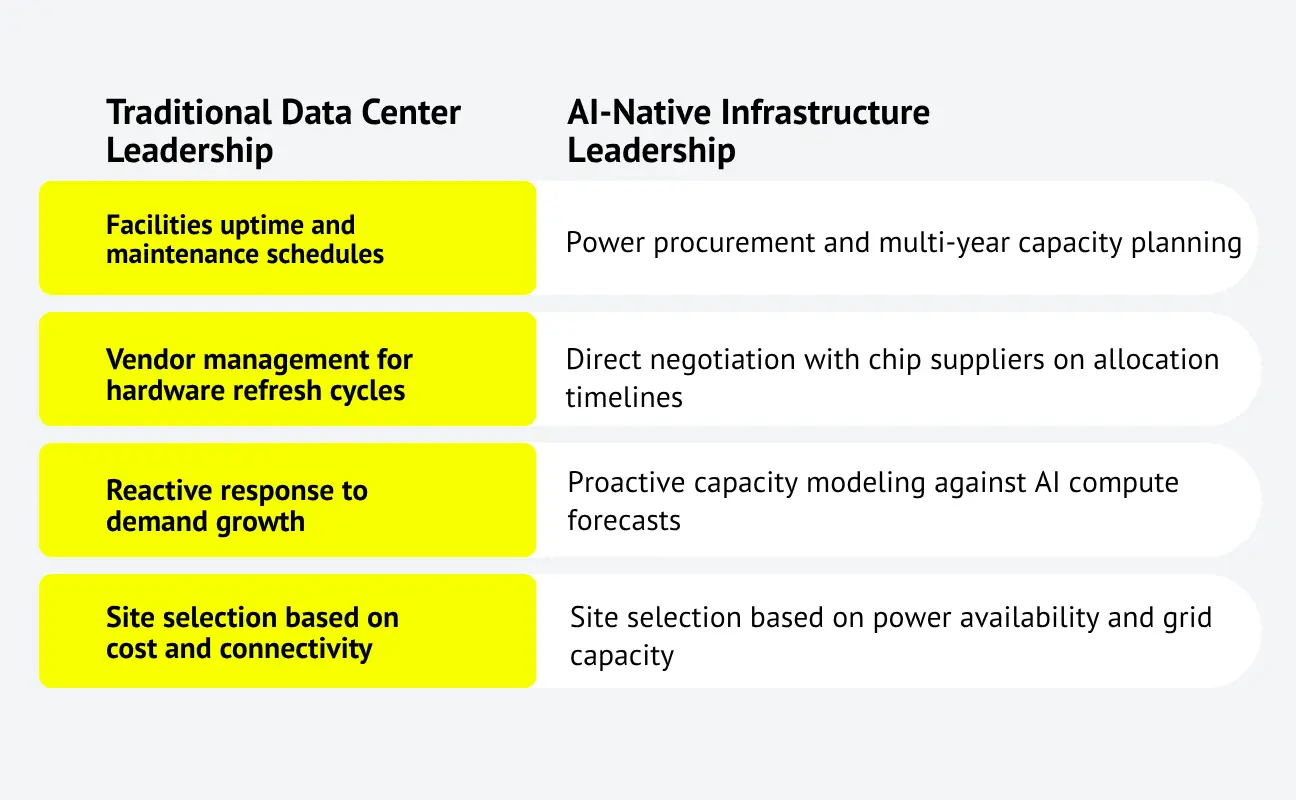
These roles sit where energy infrastructure meets technology strategy, a combination most executive rosters were never built to cover.
What Makes an AI-Native Infrastructure Leader?
AI-native infrastructure leaders connect infrastructure decisions directly to how AI systems move into production. They understand the operational demands of large-scale AI environments and can assess how changes in models or business demand affect capacity decisions over time.
These leaders have often built their experience inside hyperscalers, semiconductor companies, cloud infrastructure providers, advanced manufacturing organizations, or other technology-intensive businesses where AI deployment directly influences infrastructure strategy. That background helps them make investment decisions under changing technical and commercial conditions, rather than treating infrastructure as a fixed operating environment.
Experienced leaders can also work across technical and business functions without losing depth in either. They help engineering and AI teams understand infrastructure constraints while giving boards and finance leaders a clearer view of where capacity investment is justified. That connection matters as AI moves into production, because infrastructure decisions can influence deployment speed and operating costs while determining how quickly an organization can expand successful AI initiatives. Leaders who align capacity investment with business demand can help AI initiatives expand without infrastructure becoming a constraint.
That mandate has grown more difficult as the underlying market has expanded. Deloitte estimates that data center power demand will climb from 47 gigawatts in 2025 to more than 176 gigawatts by 2035. At the same time, data center developers and power companies compete for overlapping pools of engineers, technicians, and computer specialists. The hiring pressure is already visible: 63% of data center executives cite a shortage of skilled infrastructure labor as their top hiring obstacle.
The Questions Boards Are Asking Their Infrastructure Leaders
Enterprise AI has changed the conversation inside the boardroom for infrastructure leadership too. Operational reliability remains a baseline expectation, but boards now expect executives to explain how power and capital decisions support AI demand and how capacity will be measured as programs grow.
Infrastructure decisions are now tied to broader enterprise AI governance. In Christian & Timbers market conversations, nearly 70% of companies with more than 50,000 employees had created an AI task force involving the CEO, CTO, CFO, and CHRO, with the Chief AI Officer included where that role exists. For infrastructure leaders, that structure raises the importance of explaining capacity and investment decisions in terms that connect technical constraints with enterprise priorities.
Global data center electricity consumption is projected to double between 2022 and 2026, according to the International Energy Agency, as reported by Futurum. That pace has put power planning at the center of board-level infrastructure discussions.
- Which facilities and markets should receive additional power and capital investment?
- Where is power availability likely to constrain AI deployment timelines?
- Which infrastructure investments should be scaled, redesigned, or discontinued?
- How should capacity performance be measured while AI demand is still evolving?
- Does the infrastructure organization have the data needed to plan power and compute investment consistently across sites?
What Differentiates Successful Leaders Today
The shift extends beyond any single company. Infrastructure investors and colocation providers are recruiting leaders with experience operating AI-scale environments rather than conventional enterprise facilities.
In May 2026, JLL strengthened its data center leadership team by naming Brandon Keesee as Managing Director of Hyperscale and Colocation Data Centers and promoting Michael Martin to Managing Director of Data Center Operations. Both bring operational backgrounds from large-scale technology and data center employers as JLL projects that global data center capacity could nearly double by 2030.
The appointments reflect growing demand for executives who have worked inside complex infrastructure environments where capacity decisions carry real operational and financial consequences. Experience with energy sourcing and complex expansion programs is becoming more relevant as AI infrastructure grows.
What Boards Discover During an AI Infrastructure Search
Experience doesn't always translate
Most infrastructure leaders have managed facilities and vendor contracts; overseeing power planning and compute capacity while AI deployments are actively expanding is a different and much rarer skill.
The talent pool is smaller than expected
Relevant candidates often come from a limited group of organizations where executives have already managed infrastructure decisions under rapidly changing AI demand. The broader AI-native talent market is also constrained. Lightcast Labor Analytics found that demand for AI-native builders exceeded available supply by 3.4x in Q1 2026. Christian & Timbers’ AI-Native Builder Report also found that time-to-fill for Staff and Principal AI-native roles runs 54 or more days longer than for comparable senior engineering roles.
Infrastructure searches can narrow the field further when the mandate also requires experience with large capital programs or complex operating environments.
Compensation assumptions may need recalibration
A constrained talent pool can create another challenge at the offer stage. Christian & Timbers’ 2026 Corporate AI Compensation Study found substantial variation in compensation for senior AI-native technology executives across public companies of different sizes.
2026 AI-Native Technology Executive Compensation Benchmarks
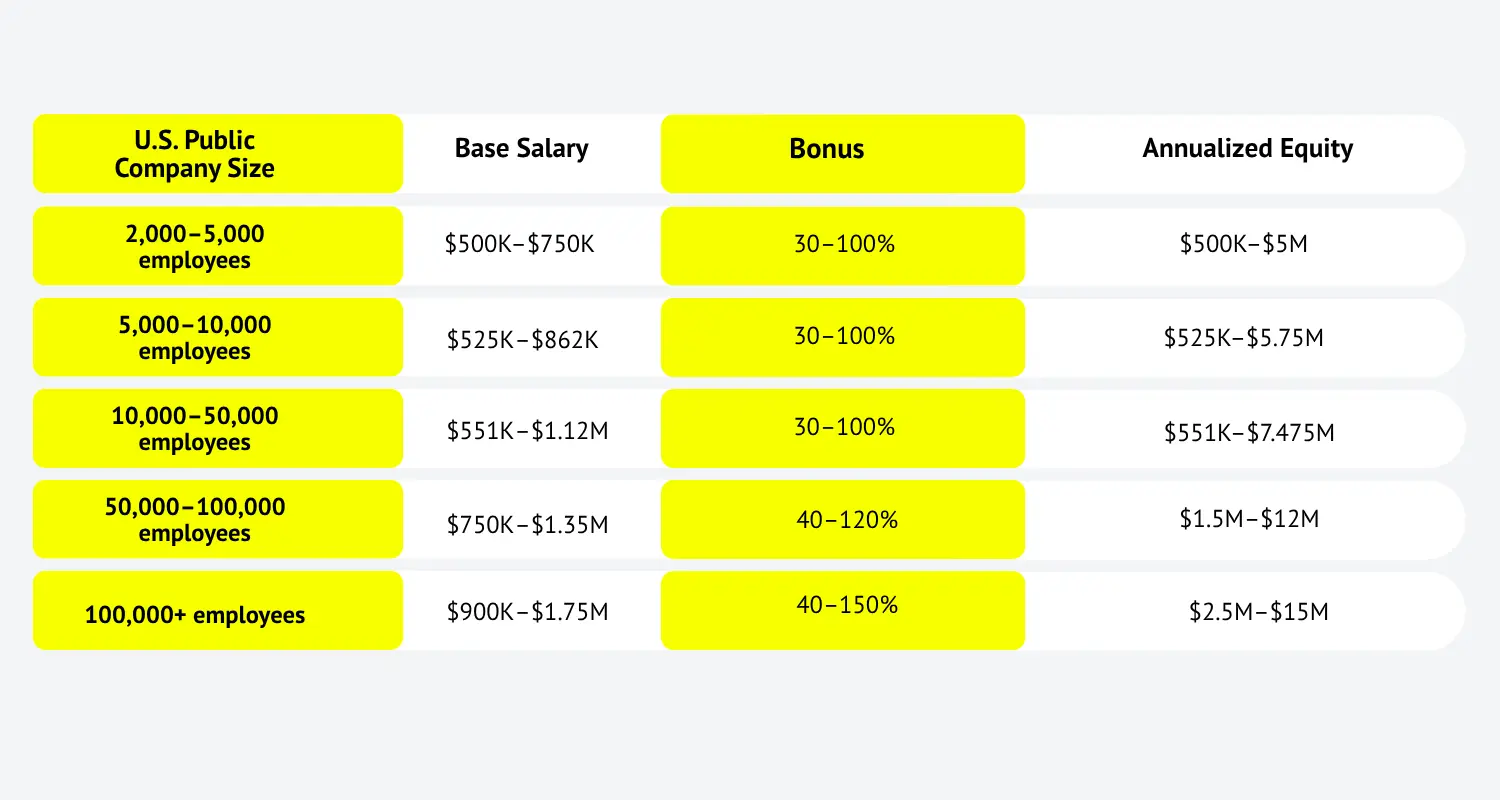
These benchmarks cover AI-native CTO, CIO, and Chief Digital and Data Officer roles reporting to the CEO, rather than infrastructure leadership as a separate category. They offer useful context when the infrastructure mandate overlaps with enterprise technology strategy and requires AI-native experience.
Boards evaluate different evidence
Instead of reviewing operational history alone, boards now ask candidates how they secured power, managed capital investment, and responded to changing AI demand. They also need evidence that infrastructure decisions helped AI systems move into production, with clear links to deployment speed, operating economics, or measurable business outcomes.
How Christian & Timbers Identifies AI-Native Infrastructure Leaders
Successful searches begin with organizational clarity. Before identifying candidates, boards need to define how AI changes the responsibilities of the role they are hiring. Christian & Timbers works with boards, CEOs, private equity firms, and infrastructure investors to understand how enterprise AI has changed the leadership an organization needs. Those conversations shape the search strategy and help identify the industries most likely to produce candidates with relevant experience.
Operational success alone is no longer enough. Christian & Timbers looks at how candidates led infrastructure while AI systems were moving into production. The firm examines decisions around power planning, infrastructure investment, and changing business priorities to understand how executives responded as enterprise AI programs expanded.
That same evaluation extends across Christian & Timbers’ broader AI-native placements. The firm placed Ashok Paranjothi as Senior Vice President of Artificial Intelligence at Acosta Group, an organization spanning more than 60,000 associates and seven agencies. Paranjothi built his AI leadership background over two decades at PepsiCo, where he most recently led the company’s global workplace AI function with responsibility spanning strategy, architecture, engineering, operations, and governance. At Acosta Group, his mandate includes enterprise AI strategy, a pragmatic AI Center of Excellence, and the expansion of AI as a governed capability across the business. His experience illustrates the kind of cross-functional operating discipline organizations now seek when AI systems must perform reliably across the enterprise.
Infrastructure hiring also influences the broader leadership team. Organizations often recruit Chief Technology Officers alongside Vice Presidents of Infrastructure or Vice Presidents of AI Infrastructure as AI programs expand. Looking at how those executives will work together can be just as important as assessing each role individually.
For boards competing for this talent, the search extends beyond traditional data center networks. Christian & Timbers combines AI-native executive search experience with access to leaders across software, semiconductors, advanced manufacturing, and other technology-intensive markets where AI is already reshaping infrastructure decisions.

Future Outlook
The AI infrastructure build is a multi-year commitment, and leadership planning will need to extend beyond individual expansion projects. As more organizations move AI systems into production, infrastructure leadership is likely to become a more permanent part of executive succession planning.
The next challenge will be building a deeper bench beneath these roles. Companies that rely on a small number of executives with deep AI infrastructure experience may face greater succession risk as demand for that talent grows. Boards will need to consider how internal leaders gain exposure to major capacity decisions before a critical vacancy emerges.
Questions Boards Ask About AI-Native Data Center Hiring
- What makes a data center executive “AI-native” rather than traditional?
An AI-native leader plans around power availability, chip supply timelines, and compute demand forecasting as core parts of the job. A traditional data center executive typically manages facilities and uptime without that level of involvement in energy and semiconductor strategy.
- Should this role report to the CTO, COO, or CFO?
Reporting lines vary by company structure, but the role needs direct access to capital planning discussions given the scale of investment involved. Some boards place it under the CTO for technology alignment, others under the COO for operational accountability, and a growing number are creating a standalone Chief Infrastructure Officer seat that reports directly to the CEO.
- What should boards prioritize when evaluating candidates?
Relevant candidates bring direct experience with hyperscale or large colocation environments, along with a demonstrated ability to plan capital investment years ahead of deployment and secure large-volume energy commitments.
- What industries are hiring AI infrastructure executives?
Demand spans hyperscalers, cloud providers, and semiconductor companies, along with utilities, colocation operators, and AI startups building dedicated infrastructure. Each faces a version of the same problem: too few executives who can plan power, compute, and construction together.
- Can a traditional data center executive become AI-native?
Yes. The transition depends on direct responsibility for AI-driven infrastructure investment. Executives who actively evaluate power and capacity decisions, work closely with technology and operating teams, and measure capacity outcomes throughout deployment can build the experience organizations expect.