



FDE job postings on Indeed jumped 729% year over year, from 643 postings in April 2025 to 5,330 in April 2026. That growth rate does not belong to a trending role. It belongs to a structural shift in how enterprises deploy AI, and what kind of talent makes the difference between a demo and a production system.
The Problem They Solve
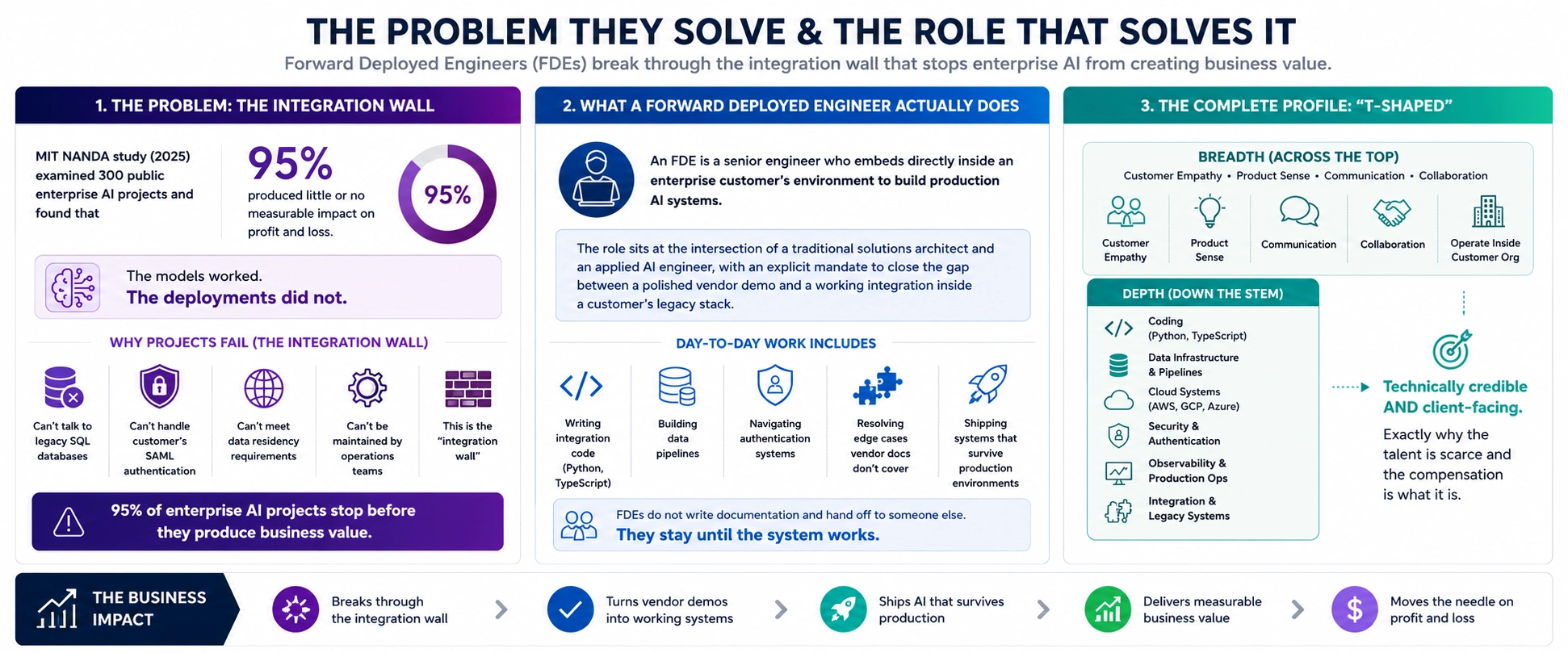
An MIT NANDA study published in 2025 examined 300 public enterprise AI projects and found that 95% produced little or no measurable impact on profit and loss. The models worked. The deployments did not.
The failure was not technical in the model sense. It was technical in the integration sense: AI systems that could not talk to legacy SQL databases, could not handle the customer's SAML authentication, could not meet data residency requirements, and could not be maintained by the operations teams who inherited them. This is the "integration wall", and it is where 95% of enterprise AI projects stop before they produce business value.
The Forward Deployed Engineer (FDE) is the professional category built specifically to dismantle that wall.
What a Forward Deployed Engineer Actually Does
An FDE is a senior engineer who embeds directly inside an enterprise customer's environment to build production AI systems. The role sits at the intersection of a traditional solutions architect and an applied AI engineer, with an explicit mandate to close the gap between a polished vendor demo and a working integration inside a customer's legacy stack.
The day-to-day work includes writing integration code (Python, TypeScript), building data pipelines, navigating authentication systems, resolving edge cases that vendor documentation does not cover, and shipping systems that survive contact with production environments. FDEs do not write documentation and hand off to someone else. They stay until the system works.
The complete profile is "T-shaped": deep technical skills across coding, data infrastructure, and cloud systems, combined with the customer empathy, product sense, and communication capability to operate inside a customer organization rather than behind a vendor firewall. That combination, technically credible and client-facing, is exactly why the talent is scarce and the compensation is what it is.
Why Every Major AI Company Is Hiring Them Now
In May 2026, OpenAI launched The Deployment Company, a $10 billion venture backed by TPG, Goldman Sachs, SoftBank, and BBVA, structured entirely around embedding engineers inside high-stakes enterprise deployments. Anthropic followed with a $1.5 billion joint enterprise services venture alongside Blackstone and Hellman & Friedman.
These are not consulting expansions. They are bets on a specific thesis: that the bottleneck to enterprise AI value is not model capability but last-mile deployment, and that the professional category that closes that gap will determine which AI companies build lasting enterprise relationships.
Salesforce publicly committed to hiring 1,000 FDEs. EY launched dedicated FDE roles in April 2026. Palantir, Databricks, Cohere, Ramp, and Rippling are all building dedicated FDE functions. As of mid-2026, 224 open FDE roles span 39 AI companies, and that number reflects only the roles posted, not the passive hiring activity at organizations that have not yet written the job description.
What FDEs Earn
Compensation reflects the scarcity. Christian & Timbers' Elite FDE Compensation Study places elite FDE compensation at $586K–$1.45M.
The premium exists for a single reason: you are paying for an engineer who can manage a multi-million-dollar enterprise relationship while shipping production code under pressure.
Why This Hire Is Hard
FDE talent is scarce for structural reasons that standard recruiting processes do not address well.
The population of engineers who combine production-level AI integration experience with client-facing credibility is small. Most strong engineers prefer building products over deploying them inside customer environments. Most strong client-facing professionals lack the technical depth to navigate legacy integration complexity. The FDE profile requires both, at the level that production enterprise deployments demand.
The best FDE candidates are inside Palantir, OpenAI, Anthropic, and Databricks, succeeding in their current roles and not updating their LinkedIn profiles. Reaching them requires direct professional relationships in the applied AI and enterprise integration engineering community, not job postings. Organizations that are treating FDE searches the way they treat standard software engineering hires are discovering that the process does not work at the pace or quality level the role requires.
The assessment challenge compounds the sourcing challenge. FDE candidates interview well. The technical vocabulary of AI deployment, LLM evaluation, RAG architecture, and enterprise integration is learnable without the production experience that distinguishes a strong FDE from someone who has read about the work rather than done it. Reference verification from the engineering leads, product managers, and enterprise customers who observed the candidate's actual deployment work is the most reliable signal in FDE evaluation.
How Christian & Timbers Finds FDEs

Christian & Timbers has built its AI leadership practice at the intersection of executive search and the applied AI and engineering communities that define this talent category. Its sourcing for FDE and AI-native builder roles draws from direct relationships in the enterprise AI deployment community at the companies that have been doing this work the longest: Palantir, OpenAI's deployment teams, major systems integrators running AI practices, and the applied ML and infrastructure engineering communities adjacent to them.
Its assessment methodology for FDE candidates focuses on production evidence: specific enterprise deployments the candidate shipped, the integration complexity they navigated, the customer environments they operated in, and the references from the technical and commercial stakeholders who observed the work firsthand.
For organizations building an FDE function or hiring their first Forward Deployed Engineers, Christian & Timbers offers a confidential market assessment covering candidate availability, compensation benchmarks, and profile requirements before any search engagement begins.