


Most AI assessments end the same way: a deck and a maturity score, then a consultant who leaves once the invoice clears. The organization knows more about its gaps than it did before, and still has no agent running in production six months later. The market is full of providers promising to solve that problem, but they approach AI assessment very differently. Some focus on governance and strategy, others on enterprise transformation, and a few are built to move directly into deployment. This guide compares the leading AI readiness and assessment providers in 2026, looking at what each evaluates, how the engagement is structured, and what happens after the assessment is complete.
Key Takeaways
- 60% of companies say their AI investments have delivered little material value in revenue or cost savings, according to a 2025 global survey reported by MIT Sloan Management Review. A structured assessment exists to keep an organization out of that group.
- A separate Gartner survey of more than 4,200 business and technology leaders found only 48% of digital initiatives met or exceeded their targeted outcomes, a pattern MIT Sloan Management Review reports holds even more strongly for AI-specific investments.
- Deployed Labs runs its assessment against two readiness checks: how well documented and change-ready an organization's workflows and workforce already are, and how compatible its tech stack is with deployment.
Why AI Assessments Are in Demand Right Now
Enterprise AI spending has outpaced enterprise AI results. A 2025 global survey reported by MIT Sloan Management Review found that 60% of companies say their AI investments have delivered little material value in revenue or cost savings. A separate Gartner survey of more than 4,200 business and technology leaders found only 48% of digital initiatives met or exceeded their targeted outcomes, a pattern MIT Sloan Management Review reports holds even more strongly for AI-specific investments. That gap is why assessment work has turned into a standing line item on the AI budget instead of a one-time diagnostic: organizations want to know where a workflow will pay back before committing further spend.
What an AI Assessment Needs to Answer
A useful assessment answers two things:
- Which workflows are worth automating first?
- Whether the organization, its people, and its systems can absorb the change fast enough to matter?
What it costs to find out for real is the quieter third question most providers skip. A lot of providers stop at the first one. They hand back a heat map of "high potential" processes and leave the harder parts, the change management and the systems integration, for a second contract.
That gap is why so much AI work stalls after a promising pilot. The MIT Sloan research above points to the same root cause across dozens of organizations: the technology mostly works, and the readiness around it usually doesn't.
How We Evaluated These Firms
This guide includes consulting firms and specialist AI assessment providers that publicly offer enterprise AI readiness, AI maturity, or AI assessment services. Firms were selected based on publicly available methodologies, enterprise delivery experience, and established market presence. The guide focuses on providers with established enterprise offerings and is designed to help buyers compare today's market.
Each firm was evaluated on three criteria: whether the assessment is offered as a standalone engagement or bundled into a larger program, what scoring model or framework it uses, and the stated path from assessment to execution. The providers are presented in alphabetical order.
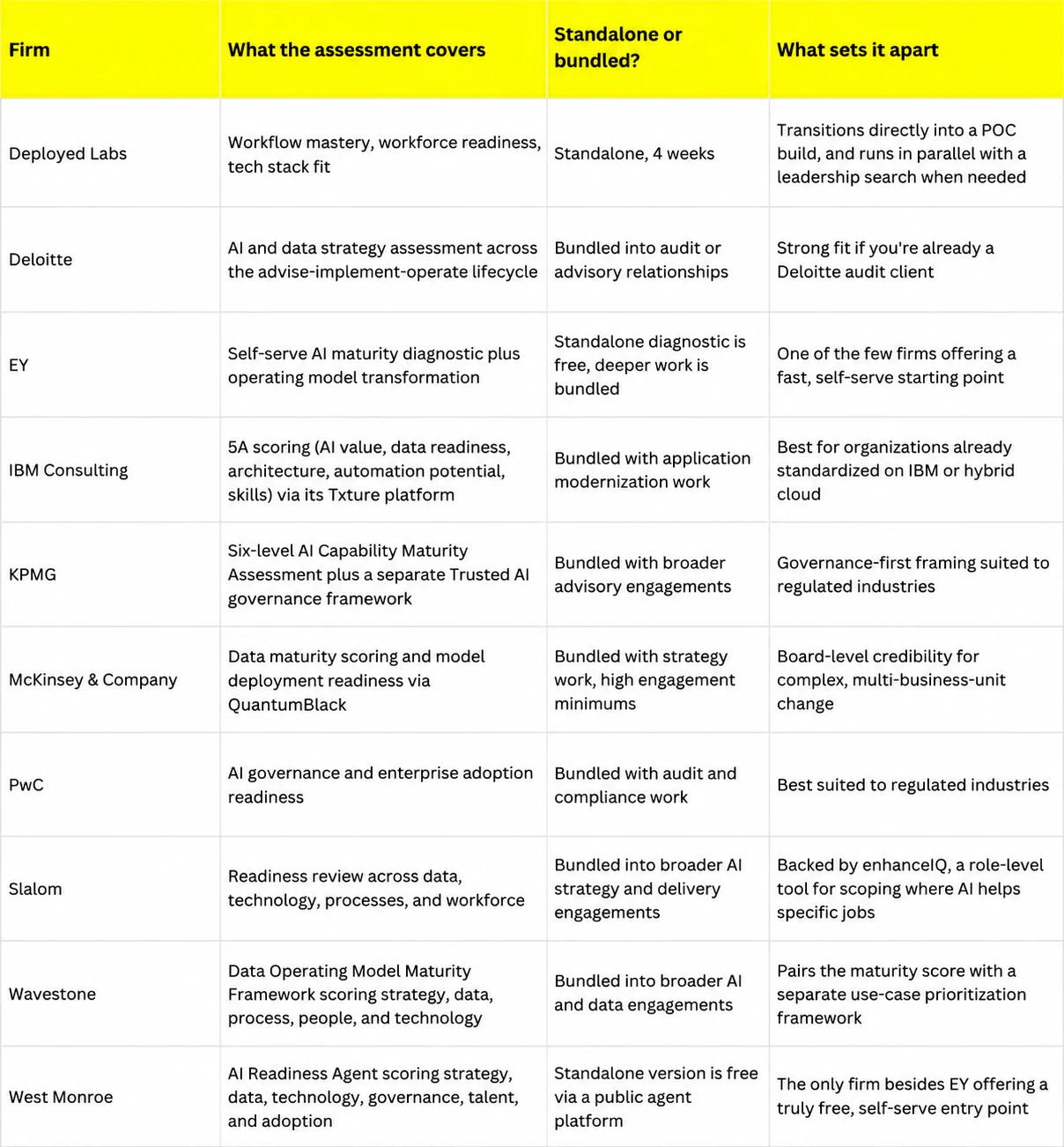
AI Assessment Services Comparison Table
Top AI Assessment Services in 2026 (In Alphabetical Order)
1. Deployed Labs
.webp)
Deployed Labs built its Agentic ROI Discovery assessment around the idea that AI readiness should lead directly to deployment planning instead of ending with a maturity score. The four-week engagement evaluates an organization across three dimensions: workflow documentation and maturity, workforce readiness for change, and technology compatibility with agent deployment. Those findings feed into an overall readiness assessment that helps determine whether an organization is prepared for deployment or needs foundational work first.
The methodology extends beyond the assessment itself. When needed, Deployed Labs can run an executive AI search in parallel so organizations can prepare leadership while the assessment is underway.
Once a workflow clears the assessment, Deployed Labs' production work centers on governance built in from day one, covering evaluation and routing, retrieval-augmented generation for enterprise knowledge, compliance-ready access controls, and observability. The firm has deployed agents across finance and insurance, supply chain and operations, HR and workforce, legal, sales and go-to-market, and general enterprise operations, aimed at B2B organizations that need auditable AI running in real workflows rather than a demo.
That combination makes Deployed Labs a strong choice for organizations looking for a fixed-scope assessment with a clear path into proof of concept and deployment.

2. Deloitte
Deloitte's AI and data strategy work lives inside its audit, tax, consulting, and advisory business, which shapes how the assessment gets sold. The firm's own 2026 outlook admits that plenty of clients are stuck in pilot mode, and the diagnostic exists to push them past it. For a company already paying Deloitte for audit work, adding AI readiness to that relationship is an easy lift. For everyone else, the assessment shows up wrapped inside a larger advisory contract, instead of something you can purchase on its own.
3. EY

EY offers the EY.ai Maturity Model, a free, self-serve diagnostic that scores an organization's generative AI maturity across seven dimensions in roughly 15 minutes. The tool functions as an entry point into EY's broader operating-model transformation practice, where the firm's paid assessment and implementation work is scoped and priced. The free diagnostic reflects general maturity indicators rather than an organization's specific workflows or systems.
4. IBM Consulting
IBM Consulting's AI readiness work runs through a tool called Txture, which applies what the firm calls a 5A framework, scoring applications across AI value, data readiness, architecture, automation potential, and available skills. It's one of five capabilities the Txture platform supports, alongside portfolio mapping and cloud migration planning, so the AI assessment tends to arrive as part of a broader application-modernization exercise instead of a standalone product. That's a reasonable fit for an organization already running on IBM infrastructure or planning a hybrid cloud migration, since the assessment speaks directly to systems it already operates. Outside that context, a buyer is evaluating an infrastructure-modernization practice that happens to include an AI lens, not an AI-first assessment.
5. KPMG
KPMG publishes its own AI Capability Maturity Assessment, a six-level framework running from 0 to 5 that scores an organization's technological capabilities and maps out what a targeted roadmap looks like from wherever it currently sits. The firm pairs that with a separate Trusted AI framework built around governance and risk, which fits its audit and advisory roots. Like the other Big Four firms on this list, the work generally arrives as part of a broader advisory engagement instead of something sold on its own, and the strongest use case is an organization that wants its AI readiness question folded into a governance and compliance conversation it's already having with KPMG.
6. McKinsey & Company (QuantumBlack)
.webp)
QuantumBlack began as an independent data science shop before McKinsey bought it in 2015, and it's since become the firm's global AI and engineering arm. Its proprietary data maturity scoring carries real weight in boardrooms, which is the audience McKinsey is built to serve. McKinsey generally serves larger enterprise transformation programs with engagement minimums to match, which makes it a less practical choice for a mid-market organization seeking a standalone, fixed-price assessment.
7. PwC

Regulation drives everything about how PwC approaches this. The firm's AI assessment work is built around governance and responsible AI adoption, which makes it a strong match for financial services and healthcare, where compliance sign-off is part of the deal. Outside of regulated sectors, that same strength can read as overhead: more documentation and process than a faster-moving company set out to buy.
8. Slalom

Slalom's AI consultants run a readiness review across an organization's data, technology, processes, and workforce, covering data quality and accessibility, existing systems and architecture, governance and risk controls, and how teams currently work. The firm backs that work with enhanceIQ, an AI-powered accelerator that analyzes specific roles and tasks to show where AI can realistically help, instead of scoring readiness only at the organizational level. That role-level detail sets Slalom's approach apart from most of the list, though the assessment itself is still positioned as the opening step of a broader strategy-through-delivery engagement instead of something sold on its own.
9. Wavestone

Wavestone evaluates AI and data maturity through its own Data Operating Model Maturity Framework, which scores an organization across strategy and governance, data quality, process and compliance, people and culture, and technology and architecture. The firm pairs that baseline with a separate AI Use Case Identification, Evaluation, and Prioritization framework, aimed at ranking which workflows are worth pursuing once the maturity picture is clear. Wavestone's own research has flagged that fewer than half of organizations have a structured way to measure AI ROI at all, which is the gap this two-framework approach is built to close. As with most of the firms on this list, the assessment is an entry point into broader AI and data engagement instead of a bounded, fixed-price product.
10. West Monroe

West Monroe's AI Readiness Agent, part of a public platform called WestMonroe.ai launched in mid-2026, scores an organization's AI maturity across strategy, data, technology, governance, talent, and adoption and returns a downloadable report with recommendations. It sits alongside a companion Workforce Future Fit Agent that tests whether a workforce can execute on a given strategy. Both tools are built to help a buyer pressure-test an idea before paying for anything, and West Monroe is explicit that the free layer is meant to shorten the path into its paid strategy and execution work.
How to Choose an AI Assessment Partner
Choosing an AI assessment provider starts with understanding what the engagement is meant to achieve. Some firms treat the assessment as the opening phase of a broader transformation program. Others position it as a standalone engagement that helps an organization decide whether and how to deploy AI.
Start with the outcome
Decide what question you need answered before comparing providers. If the goal is governance and risk oversight, a firm with deep regulatory expertise may fit best. If the goal is identifying high-value workflows and moving quickly into deployment, look for a provider whose methodology extends beyond a maturity score.
Understand what happens after the assessment
The most important difference between providers is what comes next. Some deliver recommendations and leave implementation to a future engagement. Others continue into proof of concept or production deployment with the same team.
Compare the engagement structure
Assessments vary widely in scope. Some are fixed-price, standalone engagements with defined deliverables and timelines. Others are bundled into larger consulting relationships where costs and timelines become clear only after the broader program begins. Understanding that structure upfront makes providers easier to compare.
Evaluate the methodology
A useful assessment should explain how it selects workflows and measures readiness, then how it turns that into an estimate of business value. Providers should describe their framework clearly and show how it has been applied in similar organizations.
Common Mistakes Buyers Make When Choosing an AI Assessment Provider
Organizations often spend more time comparing brand names than comparing engagement models. These are the mistakes that most often lead to disappointing outcomes.
Choosing the biggest firm by default
Large consulting firms bring extensive resources and industry expertise, but most package AI assessments within broader transformation programs. Organizations seeking a fast, standalone assessment can end up paying for capabilities they don't yet need.
Treating a maturity score as the end goal
A readiness score provides context, but it doesn't create business value on its own. A useful assessment identifies where AI can be deployed and what it will take to succeed, with a way to measure progress once implementation starts.
Ignoring what happens after the assessment
An assessment without a clear execution path often becomes another report on the shelf. Before selecting a provider, confirm whether the same team carries the work into deployment or hands it off to a separate engagement.
Comparing price without comparing scope
Two assessments with similar price tags can deliver very different outcomes. Compare what's included, how long the engagement lasts, what deliverables are produced, and whether implementation support is part of the offering, not just the headline cost.
Critical Questions to Ask Before Choosing a Provider
Scope and deliverables
- What does the final deliverable look like, and what happens the week after we receive it?
- Is the assessment priced as a standalone engagement, or does it require a larger commitment to purchase?
Methodology
- What framework or scoring model do you use, and can you show it applied to a comparable company?
- How much of the assessment is benchmarked against external data versus based on interviews alone?
Execution path
- If the results say a workflow is ready, what's the next step, and who owns it?
- Do you build what you recommend, or does that require a separate vendor?
Cost and timeline
- What is the total cost of the assessment alone, separate from any follow-on work?
- How long from kickoff to a final readout?
Ready to Assess Your AI Readiness?
The right assessment should leave you with more than a maturity score. It should provide a practical path from diagnosis to production.
Frequently Asked Questions
- How long does an AI assessment take?
Timelines vary widely by provider. A small number of firms quote a fixed number of weeks for a standalone engagement, while most large consulting firms fold the assessment into a broader transformation program and don't quote a standalone timeline at all. Ask for a specific week count before assuming any figure applies to your situation.
- What does an AI assessment cost?
Cost is one of the least standardized parts of buying an AI assessment. A handful of providers publish a fixed price for the assessment itself, and a couple offer a free, self-serve version. Most price the assessment as part of a larger engagement, so the real number only becomes clear once you're already committed to a bigger scope.
- Do I need a full transformation program to get value from an assessment?
No, though most large consulting firms structure their offerings that way. A well-scoped assessment should produce a prioritized list of workflows worth automating and a clear estimate of what it would take to prove one out, independent of any larger commitment.
- Why do AI initiatives so often fail to deliver value even after an assessment?
Because most assessments stop at the score. A 2025 BCG survey reported by MIT Sloan Management Review found 60% of companies saw little material value from their AI investments, and the pattern tracks more closely with execution gaps than with the technology itself.