



Choosing the right aviation staffing partner in 2026 demands a structured, objective approach. With technical roles averaging 62 days to fill internally, and a global demand for 2.37 million new professionals over the next two decades, specialized agencies are essential for sourcing, compliance, and operational excellence. This guide delivers a 9-step decision framework used by top aviation employers to assess, compare, and maximize agency partnerships—ensuring faster placements, higher retention, and regulatory peace of mind.
Aviation HR leaders face a market defined by acute skill shortages, evolving safety standards, and rising pressure to reduce time-to-hire. This tutorial walks you through every stage of evaluating staffing partners, from benchmarking industry expertise to establishing KPIs and scorecards for the final decision. Christian & Timbers brings four decades of executive search and aviation transformation leadership, but this framework is designed for any aerospace company seeking to optimize hiring outcomes in 2026 and beyond.
Key Takeaways
- Specialized aviation staffing expertise reduces time-to-fill for complex technical roles from 62 days (internal average) to 30–45 days, driving faster operational readiness (Noon.ai).
- A 7-dimensional evaluation framework (expertise, speed, vetting, compliance, network, fees, customization) enables objective agency comparison and higher 12-month retention rates (Total Aviation Staffing).
- The right aviation staffing partner should achieve 90%+ retention at 12 months and provide documented compliance tracking for FAA, EASA, and DOT requirements (Total Aviation Staffing).
Understanding Aviation Staffing Solutions: When to Partner vs. Hire Internally
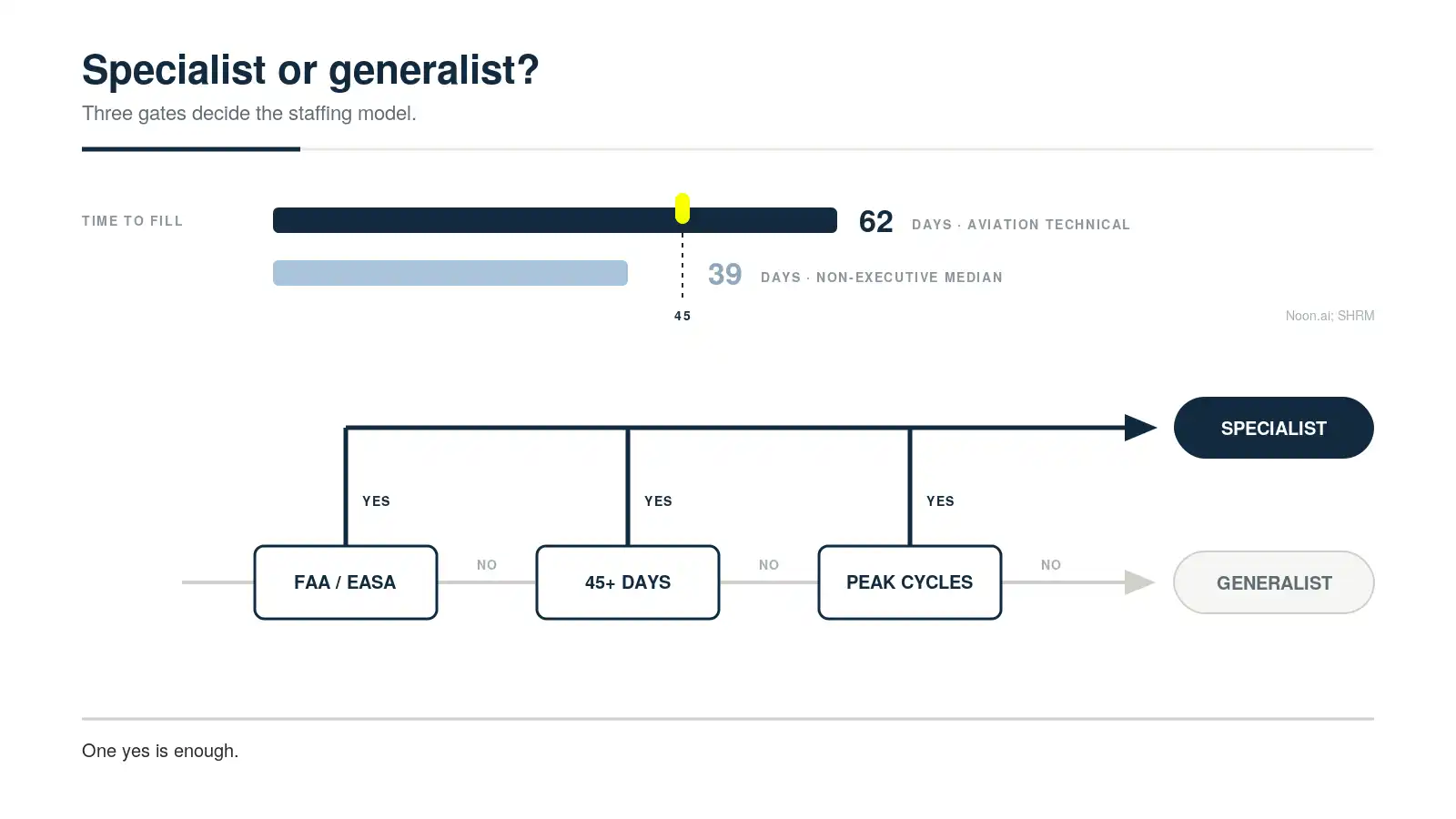
Aviation staffing solutions include temporary, contract-to-hire, direct placement, and project-based recruitment for roles ranging from A&P (Airframe and Powerplant) mechanics to executive leadership. Internal HR teams in aerospace firms often encounter bottlenecks when facing high-volume or specialized hiring, especially as technical roles can average 62 days to fill, well above the 39-day median for non-executive roles (Noon.ai; SHRM).
Scenarios that favor partnering with a specialized aviation agency include:
- Sudden spikes in hiring (fleet expansions, heavy maintenance checks)
- Roles requiring niche certifications (EASA, FAA Part 147/145)
- Geographic expansion or opening new bases
- Need for rapid scaling without long-term payroll liabilities
Generalist recruiters often lack the regulatory fluency and network depth needed for aviation. Specialized agencies, by contrast, provide tailored vetting, compliance tracking, and access to passive candidates. Use the following decision tree to assess your needs:
- Do your open roles require FAA/EASA certifications or aviation-specific experience?
- Yes: Specialized aviation agency recommended
- No: Generalist recruiter may suffice
- Is your time-to-fill for technical roles exceeding 45 days?
- Yes: Agency partnership can reduce vacancy time
- No: Internal recruitment may be adequate
- Are you experiencing seasonal or project-based workforce fluctuations?
- Yes: Consider contract or project-based staffing models
Specialized agencies also offer flexible workforce solutions for rapid scaling during seasonal peaks or heavy maintenance checks.
Step 1: Verify Deep Aviation Industry Expertise and Specialization
Assess each agency's technical knowledge with targeted questions, do they understand the difference between FAA Part 147 (maintenance technician schools) and Part 145 (maintenance organizations), and can they explain EASA Part 66 licensing? Agencies should demonstrate successful placements for A&P (Airframe and Powerplant) mechanics, composite engineers, and avionics professionals (Total Aviation Staffing).
Red flags include agencies using generic manufacturing language or showing unfamiliarity with aviation acronyms. Request case studies across your aviation segment (such as MRO [Maintenance, Repair, and Overhaul], commercial airlines, UAVs) and check for industry affiliations such as NBAA, AEA, or ARSA. A general recruiter unfamiliar with the distinction between a systems engineer and a mechanical engineer will struggle to meet aviation needs.
Christian & Timbers specializes in executive-level aviation placements, such as CTOs for drone enterprises managing AI-based optimization, while other agencies may focus on volume or broader industrial staffing.
Step 2: Evaluate Speed, Efficiency, and Time-to-Fill Metrics
Require agencies to provide historical time-to-fill data for roles similar to yours: the industry benchmark for complex technical aviation roles is 30–45 days (Pin.com). Compare this to internal averages of 62 days (Noon.ai).
Ask about:
- Depth of candidate pipeline and access to passive talent
- Responsiveness to urgent requests (AOG [Aircraft on Ground], unexpected departures)
- Metrics on first-interview-to-offer ratios and offer acceptance rates
- Use of AI-assisted sourcing, which can reduce cycle time to as little as 28 days (Noon.ai)
Agencies assigning dedicated account teams and maintaining engaged talent communities typically outperform those with fragmented focus. Christian & Timbers’ approach emphasizes strategic workforce planning, anticipating needs before vacancies arise.
Step 3: Examine Screening, Vetting, and Technical Assessment Processes
Aviation vetting starts with independent verification of licenses and certifications (A&P, ATP, avionics ratings). Leading agencies administer practical skills tests—such as software simulation exercises for digital engineers or OEM-aligned knowledge tests for mechanics (Total Aviation Staffing).
Robust background checks should include FAA database searches, employer verification, safety record review, and drug testing. Advanced agencies use behavioral and team compatibility interviews to assess cultural fit. Use a scorecard to compare:
- Technical skills validation methods
- Rigor of background and safety checks
- Quality metrics such as candidate pass rate and retention
Structured reference intelligence tools transform feedback into quantitative, benchmarked insights, outperforming traditional reference checks.
Step 4: Verify Compliance Knowledge and Safety-First Culture
The right staffing partner must navigate a maze of regulations: FAA, EASA, TSA, DOT, and ICAO standards (Total Aviation Staffing). Agencies should manage TSA background checks, DOT drug and alcohol testing, and maintain certification currency including A&P renewals, medical certificates, and recurrent training.
Assess their documentation and compliance tracking systems. Agencies should align with your safety-first culture by screening for incident history and attitude toward procedures. For international operations, ensure EASA/ICAO compliance and cross-border work authorization capabilities. While competitors focus on compliance, Christian & Timbers differentiates by sourcing leaders who embed compliance into organizational culture.
Step 5: Assess Candidate Network Reach and Talent Pool Depth
Boeing forecasts 2.37 million new aviation professionals will be needed globally over the next two decades (Pilot Career News). The best candidates are often passive, currently employed, and only accessible through agencies with deep proprietary networks.
Ask agencies about:
- Geographic coverage and ability to source in target regions
- Relationships with passive candidates
- Diversity partnerships such as Women in Aviation International and OBAP (Organization of Black Aerospace Professionals)
- Success in filling niche roles (helicopter mechanics, UAV operators)
A strong agency will demonstrate years of aviation staffing experience, high annual placement volume, and a robust active candidate database. Request specifics: “How many A&P mechanics or avionics techs are in your active network?”
Step 6: Compare Fee Structures, Guarantees, and Contract Terms
Industry-standard fee structures:
- Contingent placement: 15–30% of first-year base salary (Total Aviation Staffing)
- Retained search: 25–35% of total first-year compensation (RemotelyTalents)
- Contract/temp staffing: 50–85% markup (Frontline Source Group)
Guarantees usually last 90 days, but some agencies, like Frontline Source Group, offer up to 5 years (Frontline Source Group). Scrutinize hidden costs—background checks, drug testing, travel, onboarding support—and clarify contract flexibility (conversion fees, volume discounts, payment terms).
Christian & Timbers delivers premium executive search for transformational leadership, complementing tactical staffing for frontline roles.
Step 7: Evaluate Customization and Strategic Partnership Capabilities
Premier agencies offer multiple engagement models: direct hire, contract/augmentation, contract-to-hire (C2H), and managed service provider (MSP)/RPO (Spectraforce). C2H is especially useful for evaluating fit in hard-to-source roles over 3–6 months.
Ask about:
- Workforce planning support for fleet expansions or contract wins
- Embedded/on-site recruiter options for high-volume needs
- Onboarding assistance (I-9 verification, benefits, orientation)
- Technology integration (ATS, dashboards, reporting)
Aerotek offers mass hiring and onboarding campaigns. Christian & Timbers stands out for C-suite succession planning and leadership development tailored to aviation organizations.
When Does Contract-to-Hire Make Sense?
Contract-to-hire (C2H) arrangements allow employers to assess performance, safety, and cultural fit over a 3–6 month evaluation period—especially valuable for avionics and specialty roles. This model reduces risk and ensures only proven talent is converted to permanent staff.
Step 8: Conduct Reference Checks and Pilot Projects
Before committing to a high-volume partnership, request 3–5 references from similar aviation companies. Ask specific questions about time-to-fill, candidate quality, communication, problem-solving, and retention. Advanced agencies leverage structured reference intelligence tools to gather quantified data from multiple perspectives (Crosschq).
Consider a pilot project, engaging the agency to fill a small number of non-critical roles (e.g., three avionics positions) using a contract-to-hire model. Measure performance by speed, candidate quality, responsiveness, and process transparency. Document lessons learned and score each agency for final selection.
Step 9: Establish Clear KPIs and Performance Metrics
Define upfront success metrics such as:
- Time-to-fill (target: 30–45 days for technical roles)
- Candidate quality scores and pass rates
- 90%+ retention at 12 months (Total Aviation Staffing)
- Hiring manager satisfaction
Implement a regular review cadence (monthly or quarterly), using a balanced scorecard that tracks speed, quality, cost, compliance, and communication. Adjust expectations to account for new business needs—seasonal peaks, new aircraft types, or expanded geographies. Advanced analytics can predict early attrition risks and inform continuous improvement.
Making Your Final Decision: Aviation Staffing Partner Selection Scorecard
Use a structured evaluation matrix to objectively score agencies across these 7 dimensions:
- Industry Expertise
- Speed & Efficiency
- Vetting Processes
- Compliance Knowledge
- Candidate Network
- Fee Structure & Guarantees
- Customization
Hiring managers should carefully weight each dimension based on their organization's specific priorities. For example, if regulatory compliance and safety are paramount, give those criteria greater importance in your evaluation. If rapid scaling is the main concern, prioritize speed and candidate network reach. Adjust the weighting so that your final decision aligns with your strategic goals and operational needs.
For frontline roles, tactical staffing specialists like Total Aviation Staffing or Aerotek may be suitable; for executive leadership and organizational transformation, a strategic partner like Christian & Timbers is essential. Many organizations benefit from using both in complementary ways.
FAQ: Aviation Staffing Partnerships
Q: What is the average time-to-fill for technical aviation roles? A: The industry benchmark for complex technical aviation roles is 30–45 days, compared to an internal average of 62 days (Noon.ai).
Q: When should aerospace companies use contract-to-hire arrangements? A: Contract-to-hire (C2H) is ideal for evaluating candidate fit, safety, and performance over a 3–6 month period, especially for avionics and specialty roles.
Q: What are standard aviation staffing fee structures? A: Contingent placements typically cost 15–30% of first-year base salary; retained searches are 25–35% of total first-year compensation; contract/temp staffing markups range from 50–85% (Total Aviation Staffing, RemotelyTalents, Frontline Source Group).
Q: What does AOG mean, and why is it important? A: AOG stands for Aircraft on Ground, a critical situation where an aircraft is grounded due to maintenance or technical issues. Staffing partners must respond quickly to AOG events to minimize operational disruptions.
Maximizing Your Aviation Staffing Partnership in 2026
Integrate your staffing partner into workforce planning by sharing detailed job requirements, company culture, interview processes, and decision timelines. Maintain regular check-ins, provide honest feedback, and collaborate to solve challenges. Leverage your partner’s market intelligence—for example, predictive analytics and direct sourcing can build talent pipelines months before requisitions are opened (Kelly Services).
Track ROI by measuring cost-per-hire, time-to-productivity, retention, and quality-of-hire scores. Re-evaluate the partnership if KPIs slip or business needs shift. Christian & Timbers’ consultative approach includes leadership succession planning and organizational design, ensuring your team is positioned for both current and future aviation challenges.
Conclusion
Aviation staffing in 2026 is defined by fierce competition for talent, complex regulatory hurdles, and the need for measurable hiring outcomes. By following this 9-step decision framework—spanning expertise, compliance, network, custom solutions, and scorecard-based evaluation—you equip your organization to select partners who drive faster placements, higher retention, and safer, more compliant operations. Specialized agencies cut technical vacancy time to 30–45 days, while premium executive search partners like Christian & Timbers deliver the leadership required for transformation in aerospace. To discuss strategic workforce planning, C-suite placements, or tailored aviation talent acquisition, contact Christian & Timbers for a confidential consultation.