

Christian & Timbers was recruiting robotics engineers and AI leaders within its first decade, when an IBM PC controlled a factory robot and expert systems were bringing rule-based AI into commercial use. Across more than four decades, the firm has placed over 500 robotics engineers and leaders.
Robot makers selling to American factories in 1980 had a hiring problem, and few search firms understood it. They needed engineers who could program a manipulator or get a camera to find a part. Most of those people worked in a handful of university labs and corporate research centers, and hardly any had run a business unit. Christian & Timbers started recruiting for those companies while commercial robotics was still taking shape. The firm's physical AI searches today draw on records that go back to the early 1980s.
How Did a 1988 Robotics Deal Connect Industrial Automation and Early AI?
American Cimflex, the Pittsburgh robot maker that began as American Robot, agreed in December 1988 to go public through a merger with Teknowledge, Tech Monitor reported. The deal closed the following year. Teknowledge sold expert system software out of Palo Alto. General Motors and Procter & Gamble owned shares, and one of its co-founders was Edward Feigenbaum, the Stanford computer scientist who helped create the expert systems field. Under the agreement, Cimflex shareholders would hold 58% of the combined company, renamed Cimflex Teknowledge, and Romesh Wadhwani would stay on as chairman and CEO.
The strategic case was easy to read. Cimflex already built Unix-based robot controllers and vision systems, and pairing them with an expert systems company reflected a bet that factory machines would need software able to make decisions on the line. As I see it, physical AI companies are pursuing a related goal in 2026, using neural networks alongside modern control systems to make robots more capable on real factory floors. Christian & Timbers had recruited for Wadhwani's company back in its American Robot years.
Which 1980s Robotics Programs Did Christian & Timbers Recruit For?
American Robot in Pittsburgh
Wadhwani studied electrical engineering at Carnegie Mellon, through a master's and a PhD, and Herbert Simon and Allen Newell were among his professors. In 1982, he took the CEO job at American Robot, a Venrock-backed startup. He wanted a vision system that used AI to tell a robot where each part sat in an assembly, so the robot could pick it up and put it where it belonged.
Ford was also an investor and development partner. In December 1987, the two companies amended a development agreement. American Cimflex closed that year with $35.4 million in sales, and the company was one of Christian & Timbers' early robotics clients.
IBM's 7535 and 7565 Robot Systems in Boca Raton
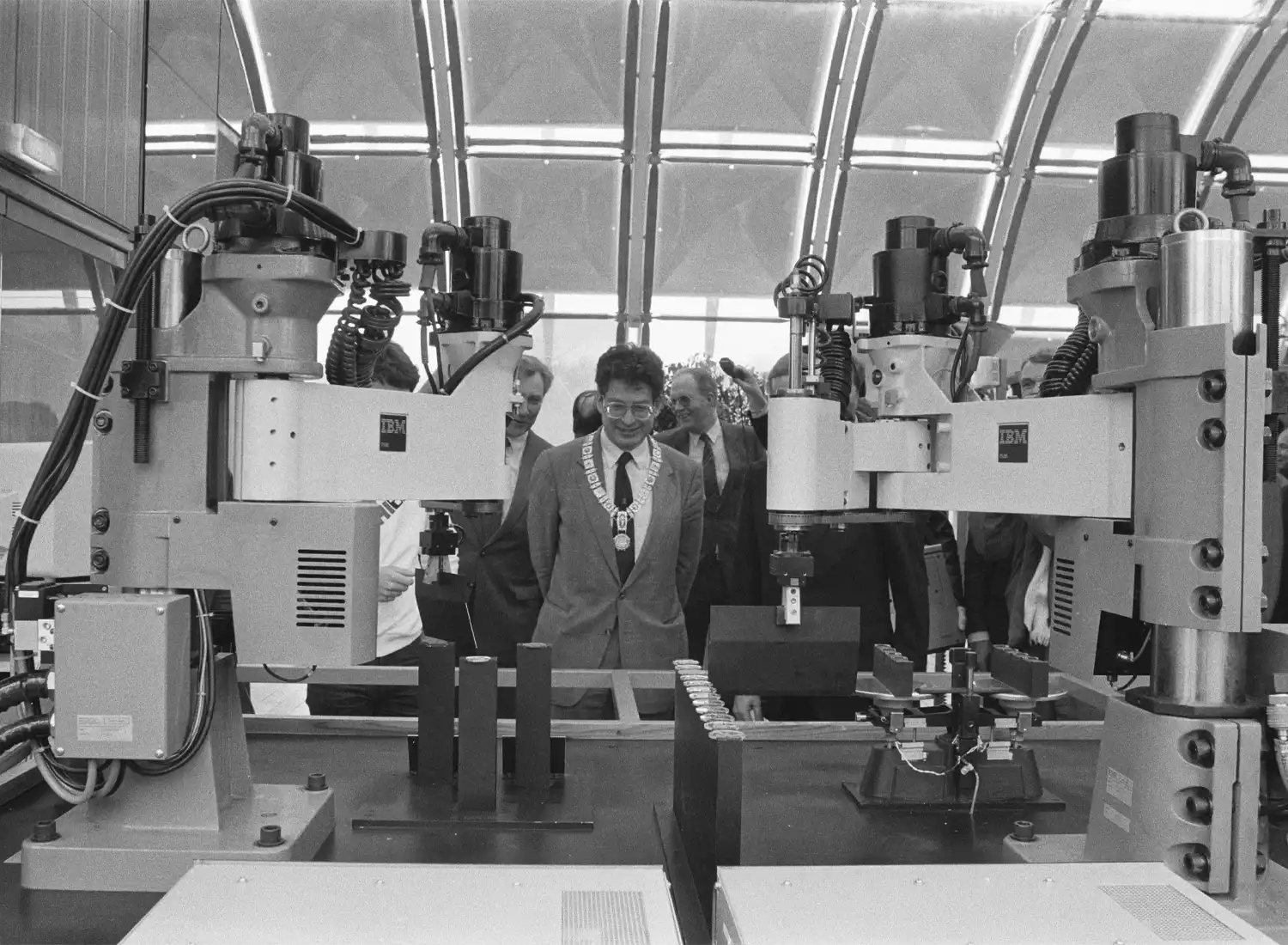
IBM announced the 7535 in February 1982. Based on a Japanese robot, it was controlled by an IBM PC and programmed in IBM's AML language. It could handle parts weighing up to 13 pounds. The larger 7565 followed in January 1983, a cartesian gantry robot that grew out of research at IBM's Yorktown Heights lab and its Advanced Manufacturing Systems group in Boca Raton.
Russell Taylor, the IBM Research scientist who was the principal developer of AML, spent two years helping establish the robot product group in Boca Raton and served as system architect for the 7565. IBM kept extending the line with the 7540, 7545, 7575 and 7576 manufacturing systems.
Christian & Timbers recruited for IBM's 7535 and 7565 programs in Boca Raton. The robotics group shared its campus with the team that had launched the IBM PC in 1981, at a time when Boca Raton was drawing technical talent from across the country.
GE's Research Center in Schenectady
GE was running robotic welding experiments in Schenectady by 1979 as part of its push into flexible automation. In the decade that followed, Christian & Timbers recruited for GE's research and development center, working across its Schenectady and Albany sites. Robotics is on the agenda there again: GE Vernova runs robotics projects at its Schenectady facilities and agreed in May 2026 to acquire Robotech Automation, an integrator based near Montreal.
The recruiting challenge has stayed remarkably familiar since the 1980s: finding engineers who can take a promising technology out of the lab and make it work in production.
What Did the Late-1980s Robotics Slowdown Change?
By the late 1980s the industry was consolidating. Tech Monitor described the failure of robotics to take hold as the biggest disappointment of the early 1980s, and it later reported that Teknowledge was cutting 60 of its 200 employees as expert system tool revenue eroded. By 1991, ABB was buying the robot businesses of Milacron and Graco.
That pressure changed the questions worth asking in a robotics search. Building a working prototype was no longer enough. I wanted to know whether a candidate could keep a team together through installation and production setbacks, and whether a board would believe the timeline that candidate gave them.
How Did Robotics Search Lead to Silicon Valley Boardrooms?
Robotics taught the firm how to work with a talent pool small enough to map by name, where the best candidates were rarely looking. That habit carried into the searches that followed as personal computing and the internet created their own leadership shortages.
In 1999 I called Carly Fiorina about the CEO job at Hewlett-Packard, a conversation Fast Company recounted in 2003 in an excerpt from George Anders' book about her time at HP. Four years later Steve Jobs called me to find Apple's next board member, and I went on to lead his final two board searches at Apple.
Those searches had little to do with robot arms, but they turned on the question the robotics years had sharpened. Could this person run a technology business in front of a board that cared about results, and would the engineers underneath them follow? The same question sits at the center of AI leadership searches in 2026.
How Does Physical AI Hiring Today Connect to the Firm's Robotics Roots?
Wadhwani's early-1980s problem, getting a robot to see where the parts are, sits at the center of warehouse automation today. Christian & Timbers placed Dr. Hui Cheng as Physical AI & Robotics Lead at Accenture, a role built to design and deploy robotic fleets for the firm's clients. Cheng previously ran robotics and automation at Coupang, where his teams across three countries built fulfillment systems that pair computer vision with robotics and warehouse software.
Before Coupang, he led JD-X RDC at JD.com and sat on the board of Kindred AI, a warehouse robotics company. He holds 50 granted U.S. patents. His Accenture mandate covers robotic fleet deployment and AI-driven manufacturing, the territory IBM was trying to claim with the 7565, now backed by simulation tools and autonomous agents nobody in Boca Raton had in the 1980s.
The talent squeeze looks familiar too. Christian & Timbers' Elite FDE Scarcity Study documents a current shortage of forward deployed engineers who can make AI work inside a customer's operations. In my experience, factory automation faced a similar talent shortage in the 1980s. Engineers who could take a robotic system from development into reliable production were hard to find.
What Should Boards Look for in Robotics and AI Leaders?
The title has changed more than the job. A company hiring a Chief Robotics Officer, VP of AI, Head of Autonomy or VP of Engineering for a physical AI program still needs someone who has moved a system out of the lab and into a facility where downtime costs money. Résumés rarely show that clearly, so I'd push candidates for deployment specifics: how many units went live, and how long they kept running.
Downturn experience deserves more weight than it usually gets. Robotics has already been through one boom and bust, and some of the leaders who held programs together in the late 1980s went on to build the next generation of companies. Wadhwani is the clearest case. After Cimflex Teknowledge he founded Aspect Development, which i2 Technologies acquired in 2000 in a deal valued at $9.3 billion when it was announced. He later founded SymphonyAI and committed $1 billion of his own capital to SAIGroup and its portfolio companies.
CEOs should also plan for a search that reaches wider than a software hire. Leaders who combine deep AI expertise with hands-on robotics deployment are hard to find, and the strongest are usually running programs their employers want to keep. A typical Christian & Timbers search runs 6 to 12 weeks, and specialized robotics searches can take longer.
Christian & Timbers has been recruiting robotics and AI leaders since the firm's first decade. Today it leads searches for CEO, CTO, CPO, CPTO, VP of Engineering, VP of AI, Head of AI, Chief Robotics Officer and VP of AI Transformation roles, along with board seats, and its global reach gives clients access to the passive candidates who are hardest to find.