


Short answer: The Chief AI Officer (CAIO) leads the cognitive layer of the enterprise, turning data into AI products, governance, and ROI, while the Chief Information Officer (CIO) owns the foundational IT layer, security, and operational reliability. The roles are complementary and work best with clear decision rights and shared roadmaps.
As AI shifts from pilots to enterprise platforms, leadership clarity matters. Up to 76% of large organizations are adding CAIOs, reflecting a need for explicit accountability and AI governance at the top table (Mexico Business News). This comparison maps the mandates, success metrics, and collaboration patterns for CAIO and CIO, shows when to hire each, and shares proven structures we deploy with clients.
Key Takeaways
- Up to 76% of large organizations have appointed a CAIO by 2026, signaling enterprise-wide AI as a board priority (Mexico Business News).
- Clarity pays: 86% lack defined AI accountability and 48% of AI projects miss objectives when responsibilities are unclear (Digital-Chiefs).
- Firms with a CAIO see roughly 10% higher ROI on AI, and AI-first C-suites scale 10% more initiatives (Talentfoot, People Matters).
What is the difference between CAIO and CIO?
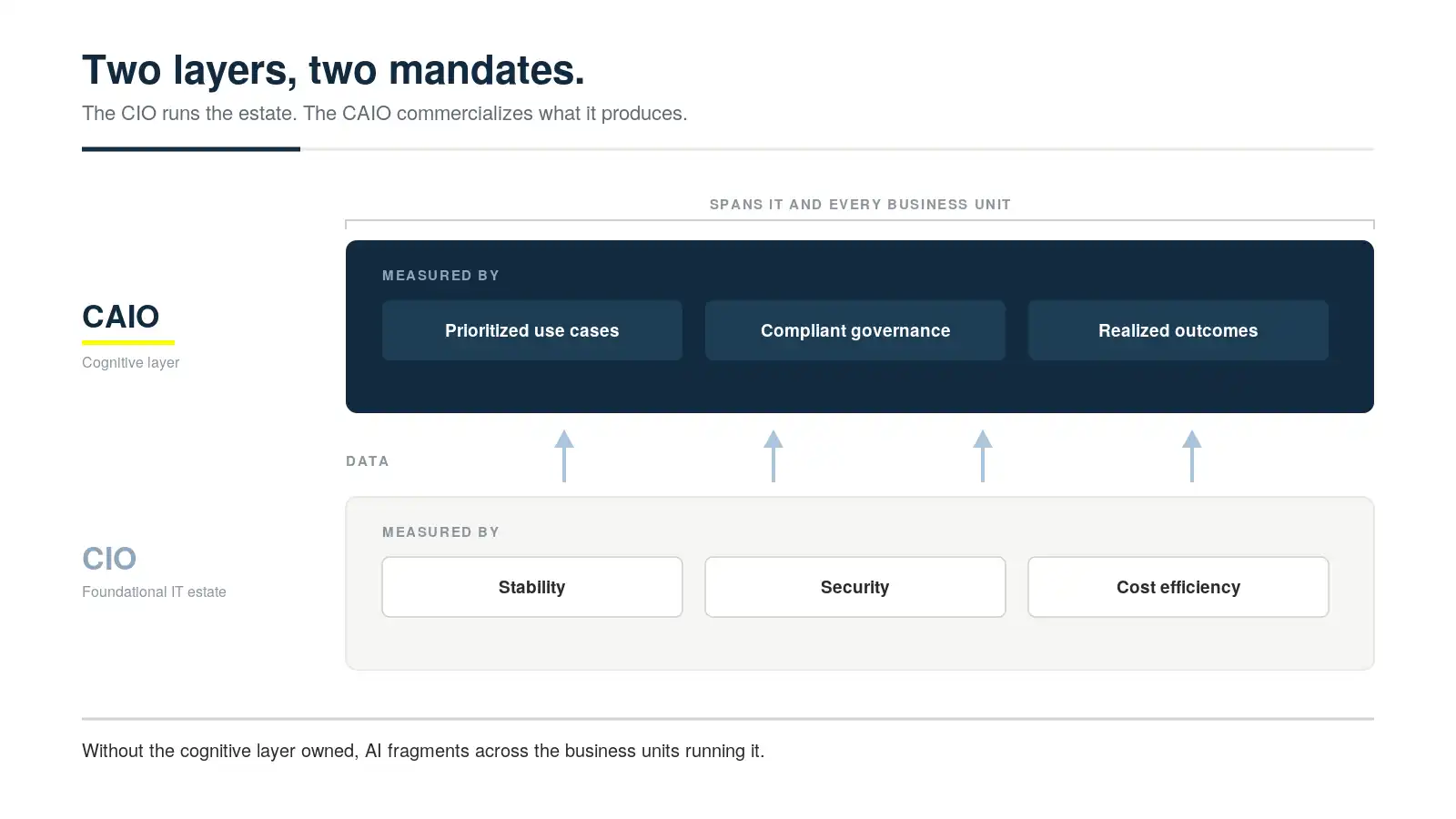
The CIO safeguards and optimizes the foundational IT estate, while the CAIO advances the cognitive layer that commercializes data through AI. CIO success is stability, security, and cost efficiency. CAIO success is measured by prioritized use cases, compliant AI governance, and realized business outcomes (ISHIR, Computing, Forbes).
As enterprises prioritize AI in strategy, CAIOs prevent fragmentation across IT and business units, while CIOs continue to run core systems and transformation programs (FutureSavvy, KUWARE).
What is a CAIO job title?
A CAIO is a C-suite executive accountable for enterprise-wide AI strategy, governance, and operationalization, created to stop AI from fragmenting across IT and business units (ISHIR, Agility at Scale). The title is rising as organizations seek advantage from applied machine learning, responsible use, and measurable ROI (Computing, Christian & Timbers).
Fractional options expand access for mid-market companies. Fractional C-suite roles have grown 340% since 2019 in the UK, making part-time CAIO leadership a viable on-ramp (Hartz AI).
CAIO archetypes
- Strategy CAIO: Translates value, sequences high-ROI use cases, and embeds AI into operating models (Christian & Timbers).
- Platform CAIO: Builds scalable AI foundations, MLOps, model lifecycle, and data pipelines (Agility at Scale).
- Fractional CAIO: 1 to 3 days per week for governance and roadmap without full-time cost, supported by 340% growth in fractional roles (Hartz AI).
CAIO vs CIO: Core Responsibilities
The CIO manages enterprise systems, cybersecurity, cloud platforms, vendor contracts, and budgets to maintain reliable, secure operations. The CAIO designs AI architectures, sets ethical guidelines, directs build versus buy, and ensures deployments meet compliance and deliver ROI (ISHIR, Agility at Scale, Forbes).
Overlap is critical: both leaders align on data infrastructure, security, and change management so AI integrates into core processes without risk. Clear decision rights prevent gaps and rework (KUWARE, Computing).
Pros and cons at a glance
- CAIO strengths: Commercialization of AI, governance, culture change. Risk: Role confusion without clear remit (Agility at Scale).
- CIO strengths: Stability, resilience, cybersecurity, vendor leverage. Risk: Innovation drag if overloaded with AI product mandates (ISHIR).
When Does a Business Need a CAIO vs. a CIO?
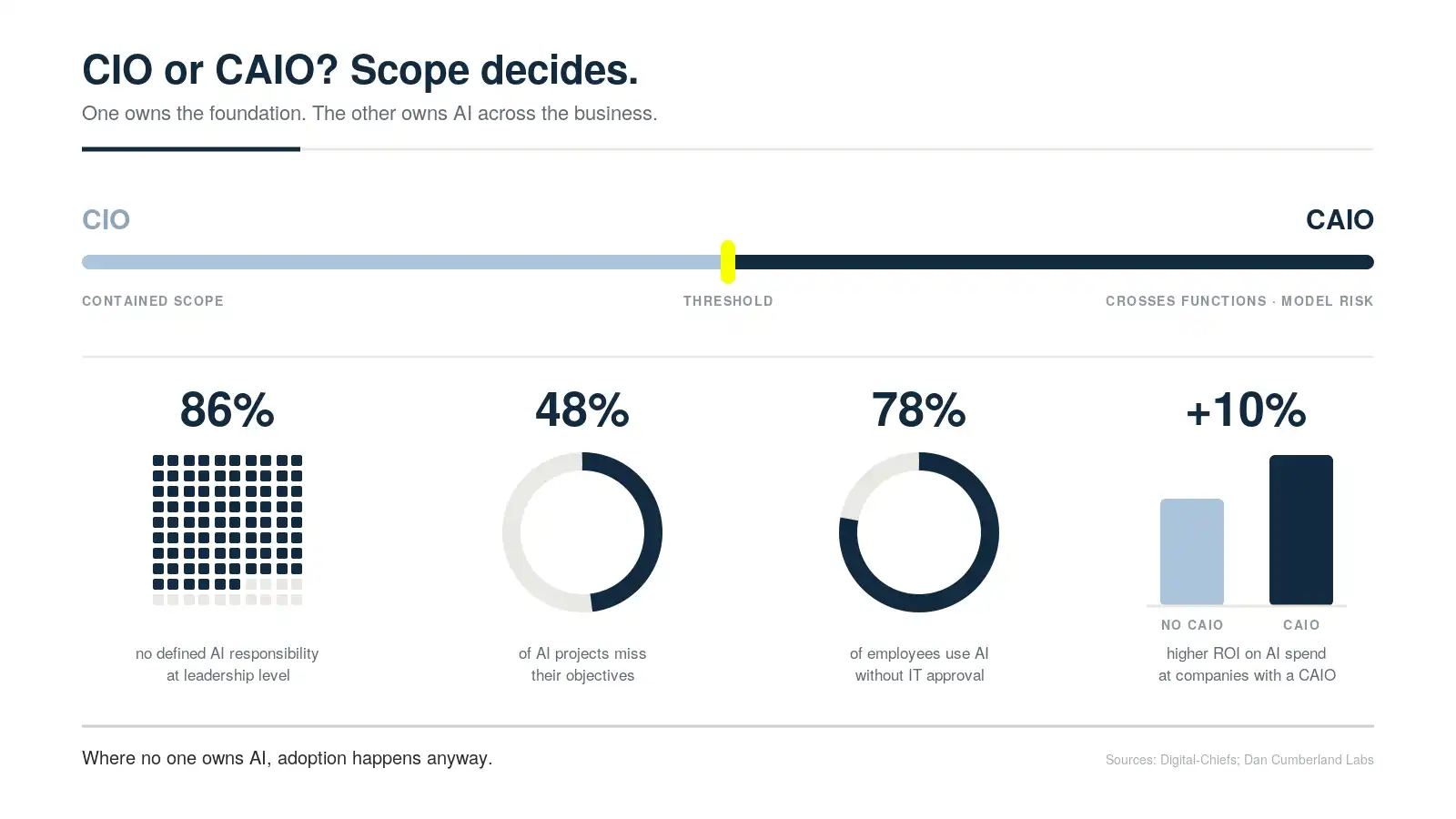
Choose a CAIO when AI spans multiple functions, carries material governance risk, or requires product leadership and workforce upskilling. Signs include fragmented pilots and model risk, often created by unclear ownership. 86% of companies lack defined AI responsibility at leadership level, and 48% of AI projects miss objectives as a result (Digital-Chiefs). Shadow AI fills the gap, with 78% of employees using tools without IT approval (Dan Cumberland Labs).
A CIO is foundational for secure, scalable IT and can steward pragmatic AI integrations when scope is narrow. Where AI is strategic, companies with a CAIO see roughly 10% higher ROI on AI spend, and AI-first C-suite structures scale 10% more initiatives (Talentfoot, People Matters).
Hiring triggers
- CAIO triggers: Cross-function AI roadmap, regulated use cases, need for AI policy and model risk governance, ambition to productize AI.
- CIO triggers: Modernize infrastructure, consolidate tech stack, raise security posture, enable safe use of tools like Copilot at scale (ZDNET).
How Do CAIO and CIO Work Together?
Set reporting and cadence first. Over half of CAIOs, 57%, report to the CEO or Board, which aligns AI mandates with enterprise strategy while enabling peer-level collaboration with the CIO (Algorithm Times). In execution-heavy firms, CAIOs frequently report to the CIO or CPO to keep platform and product close (KUWARE, Christian & Timbers).
Joint roadmaps and governance avoid silos. Create an AI steering committee with Legal, Compliance, Security, Data, CAIO, and CIO. Target appointed Chandhu Nair as CAIO reporting to the Chief Information and Product Officer to bind product, data, and IT from inception (CAIO Strategy Substack, Retail Dive). Schneider Electric uses a hub and spoke model, centralizing AI strategy and tooling while embedding delivery in business units.
Operating model essentials
- Shared portfolios: Align capacity for data pipelines, model hosting, and security controls so AI features ship safely.
- Decision rights: CIO owns infra standards, CAIO owns AI policies and model risk management. Escalation rules prevent delays.
- Metrics: Pair uptime and cost metrics with AI ROI, time-to-value, and compliance adherence (Agility at Scale).
Christian & Timbers’ Perspective
We see sharp acceleration in CAIO demand across searches, while only 14% of enterprises broadly employ a CAIO today, per Foundry’s State of the CIO, indicating a wide maturity gap (Christian & Timbers). Compensation is rising as well, with total cash for CAIOs at growth-stage tech companies up 8% to 10% year over year (Aiken House).
Our advisory starts with a structured assessment: determine if your core deficit is translational, best served by a Strategy CAIO, or technical, best served by a Platform CAIO. Then define joint CAIO-CIO decision rights, governance, and hiring criteria to match your risk profile and roadmap (Christian & Timbers).
Frequently Asked Questions
Can one executive serve as both CAIO and CIO?
Yes, in smaller or less AI-intensive contexts, if the leader has cross-disciplinary fluency. As scope and risk grow, combining roles can create a governance vacuum and fuel shadow AI (FutureSavvy, Dan Cumberland Labs).
What backgrounds suit a CAIO vs. CIO?
CIOs typically come from enterprise IT and systems leadership. CAIOs split by archetype: Platform CAIOs from engineering and MLOps, Strategy CAIOs from data science or analytics plus product and change expertise (Agility at Scale).
Is a CAIO necessary for every industry?
No. A CAIO adds the most value when AI spans multiple functions, involves distinct compliance risk, or when speed to ROI is a priority. If AI remains a contained IT enablement, a CIO with an AI governance lead can suffice (FutureSavvy).
Conclusion
The CAIO builds the AI engine for value and governance, the CIO keeps the enterprise chassis secure and reliable. Both are essential when AI is strategic and cross functional. The data shows that clarity in ownership and reporting correlates with scaled initiatives and higher ROI, while diffuse responsibility drives shadow AI and failed projects (Algorithm Times, Digital-Chiefs, Talentfoot).
Next steps: assess whether your gap is Strategy or Platform, formalize CAIO-CIO decision rights, and set a joint roadmap and governance committee. If you need help designing the role or hiring the right CAIO archetype, connect with Christian & Timbers for a confidential assessment.