



Key Takeaways
- AI layoffs and AI hiring are happening at the same companies, in the same quarter. During the period with the highest tech layoff total in at least two years, roughly 275,000 AI-related positions remained open in the US.
- In aerospace and defense, this shows up as a leadership shift. Roles like General Manager and CTO now carry an implicit expectation of AI fluency that wasn't part of the job five years ago.
- Companies like Anduril and Palantir are changing how the industry competes, pushing traditional primes to rethink the leadership capabilities needed for the next generation of programs.
Aerospace and defense is quietly rewriting what it wants from a leader. The AI layoff headlines don't capture that shift. From an executive search perspective, the conversations with clients sound very different from the layoff narrative. The real question is which leaders can turn AI into practical capability across a defense program or a manufacturing floor.
That shift is changing leadership mandates faster than job titles. Companies are still hiring General Managers, Chief Technology Officers, VPs of Engineering, and strategy leaders. What has changed is what those leaders are expected to deliver.
The same companies announcing layoffs are expanding AI hiring. During the quarter that produced the highest tech layoff total in at least two years, roughly 275,000 AI-related job postings remained open across the United States. AI-related hiring is up 92% in 2026, and roles in highest demand carry a 56% wage premium. Customer support, quality assurance, content moderation, and middle management are shrinking. Demand stays high for machine learning engineers and data infrastructure specialists.
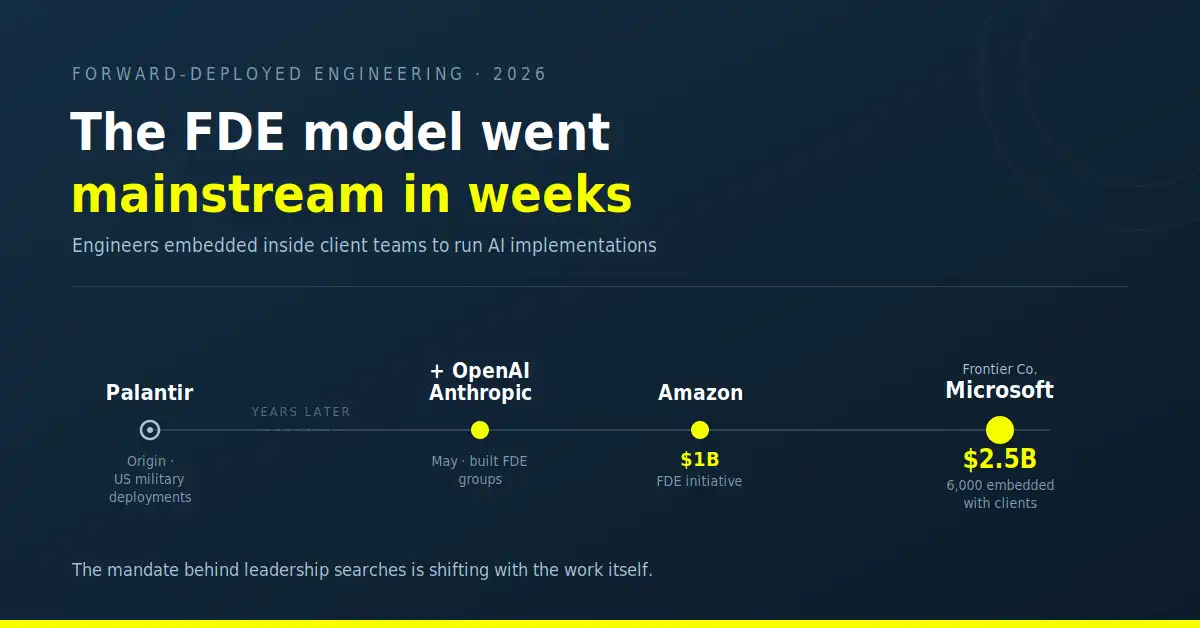
Recent investments in AI deployment help explain why executive expectations are changing. Microsoft is investing $2.5 billion into Microsoft Frontier Co., a new division that will embed 6,000 employees directly with clients on AI implementations, a practice known as forward-deployed engineering (FDE). Amazon put $1 billion behind a similar FDE initiative two days earlier. Anthropic and OpenAI both built out FDE groups of their own in May. The FDE model itself traces back to Palantir, which sent forward-deployed engineers to work alongside the US military years before the rest of the industry picked up the model. Whatever explanation companies offer for their layoffs, the broader direction is consistent. Businesses are redesigning how work gets done. The mandates behind leadership searches are changing with it.
What this looks like in hiring mandates
The mandate usually runs deeper than the title on the job spec. Consider a General Manager search. Ten years ago that meant operations experience and a track record running a P&L. Today it means understanding how AI can improve throughput and margins on the factory floor. Strategy roles have shifted the same way. Boards are less interested in someone who can set direction and more interested in someone who already understands where autonomy and AI are rewriting the competitive map in their sector.
Aerospace and defense is one of the clearest places to see this shift.
The primes are facing a different kind of competitor
Traditional defense primes built their advantage over decades of customer trust, program history, and relationships inside the Pentagon. Those strengths still matter. They just aren't enough on their own anymore.
Back in 2018, the public conversation about defense innovation centered on legacy primes and their major platforms, programs like the F-35 or the B-21 Raider. By 2026, that conversation centers on Anduril's autonomous systems and on Palantir's Maven Smart System, which the Pentagon designated a formal program of record earlier this year, locking in stable multiyear funding across the joint force. That shift in attention influences recruiting and shapes the broader conversation around defense funding.
Anduril and Palantir occupy different lanes here. Anduril builds hardware and autonomy at industrial scale, everything from drones to autonomous undersea systems, run on a software platform called Lattice that controls large autonomous fleets across domains. Palantir works one layer down, on the data and AI side, with Maven doing the analysis rather than building the vehicles. What pulls engineers toward both is the same instinct: a preference for shipping fast over the slower, hardware-first cycle the traditional primes were built around.
That preference is forcing a leadership conversation the primes can't sidestep much longer. Winning the next generation of programs means finding leaders who understand how AI reshapes cost structure, speed to field, system autonomy, and program risk. Thirty years of defense procurement built a different kind of bench than the one this moment calls for.
Are AI-native mandates here yet?
The more common question from boards right now looks forward rather than back: how close is this leader to being AI-native within two or three years? What boards want is someone capable of driving that transition from where the company sits today.
Compliance and regulatory leadership remain among the hardest areas to recruit for. Defense and aerospace operate in highly regulated environments, which makes a leader who has already built AI-driven systems inside that kind of environment rare. Those candidates are moving through the market quickly.
The layoffs and the hiring are the same trend
Companies investing in AI hiring are, in many cases, the same companies reducing headcount elsewhere. At first glance, that looks contradictory. It's a company rebuilding itself around a different set of skills, with talent needs shifting to match.
In aerospace and defense, this rebuild sits on top of new market entrants reshaping what customers expect. Primes need a leadership bench that understands this shift to remain competitive for the next generation of programs. Without it, they'll continue ceding ground to companies that were built AI-native from the start.
The bigger picture
The strongest leaders today can take AI and make it practical inside a real operating environment, whether the title is Chief Technology Officer, General Manager, VP of Engineering, or Chief Robotics Officer. The title on the door matters less than the ability to turn AI into throughput, margin, speed, and program wins.
The companies adapting fastest aren't simply adding AI to existing workflows. They're redefining how work gets done and looking for leaders who can guide that transition. Executive search often sees those shifts before they become standard hiring expectations.
To hear more about these trends and how they're shaping executive hiring, check out the full conversation below.