



Key Takeaways
- Enterprise AI has expanded the CFO's role beyond financial oversight. Capital allocation and investment governance have become core leadership responsibilities.
- Organizations hiring AI-native CFOs need evidence of enterprise AI deployment experience alongside financial leadership. Traditional CFO evaluation rarely captures both.
Enterprise AI Has Changed the CFO Role
Enterprise AI has become one of the largest investment priorities for many organizations. AI programs require continuous funding decisions, ongoing measurement, and frequent reassessment as models, infrastructure, and business priorities evolve. Finance leaders own those decisions because AI investment now reaches every business function across the enterprise.
A Boston Consulting Group survey of 2,360 senior executives found that companies expect to spend approximately 1.7% of their revenue on AI in 2026, more than double the 0.8% average from 2025.
Boards have noticed the shift. They still expect financial discipline, but they are also asking whether the CFO can evaluate AI investments with the same confidence they evaluate acquisitions, manufacturing expansion, or product development. Those expectations extend beyond approving budgets. They include deciding where additional investment belongs, identifying projects that are failing to deliver value, and understanding how AI affects long-term enterprise performance.
That change is creating a different leadership profile. The finance executive responsible for enterprise AI must understand capital allocation, commercial priorities, operational performance, and how AI deployments influence each of those areas. The role is expanding beyond traditional financial oversight.
How Enterprise Finance Is Changing
The responsibilities attached to the CFO have expanded alongside enterprise AI adoption. Finance leaders still oversee financial performance, but they are expected to determine how AI investments are funded, measured, and prioritized across the organization.
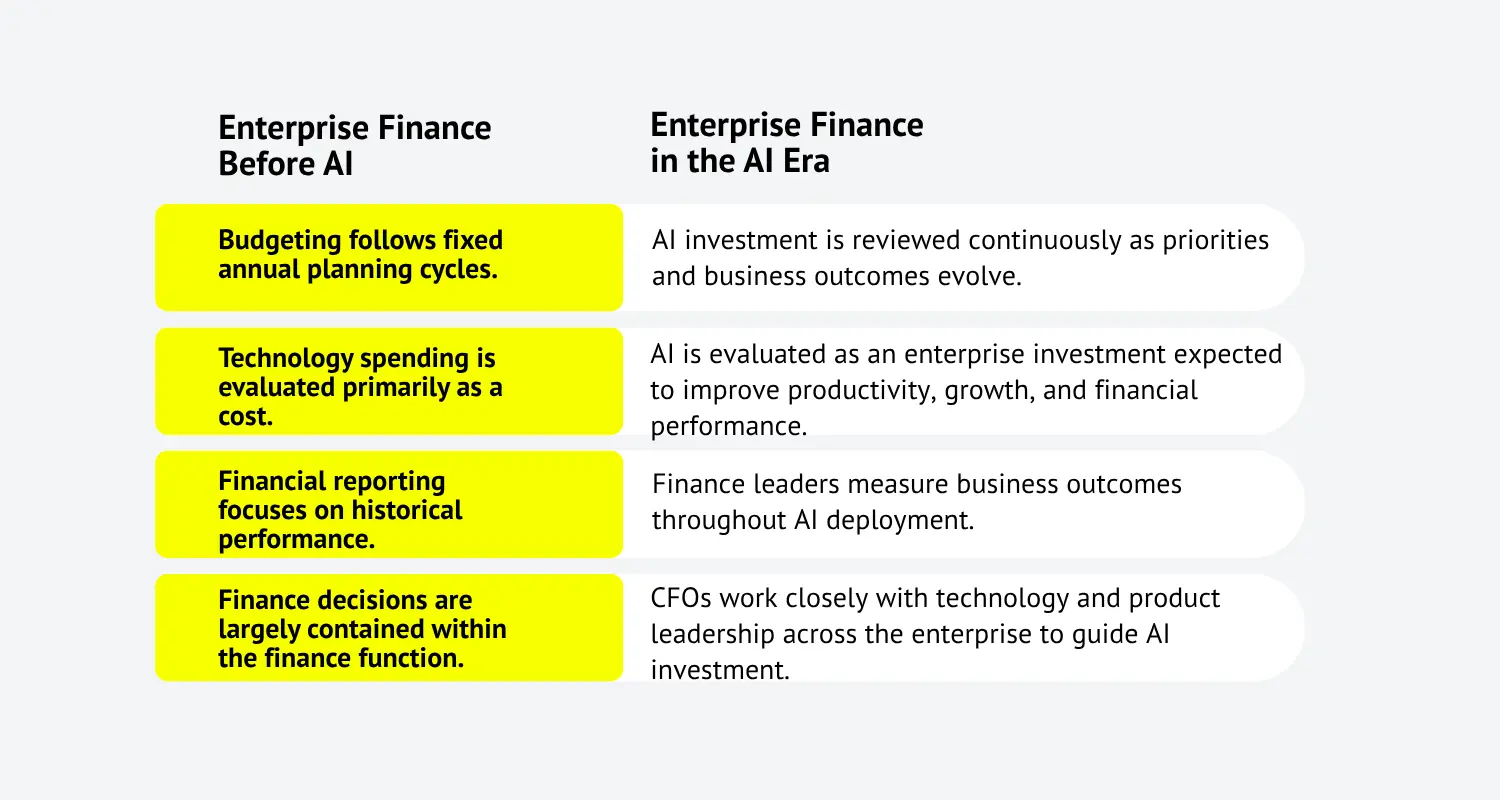
This shift has changed what boards expect from financial leadership. Capital allocation has become a continuous exercise as organizations decide which AI initiatives deserve additional investment, which require adjustment, and which should be discontinued before costs accumulate.
Enterprise AI has also expanded the CFO's influence beyond the finance function. Decisions about AI funding affect product strategy, commercial operations, manufacturing, and corporate planning. Organizations that consistently generate value from AI align financial oversight with enterprise execution, treating AI investment as a core strategic priority.
The Questions Boards Are Asking Their CFOs
Enterprise AI has changed the conversation inside the boardroom. Financial oversight remains essential, but boards expect CFOs to explain how AI investments support business strategy, where additional capital should be deployed, and how financial performance will be measured as programs mature. Deloitte's Q4 2025 CFO Signals survey of 200 North American CFOs found that 87% expect AI to be extremely or very important to finance operations in 2026, and tech transformation has replaced enterprise risk management as the top board priority.
The discussion has also become more dynamic. AI initiatives often evolve over months rather than years, requiring finance leaders to reassess investment decisions as technology capabilities, customer demand, and operating priorities shift. Waiting for annual planning cycles can delay decisions that affect competitiveness.
Boards are asking a different set of questions than they did only a few years ago:
- Which AI initiatives are creating measurable business value?
- Where should additional AI investment be concentrated?
- Which deployments should be scaled, redesigned, or discontinued?
- How should financial performance be measured while AI programs are still evolving?
- Does the finance organization have the data needed to evaluate AI investments consistently across the business?
These questions call for finance leaders who understand how enterprise AI affects commercial performance, operations, product development, manufacturing, healthcare, and other functions where investment influences long-term business outcomes.
What Makes an AI-Native CFO Different
The defining characteristic of an AI-native CFO is experience making financial decisions around enterprise AI deployments that reached production and produced measurable business outcomes.
Finance leaders have always allocated capital. AI investment behaves differently from traditional technology spending. Models improve over time, infrastructure requirements change, and business value often depends on adoption across multiple departments. The CFO must decide where additional investment creates value, where expectations should be adjusted, and when resources should move elsewhere.
An AI-native CFO operates across the organization, well beyond the finance function. Investment decisions depend on close collaboration with technology and product leadership, including CIOs, CTOs, Chief AI Officers, VP of AI, VP of Engineering, and VP of Product, as well as commercial leaders and business-unit executives responsible for deploying AI inside real operating environments.
The difference becomes most visible when an AI deployment falls short of expectations. A traditional finance leader evaluates whether the project remains within budget. An AI-native CFO assesses whether the deployment is producing measurable business value, whether adoption supports continued investment, and whether capital should be redirected before costs accumulate further. That judgment depends on operational familiarity with how AI programs develop.
Traditional CFO vs. AI-Native CFO
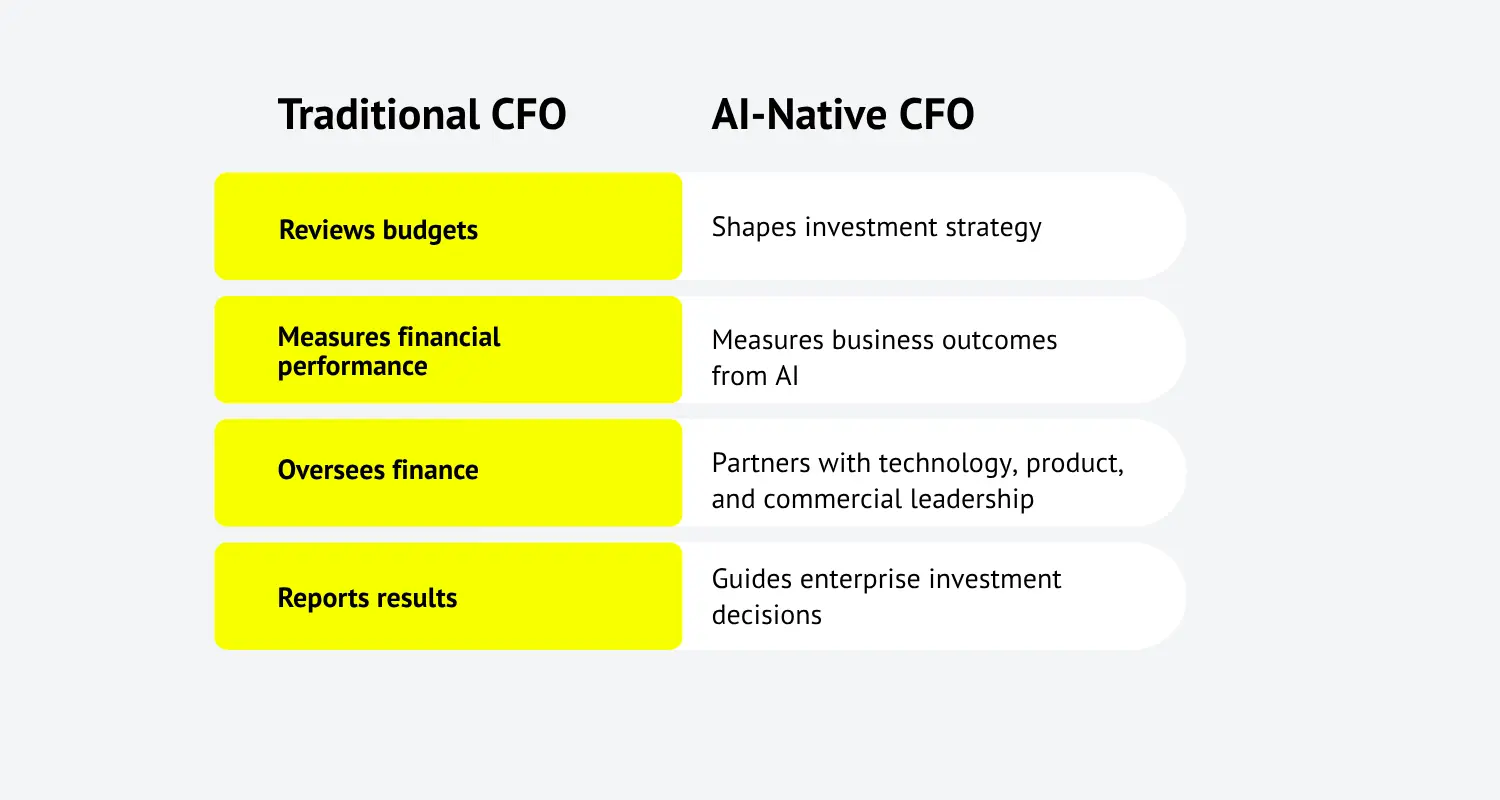
The result is a broader leadership role. Financial discipline remains central to the position, but enterprise AI has made capital allocation, investment governance, and business transformation equally important responsibilities.
Those differences also explain why these searches have become harder to complete. The experience required to lead enterprise AI investment does not follow the same path as conventional financial leadership.
Why Companies Struggle to Hire AI-Native CFOs
AI Familiarity Is Only Part of the Picture
The challenge is not finding finance executives who understand AI. Many senior financial leaders have approved AI budgets, sponsored transformation initiatives, or participated in technology strategy discussions. That background does not demonstrate the ability to lead enterprise AI investment.
The strongest candidates have made financial decisions while AI systems were actively being deployed across the business. They understand how capital allocation shifts as projects mature, how operational adoption influences financial outcomes, and when continued investment creates value instead of compounding cost.
Finding Leaders With the Right Experience Takes Longer
That combination of experience remains uncommon. Organizations are recruiting finance leaders from enterprise software, advanced manufacturing, robotics, healthcare, and cybersecurity sectors, where large-scale AI deployment is already part of day-to-day operations. These environments expose executives to investment decisions that many traditional finance organizations have only recently begun to face.
Executive Search Has Changed
Evaluating these leaders requires different criteria from a conventional CFO search. Financial performance remains important, but boards also need evidence of AI deployment history, enterprise transformation, cross-functional leadership, and measurable business outcomes linked to investment decisions. A candidate who can explain how capital was allocated, what changed during deployment, and what financial results followed provides a much clearer picture than one who lists AI initiatives on a résumé without specifics.
Those changing expectations have reshaped how executive search firms approach these assignments. Evaluating AI-native CFOs means assessing how candidates make investment decisions across the full lifecycle of enterprise AI. Financial reporting and compliance track records alone do not capture that.
How Christian & Timbers Approaches These Searches
The starting point is rarely the candidate profile. Christian & Timbers begins by helping boards, CEOs, private equity firms, and venture investors define how enterprise AI changes the financial leadership the organization needs. That discussion shapes the search strategy, the evaluation criteria, and the industries most likely to produce relevant candidates.
Christian & Timbers' AI-Native Builder Report reflects the growing specialization of this market. Searches for AI-native executive leaders typically remain open more than 54 days longer than comparable non-AI executive searches, and many successful appointments come through direct engagement with passive candidates rather than active applicants.
The assessment goes beyond financial performance. The firm examines how candidates allocated capital while AI systems were being deployed, how investment priorities evolved as projects matured, and how those decisions affected business performance. Experience leading finance during enterprise AI transformation carries greater weight than familiarity with AI technology.
The same evaluation criteria also guide searches for AI-native technology and transformation leaders. Christian & Timbers placed Ashok Paranjothi as SVP of Artificial Intelligence at Acosta Group, where he leads enterprise AI strategy across more than 60,000 associates and is building the AI Center of Excellence responsible for embedding AI across commercial and operational functions. The firm also placed Sylvia Isler as Chief Technology Officer at Atropos Health, where she leads the engineering foundation for GENEVA OS, a real-world evidence platform used across clinical and research environments. These searches illustrate the firm's emphasis on executives who have deployed AI in production and delivered measurable business outcomes across the enterprise.
These searches frequently extend beyond the CFO role itself. Organizations often search simultaneously for Chief Strategy Officers, Chief AI Officers, SVP of AI, VP of AI, VP of Engineering, VP of Product, Chief Commercial Officers, and other executives responsible for enterprise AI deployment. Evaluating how those leaders work together has become just as important as assessing individual credentials.
Organizations preparing to hire an AI-native CFO or other executive responsible for enterprise AI transformation can contact the Christian & Timbers team to discuss their leadership requirements and search strategy.

Questions Boards Ask About AI-Native CFOs
- What is an AI-native CFO?
An AI-native CFO is a finance leader who has experience making capital allocation decisions while AI systems are being deployed across the enterprise. The defining characteristic is operational history. They have evaluated AI investments as they evolved, measured business outcomes throughout deployment, and adjusted financial strategy as organizations expanded AI across multiple functions.
- Why are boards changing how they hire CFOs?
Enterprise AI has increased both the scale and complexity of technology investment. Boards expect CFOs to explain where AI capital should be deployed, how performance will be measured, and when investment priorities should change. Financial oversight remains essential, but AI has expanded the strategic responsibilities attached to the role.
- What experience should organizations look for?
The strongest candidates can describe AI investments they evaluated, the financial decisions they made during deployment, and the measurable business outcomes that followed. Experience approving technology budgets alone rarely provides enough evidence that a leader can guide enterprise AI investment.
- Which industries produce the strongest AI-native finance leaders?
Enterprise software has the longest history of large-scale AI deployment, but organizations are recruiting finance executives from robotics, advanced manufacturing, healthcare, cybersecurity, semiconductor, and other deep-tech sectors where AI has become part of day-to-day operations.
- Can a traditional CFO become AI-native?
Yes. The transition depends on direct responsibility for enterprise AI investment. Finance leaders who actively evaluate AI deployments, work closely with technology and operating teams, and measure business performance throughout implementation can build the experience organizations expect.