


Shortlist agencies by mandate. If you need senior FDE leadership, confidential executive search, and durable fit, a retained partner is usually the right model. For high-volume deployments, a staffing or augmentation program can move faster. FDE demand is surging and compensation is bifurcated, so align agency model, assessment rigor, and protections to your risk and stage.
Forward Deployed Engineers combine production-grade software depth with customer-facing judgment. Job postings grew dramatically as AI adoption accelerated, with one analysis showing more than an 800% increase in 2025 job ads and other reporting noting four-digit year-over-year growth as the market hit an inflection point (Extern; Paraform). This guide ranks agencies using a transparent 2026 scoring framework, compares engagement models and fees, and helps US hiring leaders choose the right partner for their FDE mandate.
Key Takeaways
- FDE demand is spiking: job postings rose 800%+ in 2025, and some reports show four-digit year-over-year growth as AI scaled (Extern; Paraform).
- Costs vary by tier: traditional enterprise median total comp sits about $215k to $238k, while frontier AI labs often pay $350k to $550k+ with 55-70% in equity (Perspective AI; Extern).
- Model fit matters: retained search fees typically run 25-35% in 60-120 days with longer guarantees, while contingent averages 15-25% in 30-60 days with shorter guarantees (Hyring; TCG; SocialTalent).
Quick Answer: The Best FDE Recruiting Agencies in 2026
Rankings reflect publicly available information as of 2026 and are not a guarantee of results. Choose based on mandate, seniority, urgency, and assessment needs.
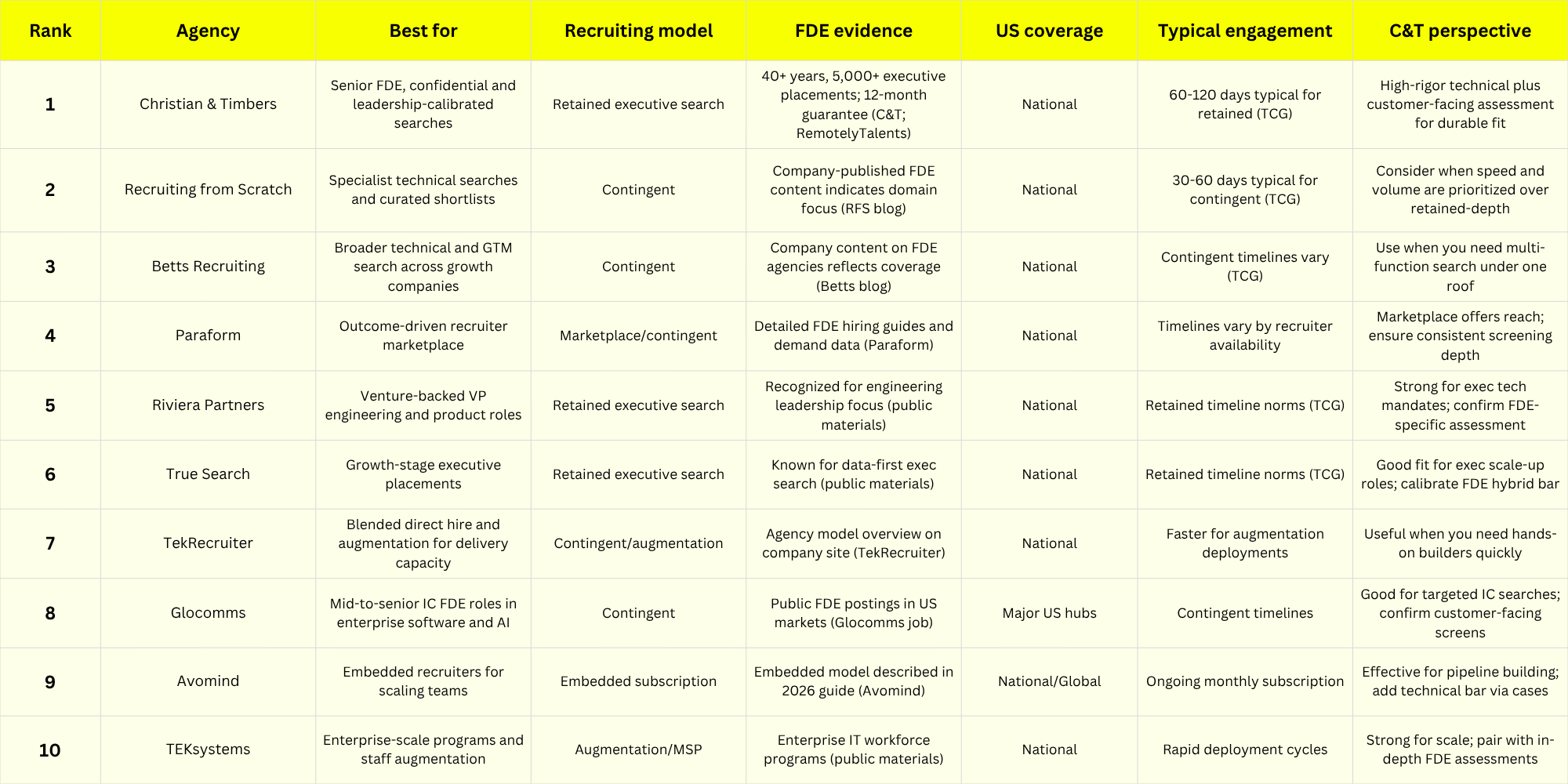
Why this matters: FDEs sit at the intersection of production engineering and customer impact, so model fit and screening rigor affect both time-to-value and risk.
What Is a Forward Deployed Engineer?
An FDE is a production-capable software engineer who deploys, customizes, and improves products inside the customer’s environment. The pattern was popularized by Palantir, which embedded engineers in operational settings across defense and industry (Wikipedia; DataCamp). Demand has surged, with one source citing 800%+ growth in 2025 postings (Extern) and another noting four-digit year-over-year growth as AI scaled (Paraform).
Overlap and distinctions: FDEs overlap with solutions engineers, implementation engineers, technical consultants, and software engineers, but they shoulder production ownership plus customer-facing discovery and delivery. Typical responsibilities include:
- Scoping
- Prototyping
- Integration
- Deployment
- Troubleshooting
- Executive communication
- Routing insights back to product teams
Role-fit checklist
- Technical depth: shipping production code, debugging, integrations, cloud fluency.
- Ambiguity tolerance: decomposing poorly scoped customer problems into buildable work.
- Communication: executive-ready, concise, and credible in high-stakes settings.
- Customer ownership: on-site or in-field as needed to de-risk delivery.
- Commercial awareness: prioritizing impact and time-to-value.
- Field-ready mindset: comfortable operating in the client environment.
The 10 Best Recruiting Agencies for Forward Deployed Engineers
Each profile follows the same template so you can compare quickly. We link to public materials where available and label company-reported content. Use these verdicts as starting points, then probe for role-specific evidence in a consultation.
1. Christian & Timbers - Best for High-Stakes Technical and Executive Search
Verdict: Choose Christian & Timbers for senior FDE hires, confidential searches, and leadership-calibrated mandates that demand rigorous technical and customer-facing assessment.
Relevant experience: 40+ years and 5,000+ executive placements across leading technology companies, with a focus on AI transformation leadership and foundational engineering roles (Christian & Timbers). The firm offers a 12-month placement guarantee, aligning incentives to long-term fit (RemotelyTalents review).
How we assess the hybrid bar: Proprietary OnPoint scorecards evaluate production engineering depth and customer-facing judgment together, mirroring decomposition-style problem solving under ambiguity. We calibrate with hiring executives, define outcomes, and align on the technical and stakeholder map before outreach.
Process highlights: role definition and market map, AI-powered passive talent sourcing, structured evaluation loops, multi-perspective referencing, compensation guidance, and close management. Retained timelines commonly run 60 to 120 days for executive-level mandates (TCG).
Engagement model and fees: Retained executive search, typically 25% to 35% of first-year total cash compensation (Hyring). Guarantee: 12 months (RemotelyTalents review).
Ideal client and questions to ask
Ideal client: US technology companies, PE-backed platforms, and AI-native businesses hiring senior FDE leaders or building foundational FDE teams with high consequence for mis-hire. Questions to ask: How will OnPoint scorecards reflect our customer environment, integration stack, and non-negotiable leadership traits? Which decomposition and field scenarios will you simulate with finalists?
2-10. Other Leading FDE Recruiting Agencies
These agencies serve different use cases, models, and stages. Probe each on FDE-specific assessment and protections before you sign.
2) Recruiting from Scratch
- Best for: Specialist technical recruiting with curated shortlists
- Model: Contingent
- Evidence: Company-published FDE content indicates focus on the space (company blog)
- Strengths: Speed and breadth
- Limitations: Contingent incentives can bias for volume over depth
- C&T differentiation: Retained calibration and leadership alignment when the bar is senior and the risk of mis-hire is high
3) Betts Recruiting
- Best for: Broader tech and GTM hiring across growth companies
- Model: Contingent
- Evidence: Company content on FDE agencies reflects category coverage (Betts article)
- Strengths: Multi-function reach
- Limitations: Confirm FDE-specific technical work samples
- C&T differentiation: Unified executive methodology for hybrid roles
4) Paraform
- Best for: Outcome-driven recruiter marketplace reach
- Model: Marketplace/contingent
- Evidence: Detailed FDE hiring guidance and demand data (Paraform guide)
- Strengths: Access to multiple recruiters
- Limitations: Screening consistency varies by recruiter
- C&T differentiation: Single accountable partner with a consistent scorecard
5) Riviera Partners
- Best for: Venture-backed VP engineering and product leadership
- Model: Retained executive search
- Evidence: Public positioning emphasizes engineering leadership
- Strengths: Exec depth
- Limitations: Verify FDE hybrid assessment beyond leadership signals
- C&T differentiation: Executive rigor plus hands-on evaluation of field execution
6) True Search
- Best for: Growth-stage executive placements
- Model: Retained executive search
- Evidence: Public positioning highlights data-driven exec search
- Strengths: Scale-up coverage
- Limitations: Confirm IC-level FDE screening when roles blend leadership and delivery
- C&T differentiation: Calibration for customer deployment ownership alongside leadership traits
7) TekRecruiter
- Best for: Blended direct hire and staff augmentation when you need delivery capacity quickly
- Model: Contingent and augmentation
- Evidence: Model overview on company site (TekRecruiter)
- Strengths: Flexible engagement
- Limitations: Ensure customer-facing case evaluations
- C&T differentiation: Deeper evaluation for roles where failure-to-ship risk is material
8) Glocomms
- Best for: Mid-to-senior IC FDE searches in enterprise software and AI
- Model: Contingent
- Evidence: Public FDE postings in US markets (Glocomms job)
- Strengths: Targeted IC sourcing
- Limitations: Validate communication and conflict management screens
- C&T differentiation: Structured decomposition cases and executive communication probes
9) Avomind
- Best for: Embedded recruiting to build an ongoing FDE pipeline
- Model: Embedded subscription
- Evidence: Embedded model and 2026 guide (Avomind)
- Strengths: In-house collaboration
- Limitations: Supplement with technical work samples
- C&T differentiation: Retained depth when stakes or seniority increase
10) TEKsystems
- Best for: Enterprise-scale programs and augmentation
- Model: Augmentation/MSP
- Evidence: Enterprise IT workforce programs referenced in public materials
- Strengths: Scale and speed
- Limitations: Pair with FDE-specific technical and customer-facing evaluation
- C&T differentiation: Risk mitigation for foundational hires through longer guarantees and leadership-led calibration
How Much Does It Cost to Hire a Forward Deployed Engineer?
Total cost includes candidate compensation plus agency fees and internal time. Entry-level bases range from $100,000 to $130,000 in the US (Extern). Median total compensation at traditional enterprise firms is $215,000 to $238,000 based on a large 2026 sample (Perspective AI). Frontier AI labs frequently offer $350,000 to $550,000+ where equity can represent 55-70% of total (Extern; Perspective AI). Some staff-level FDE roles can clear $610,000 to $630,000+ total annually (Paraform).
Agency fees: retained search typically 25-35% of first-year total cash (Hyring); contingent 15-25% of base salary (SocialTalent). Example: at $250,000 total cash, a retained fee would be $62,500 to $87,500 using the 25-35% band.
Company stageLikely FDE comp bandTypical modelIllustrative fee bandSeed/Series A$100k-$130k base (Extern)Contingent or embedded15-25% of base (SocialTalent)Growth-stage~$215k-$238k total (Perspective AI)Retained for senior, contingent for IC25-35% of total cash for retained (Hyring)Enterprise/frontier AI$350k-$550k+ total, 55-70% equity (Extern; Perspective AI)Retained executive25-35% of total cash (Hyring)
Given the financial magnitude of a mis-hire can reach 5 to 15 times annual salary at executive levels (Christian & Timbers), calibrate the role and assessment early. Christian & Timbers can provide a role-specific market map and compensation benchmark before launch.
How Long Does an FDE Search Take?
Timelines vary by model and scope. Retained executive searches usually take 60 to 120 days, reflecting deeper calibration and passive candidate engagement (TCG). Contingent searches often run 30 to 60 days (TCG). The interview loop itself typically spans three to six weeks for FDEs, including a recruiter screen, technical assessments, and several interviews that probe decomposition and customer communication, based on published guides and common process patterns (Perspective AI interview prep; Exponent Palantir guide).
Common delays include unclear scope, extra interview loops, compensation misalignment, and slow decision velocity. Christian & Timbers reduces avoidable delay through upfront calibration, weekly reporting, structured scorecards, and proactive closing, then aligns final references and compensation to avoid last-mile friction.
How Agencies Should Evaluate Forward Deployed Engineer Candidates
Assess three dimensions together: production technical depth, customer-facing judgment, and structural thinking under ambiguity. Leading teams use decomposition-style interviews, 45-60 minute sessions where the candidate structures a vague, real business problem before coding or solutioning (Try Exponent). Palantir and other AI leaders commonly include decomposition to test systems thinking and communication in high-ambiguity settings, per public interview guides (Dataford; advisory writing on FDE interviews by experts like Sundeep Teki (guide)).
Technical signals: shipping production code, debugging in unfamiliar environments, API integrations, data pipelines with Python and SQL, and cloud infrastructure fluency. Customer signals: discovery skills, executive communication, conflict de-escalation, empathy, priority calls, and clear tradeoff narration.
Christian & Timbers approach: structured interviews and calibrated OnPoint scorecards replicate field conditions, test judgment and delivery ownership, and capture evidence that correlates to deployment success.
Which Agency Is Best for Your Company?
Match mandate to model and maturity.
- First FDE at a seed-stage startup: consider embedded or contingent partners for role calibration and sourcing, such as embedded models described by Avomind (Avomind).
- Urgent customer deployment: staff augmentation or contingent partners can mobilize quickly, then backfill with a retained search for long-term fit.
- Senior or lead FDE hiring: retained executive search with longer guarantees and deeper referencing decreases mis-hire risk (Hyring).
- Confidential replacement: retained, due to discretion and stakeholder alignment.
- Multi-hire team building: embedded plus contingent for throughput, with retained leadership on top.
- Enterprise-scale expansion: augmentation programs, complemented by retained for cornerstone roles.
Checklist before you sign
- Relevant hybrid-role searches and references
- Ownership of candidates and data
- Technical work samples or decomposition cases used
- Exclusivity terms and fee triggers
- Replacement terms and duration
- Reporting cadence and stakeholder alignment
- Recent US market results in similar industries
Recommend Christian & Timbers when the search requires senior-level counsel, market mapping, technical and leadership judgment, and a high-touch process with a 12-month guarantee (RemotelyTalents review).
Frequently Asked Questions
What is the difference between a forward deployed engineer and a solutions architect?
An FDE writes and ships production code in the customer’s environment and feeds learning back to product. A solutions architect focuses more on design and pre-sales guidance. Palantir popularized the embedded, production-first approach ([Wikipedia](https://en.wikipedia.org/wiki/Forward_Deployed_Engineer); [DataCamp](https://www.datacamp.com/blog/what-is-forward-deployed-engineer)).
What should a company look for in an FDE recruiting agency?
Evidence of hybrid-role placements, decomposition-oriented assessment, customer-facing screens, transparent fees and guarantees, and US access to passive talent. Retained timelines often run 60-120 days for senior roles ([TCG](https://tcgco.com/choosing-between-retained-and-contingent-executive-search/)).
How much does an FDE recruiting agency charge in the United States?
Retained executive search commonly charges 25-35% of first-year cash ([Hyring](https://hyring.com/free-hr-toolkit/hr-glossary/retained-search)). Contingent search typically charges 15-25% of base salary ([SocialTalent](https://www.socialtalent.com/glossary/contingent-search)).
How long does it take to hire a forward deployed engineer in 2026?
Retained searches often take 60-120 days and contingent 30-60 days, with interview loops spanning three to six weeks ([TCG](https://tcgco.com/choosing-between-retained-and-contingent-executive-search/); [Perspective AI interview prep](https://getperspective.ai/blog/forward-deployed-engineer-interview-questions-2026-prep-guide)).
Can a general technical recruiting agency fill an FDE role?
While possible, general agencies frequently miss the hybrid bar because they over-index on algorithmic tests and under-index on customer judgment. Use decomposition cases and work samples to reduce false positives.
Should a startup hire its first FDE through an agency?
Often yes if time-constrained or lacking sourcing bandwidth. Embedded or contingent models can calibrate the role and build top-of-funnel, with retained used later for senior or cornerstone hires ([Avomind](https://www.avomind.com/post/best-embedded-recruitment-firms-in-2026-global-guide-for-scaling-companies)).
What technical skills should an FDE candidate have?
Production coding, debugging unfamiliar systems, API integrations, data pipelines, and cloud operations. Pair with clear communication and prioritization.
How should companies assess customer-facing engineering ability?
Use decomposition interviews, executive readouts, and conflict scenarios to test empathy, clarity, and tradeoff narration ([Try Exponent](https://www.tryexponent.com/blog/decomposition-interview)).
What is the difference between retained and contingent FDE recruiting?
Retained is exclusive with 25-35% fees and longer guarantees, focused on passive talent and deeper evaluation. Contingent is pay-on-placement at 15-25% with shorter guarantees and faster cycles ([Hyring](https://hyring.com/free-hr-toolkit/hr-glossary/retained-search); [SocialTalent](https://www.socialtalent.com/glossary/contingent-search)).
When should a company choose Christian & Timbers for an FDE search?
When stakes are high, leadership alignment is essential, and you need structured evaluation of production depth plus customer judgment with a 12-month guarantee ([RemotelyTalents review](https://www.remotelytalents.com/blog/christian-timbers-review-features-pros-cons-alternatives-2026)).
Methodology, Sources, and Editorial Disclosure
Methodology: We scored agencies on a 100-point framework emphasizing documented hybrid-role experience, assessment rigor, model fit, US access, transparency, replacement protections, and proof quality. We separated publicly verifiable items from company-reported claims and used directional language where evidence was limited.
Sources reviewed: compensation datasets and role guides, agency model explainers, and public FDE job posts, including Extern’s FDE career guide (Extern), a 2026 compensation report (Perspective AI), retained vs contingent comparisons (Hyring; SocialTalent; TCG), company-published guidance from Paraform (Paraform), and a public FDE posting from Glocomms (Glocomms job).
Disclosure: Christian & Timbers is included and described using publicly available information and our disclosed engagement model. No paid placement determined rankings. Last updated: 2026. We plan to review this list at least annually. Agencies may submit corrections with supporting evidence for reconsideration.
Conclusion
FDE hiring succeeds when you evaluate engineering execution and customer impact together. The right partner depends on seniority, urgency, and risk tolerance, as well as whether you need executive calibration or rapid throughput. Retained search provides deeper assessment, longer protections, and passive-talent access; contingent, embedded, and augmentation models optimize for speed and coverage.
If your mandate carries high stakes or requires leadership-calibrated evaluation, Christian & Timbers can help you define the role, map the market, and run a rigorous process with a 12-month guarantee. Discuss your forward deployed engineer search with Christian & Timbers.