



Companies often realize too late that they hired at the wrong level. Before opening the search, leadership should decide who will set the AI agenda and control investment decisions. That authority usually belongs with a VP. Once the direction is established, a Director can take responsibility for delivery.
Companies use these titles differently. The clearest distinction is the authority each leader holds when budgets tighten or priorities compete.
Key Takeaways
- Hire a VP of AI when the company needs an executive to define its AI strategy and operating model.
- A Director of AI can be a strong fit when the strategy already exists and the priority is managing delivery.
- IBM’s 2026 CEO Study found that 76% of surveyed organizations had a Chief AI Officer, up from 26% in 2025.
- Christian & Timbers’ compensation research places VP of AI Engineering base pay at $300K to $603K and Director-level base pay at $275K to $546K, showing substantial overlap between the two levels.
What Does a VP of AI Do?
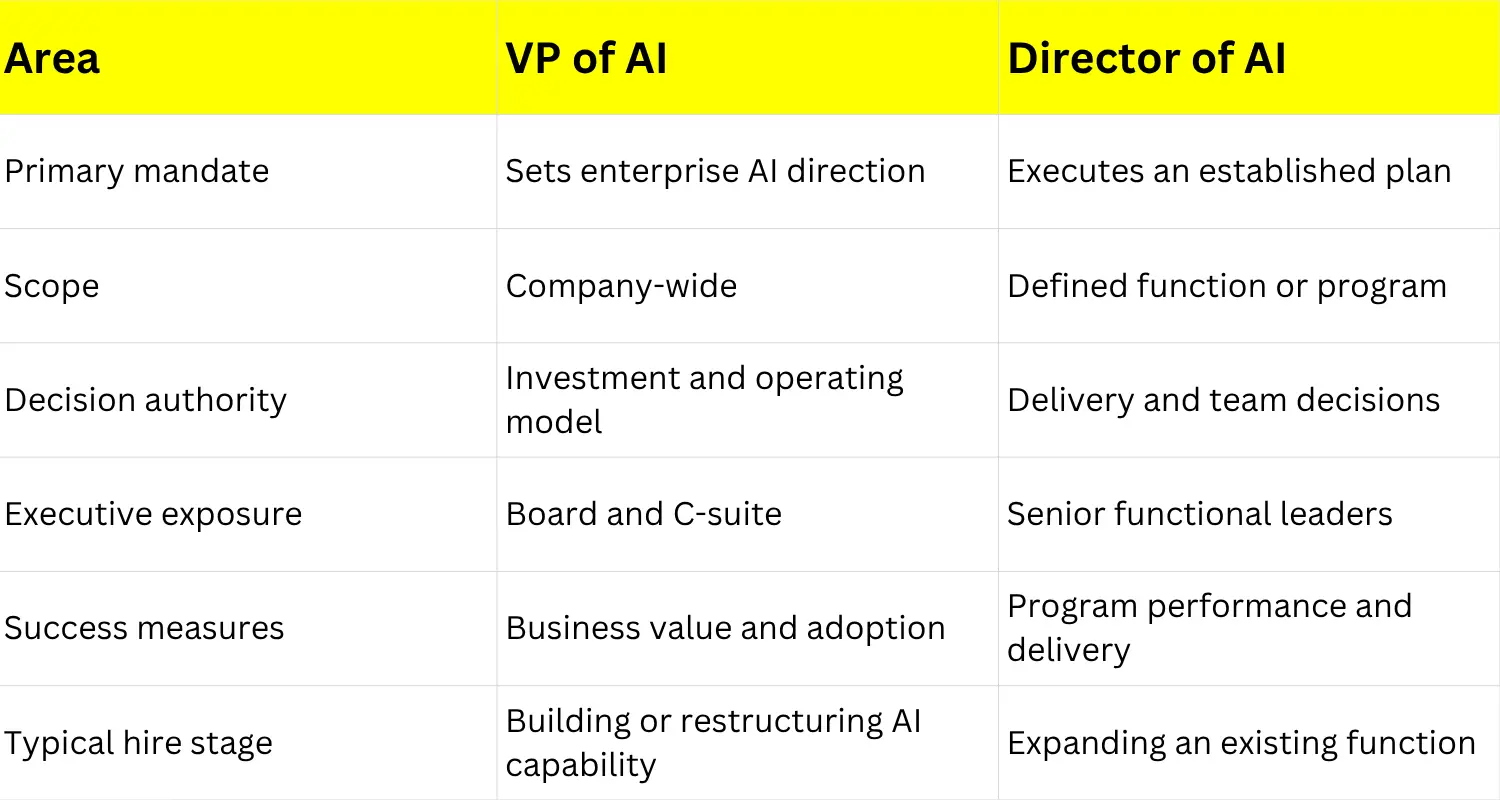
A VP of AI owns AI direction across the company. That means setting investment priorities across functions and deciding which initiatives receive funding. The VP also answers for the resulting business value. The role sits close to the top of the org chart. A VP of AI commonly reports to the CEO or a senior technology executive. The role also requires the ability to explain AI priorities clearly during board discussions.
The scope runs wider than most job postings suggest. A VP of AI is usually accountable for the operating model itself: how AI gets evaluated and rolled out across the company, and who has authority to make that call when priorities compete.
What Does a Director of AI Do?
A Director of AI runs a team or a defined program. The work is real leadership, but it operates inside boundaries someone else set. That includes project delivery and technical team management. The director also coordinates with the business units affected by the work.
Senior leadership usually establishes the priorities. The Director of AI turns those decisions into a delivery plan and keeps the work moving toward production.
VP of AI vs. Director of AI: The Main Differences
When Should a Company Hire a VP of AI?
The clearest signal is fragmentation. Several teams may be running AI pilots without a shared roadmap or clear accountability. When projects stall and no executive owns the outcome, the company likely has a VP of AI leadership gap. Companies building their first AI organization face a similar problem from a different angle: without someone empowered to set the operating model, every new initiative reinvents its own process.
When technical and business teams pursue separate AI agendas with no one able to arbitrate between them, adding another director just adds a voice to the argument. What the company needs is someone with the standing to make the call and own what happens next.
IBM’s 2026 CEO Study surveyed 2,000 CEOs across 33 countries and found that 76% of their organizations had a Chief AI Officer, up from 26% in 2025. The finding shows how quickly companies are assigning executive ownership of AI.
When Is a Director of AI the Better Hire?
A Director of AI is the right hire when an accountable executive already owns the strategy and the organization has approved a roadmap. The role then centers on team decisions and getting the work into production.
This is often the right call for companies expanding a function that already works. The AI program exists, it has budget, and the remaining need is a leader who can manage the team and delivery schedule.
Why Companies Mislevel the Role
The mistake often appears in the job description before it reaches a candidate. Companies ask a Director of AI to define enterprise strategy while giving the role limited authority over budget or organizational priorities. That mismatch can deter senior operators who recognize that the mandate exceeds the position's actual power, and the ones who take the job anyway tend to leave once they hit the ceiling built into the title.
Misleveling also creates problems at the VP level. A company that gives the VP title while retaining budget authority under the CTO creates an expensive figurehead. At the director level, expecting board-level ownership produces a mandate that exceeds the role's authority.
Christian & Timbers' 2026 Corporate AI Compensation Study, drawn from closed offers at public companies between 2,000 and 10,000 employees, puts VP of AI Engineering base salary at $300K to $603K with equity ranging from $350K to $2.3M. Director of AI Engineering base salary runs $275K to $546K, with equity between $300K and $1.495M. The compensation ranges overlap substantially. A company can therefore pay VP-adjacent compensation while limiting the role to director-level authority. That mismatch raises the cost of getting the mandate wrong.
IBM found that organizations with a Chief AI Officer achieved a 5% higher return on their AI investments.
How AI Deployment Changes the Decision
Building models and deploying them into production call for different leadership instincts, and that's worth separating clearly from the VP of AI question. A VP of AI may own the full portfolio, including model strategy and the business case behind it. A VP of Deployment has a more focused mandate: moving AI systems into production and making them work under real operating conditions.
A Director of AI can report to either leader depending on how the company has split the work. Some organizations keep model development and deployment under one VP of AI umbrella. Others split the two roles apart. Either structure can work. The company must define the boundary between model ownership and deployment accountability. It should also assign final decision authority when priorities conflict.
Christian & Timbers’ AI-Native Builder Report identifies the Chief Agentic Deployment Officer as an emerging role focused on moving AI agents into production and tracking returns across the business. Christian & Timbers expects large enterprises to establish the position by 2027. The distinction between VP of AI and VP of Deployment follows similar logic one level down.
What to Assess During the Search
Four things separate a strong candidate from a resume that just uses the right words:
- Scope of previous ownership. Did they run a company-wide mandate, or a single team's roadmap within someone else's strategy?
- Production deployment record. Have they shipped AI systems that survived contact with real users and real data, or only pilots that stayed pilots?
- Ability to connect AI work to financial outcomes. Can they point to a number the business cared about, not just a model that performed well in testing?
- Experience building teams and decision systems. Have they set up the process that lets an organization make AI decisions repeatedly, or did they make good calls once and rely on instinct after that?
How Christian & Timbers Recruits VP and Director of AI Leaders
Christian & Timbers begins AI leadership searches by defining the mandate before sourcing candidates. The process establishes the decisions the new leader must own and the experience required to carry that authority.
Because titles vary across companies, the candidate map extends into adjacent roles. That can include Heads of AI, VPs of Machine Learning, Directors of Applied AI, and enterprise AI leaders whose responsibilities match the mandate. Christian & Timbers evaluates what each candidate controlled and the results they delivered once the work reached production.

Frequently Asked Questions
- Is a VP of AI higher than a Director of AI?
In most org structures, yes. A VP of AI typically sits above a Director of AI and holds broader scope and decision authority. That said, title inflation is common enough in AI hiring that scope should always be verified independently of the title on the job posting.
- Can a Director of AI report to the CTO?
Yes, and it's a common structure. A Director of AI reporting directly to the CTO works well when the company hasn't yet created a dedicated VP of AI role, or when AI strategy sits close enough to the technology function that a separate VP layer isn't needed yet.
- Does a company need both roles?
Larger organizations with mature AI programs often do: a VP of AI for direction and a Director of AI for execution. Smaller companies can usually cover the work with one clearly scoped leadership role.
- When should a Director of AI be promoted to VP?
When their scope has already expanded past the title. Promotion becomes appropriate when a Director of AI controls investment decisions across teams and presents the company's AI strategy to the board.