
A sales engineer's core job is largely done once the customer signs: proving the product can solve their problem. Everything that follows, from integration through the measurable result it produces, is what a Forward Deployed Engineer owns.
Christian & Timbers found roughly 17,000 U.S.-based FDEs, but fewer than 2,000 meet the firm's bar for repeated, production-proven deployments. TechCrunch later profiled the race for FDE talent as the AI industry's latest talent obsession. The gap widens further when companies write FDE searches around responsibilities that still resemble sales engineering, mistaking proximity to a deployment for ownership of one.
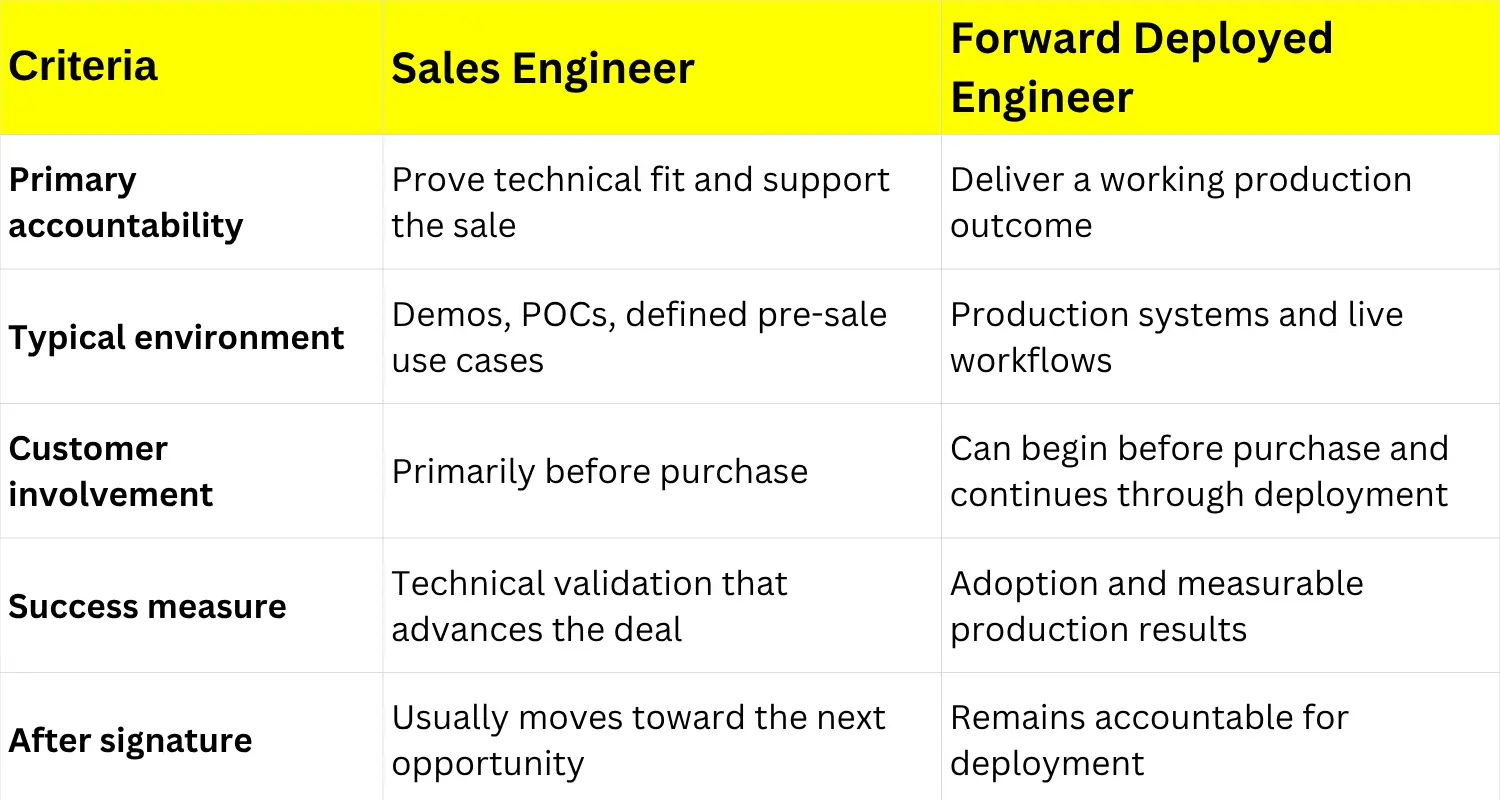
The two roles differ less in technical skill or customer contact than in where accountability ends.
Key Takeaways
- Sales engineering accountability centers on technical fit during the buying process. FDE ownership continues well past the signature, into production and measurable results.
- Sales engineers typically work toward defined pre-sale questions through demos, proofs of concept, technical discovery, and validation exercises. FDEs work through live permissions, legacy infrastructure, security reviews, and workflows that rarely match the original spec.
- The clearest test for which role a company is describing: does the person's accountability largely end at signature, or continue through production?
- Elite, production-proven FDE talent is the harder hire by a wide margin. Sales engineering draws from a far larger, more established talent pool.
- Demand is accelerating fast: Christian & Timbers found the share of companies planning to hire an FDE jumped from 5-10% to 70% in two quarters, with total FDE demand projected to rise 2,100% by year-end.
What Does a Sales Engineer Do?
A strong sales engineer can prove technical feasibility without ever owning the production system that follows. The distinction matters when companies use sales engineering experience as a stand-in for FDE experience.
The work runs through technical discovery calls, live demonstrations, integration discussions, and proofs of concept built to answer a specific buying question. A good sales engineer speaks fluently to both the technical buyer and the economic buyer, translating product capability into a case for purchase.
The sales cycle defines the boundaries of the role. Once the deal closes, the sales engineer's accountability for that account typically winds down, and the engineer moves to the next prospective customer.
How a Forward Deployed Engineer Operates
The FDE's value becomes clearest once the conditions that made the demonstration work disappear.
Production introduces live permissions, legacy infrastructure, security requirements, unexpected edge cases, and users whose workflows rarely match the original specification. The FDE is hired to handle exactly that environment.
The FDE stays with the deployment through go-live and beyond, adapting the system to the customer's actual environment and remaining accountable for the outcome it produces.
The Difference Is Where Accountability Ends
A sales engineer's accountability is scoped primarily to the commercial process and typically winds down after the deal closes. For the FDE, the clock doesn't stop at signature. Accountability follows the work into the production result, regardless of when the customer relationship began.
For hiring teams, one question often exposes the difference: does this person's accountability largely end at signature, or continue through production? If the engineer typically moves to the next opportunity once the contract is signed, the company is probably describing a sales engineering role. If the engineer remains accountable as the system moves into production, the role is much closer to forward deployed engineering.
Sales Engineer vs. Forward Deployed Engineer
Where Companies Get the Role Wrong
The hiring mistake usually appears in the search specification before it appears in the candidate pool. Christian & Timbers found the share of companies planning to hire an FDE jumped from 5-10% at the start of the year to 70% by the end of the second quarter, part of a surge the firm projects will push overall FDE demand up 2,100% by year-end. That rapid expansion creates a role-definition problem. A company asks for someone who can run technical demonstrations, support enterprise sales, deploy AI into production, work through security and integration failures, drive user adoption, and remain accountable for ROI.
On paper, that can look like one customer-facing engineering role. In practice, the company has combined two different accountability models.
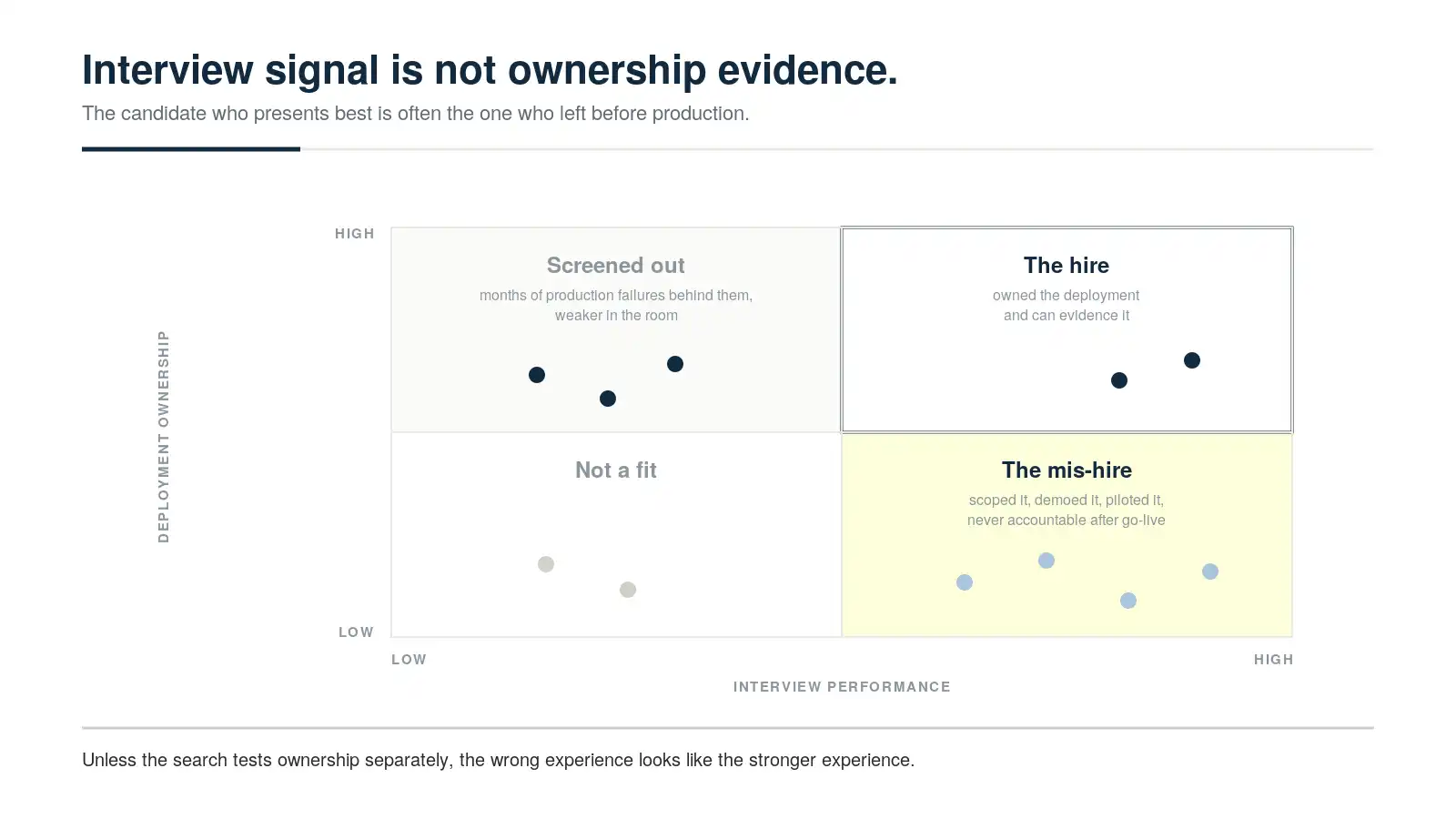
Proximity to a deployment is weak evidence of deployment ownership. A candidate may have scoped the use case, run the demo, built the proof of concept, and worked directly with the customer without ever being accountable for what happened once the system reached production.
The problem carries into the interview process. A candidate who is exceptional at discovery and technical persuasion can interview better than an engineer whose experience was built over months of resolving production failures after the contract was signed. Unless the search tests deployment ownership separately, the wrong experience can look like the stronger experience.
When Should You Hire an FDE Instead of a Sales Engineer?
The decision comes back to the same question that's run through this whole comparison: what does the hire need to be accountable for? A sales engineer search should test for the ability to convince a customer the product works. Once that question turns into making the system work after signature and owning what happens next, the search needs FDE evidence instead.
Companies that need both sometimes try to compress them into a single role, and the mistake shows up quickly. A sales engineer asked to own production deployment is being moved beyond the role's typical accountability structure, and the hiring process may never have tested for the production engineering depth the work requires. An FDE asked to spend their time on pre-sale demonstrations is being pulled off the deployment work that justifies the hire. Either way, the hire's accountability has to match the question the search was meant to answer.
What Hiring Teams Ask About FDEs and Sales Engineers
- Is a Forward Deployed Engineer a sales role?
No. An FDE may work closely with customers and account teams, but the job is defined by accountability for a production deployment rather than for closing revenue.
- Can a sales engineer become a Forward Deployed Engineer?
Some do, but it requires a real shift in scope, from supporting a buying decision to owning a system through production. The customer-facing skills transfer. The engineering depth and production accountability have to be demonstrated separately.
- Do companies need both sales engineers and FDEs?
Often, yes. A sales engineer supports the deal. An FDE delivers on what the deal promised. Treating them as interchangeable when writing a search specification is one of the more common hiring mistakes we see.
- Which role is harder to hire?
Forward Deployed Engineers are the scarcer hire. Christian & Timbers identified roughly 17,000 people in the broader U.S. FDE market, but fewer than 2,000 met the firm's bar for repeated, production-proven deployments. Sales engineering draws from a much larger and more established talent pool.
How C&T Evaluates Candidates
Christian & Timbers built its Elite FDE Scarcity Study after seeing the same problem surface across AI talent searches: customer-facing technical experience was being treated as evidence of production deployment ownership, even though that experience alone doesn't establish the record. In an FDE search, the firm looks beyond the title to the candidate's actual deployment record: what they built inside a customer environment and what measurable result the deployment produced after go-live. This distinction changes both the candidate pool and the evidence required to advance someone through the search.
Companies often discover the distinction between sales engineering and forward deployed engineering when a search specification crosses both functions. For sales leadership recruiters and internal talent teams, the challenge is determining whether customer-facing technical experience includes production ownership. A search for technical talent that helps win complex enterprise deals requires different evidence from an FDE search, where production deployment ownership is central. In interviews, that means getting specific about what broke during deployment, what the candidate changed to fix it, who ultimately adopted the system, and how the business result was measured.