



Speaking fluently about AI has become common among executive candidates. Leaders who have repeatedly deployed AI systems that produced measurable business outcomes remain much harder to find.
In my previous article, I wrote about why enterprises are building permanent Forward Deployed Engineering teams. In this article, we will discuss the next challenge: separating AI fluency from AI-native experience when hiring the people who will lead and build them.
Key Takeaways
- AI fluency has become close to universal among executives, with Chief AI Officer roles nearly tripling in a single year and AI-referencing job titles more than tripling since 2022.
- AI-native experience means having built and deployed real systems, then kept them running under pressure, a different skill than explaining how they work.
- Boards now ask AI leadership candidates for proof of delivered ROI instead of a vision statement.
- Christian & Timbers' research found only about 2,000 of the roughly 17,000 U.S. Forward Deployed Engineers consistently deliver measurable outcomes.
Two AI leadership candidates can walk into the same interview and sound equally sharp. Both can explain large language models, retrieval-augmented generation, and agent orchestration without missing a beat. Only one of them has shipped an AI system into production and watched a real business metric move because of it.
That gap, fluent versus native, is becoming one of the most expensive hiring mistakes in enterprise AI, right as companies stand up permanent Forward Deployed Engineering teams to close it.
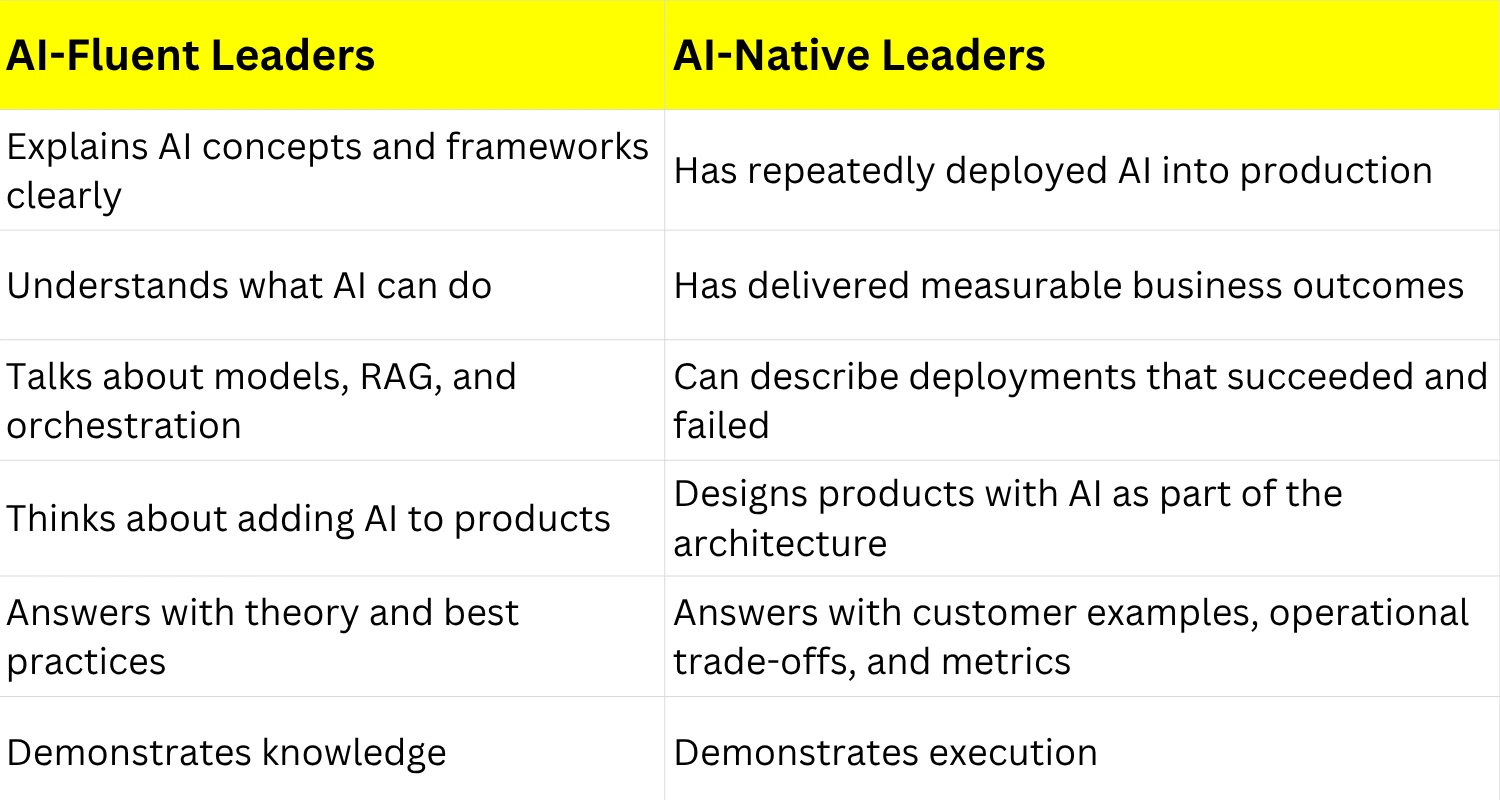
At Christian & Timbers, we define AI-native leaders by three characteristics: they've repeatedly deployed AI into production, delivered measurable business outcomes, and think about AI as part of the architecture rather than another product feature.
AI-fluent leaders understand AI concepts, terminology, and strategy. AI-native leaders have repeatedly translated that knowledge into production systems that delivered measurable business value.
AI Fluency Has Become the Default
The vocabulary shift shows up in the data as clearly as it does in conversation. The share of organizations with a Chief AI Officer jumped from 26% to 76% in a single year, according to IBM's Institute for Business Value. Job titles referencing AI expanded alongside it: Indeed Hiring Lab research shows the number of frequently advertised AI-referencing job titles grew from 264 in 2022 to 822 in the first quarter of 2026, with nearly two-thirds sitting outside traditional technology roles entirely.
None of that is a bad thing on its own. It means baseline fluency, understanding what a model can do and being able to talk about it credibly in a boardroom, has become standard for any executive role touching technology. The problem is what happens once fluency becomes standard: it stops working as a signal for anything.
AI terminology used to signal expertise. It doesn't anymore. A phrase like 'RAG pipeline' now shows up in job postings and everyday conversation across most functions in a company. Executives who've never touched a line of code can explain how a vector database works because that vocabulary has become table stakes in leadership conversations about AI.
Some organizations believe they're hiring AI-native talent when they're hiring AI-adjacent talent instead. The distinction often becomes visible only after a deployment reaches production.
Why AI Fluency Is Easy to Mistake for AI-Native Experience
Hiring teams get fooled for a predictable reason. Confidence and execution look identical from across a conference table, and a candidate who can walk through a maturity framework and answer follow-up questions without hesitation reads as an expert, whether or not they've ever carried a system into production.
Conference speakers and consultants are particularly good at generating this impression, since fluency and delivery experience often appear in the same biography without one implying the other.
The result is that interview panels end up rewarding the wrong evidence. A polished framework explains what should work in general. It says nothing about what a specific candidate has gotten to work, inside a company's actual constraints.
Most interviews form an opinion before they ever ask for evidence of execution. By the time the conversation turns to delivery, most hiring teams have already decided who the expert is.
What AI-Native Experience Looks Like
AI-native builders leave different evidence behind. They've taken a system from prototype into production, then spent the following months keeping it running against real customer data instead of a curated demo set, working inside legacy systems and constraints a demo never has to touch. They've sat through a deployment that broke in front of a client and had to explain, on the spot, what went wrong and how they'd fix it. And they can point to a specific number, like revenue recovered or defects caught before they reached a customer, that changed because of what they built.
AI-native leaders also approach product design differently. Instead of asking how AI fits into an existing product, they ask what the product would look like if AI shaped it from day one. That architecture-first thinking rarely appears in a resume bullet, which is why it often gets missed.
Christian & Timbers' research found that of the roughly 17,000 Forward Deployed Engineers in the United States, only about 2,000 have consistently delivered measurable enterprise AI outcomes. Those are the builders who meet our definition of AI-native experience.
That's the difference interview panels should be looking for. The distinction becomes clearer when viewed side by side:
Boards Are Looking for AI-Native Leaders
Boards have changed what they expect from AI leadership candidates because AI spending has become material to company performance. Once AI investment reaches that scale, oversight changes too. Directors are responsible for understanding how that capital will generate returns, making execution history far more relevant than a well-articulated strategy.
As a result, interviews resemble due diligence rather than vision-setting. Boards want evidence that a candidate has taken AI initiatives from investment to measurable business outcomes that directors can confidently defend to shareholders.
Why Interviews Miss the Difference
Most organizations still evaluate AI leadership candidates using hiring frameworks built for earlier technology transitions, like cloud migration and digital transformation, where strategy and change-management experience carried real weight. Those frameworks worked reasonably well for a slower kind of change, one where the gap between describing a transformation and running one stayed relatively narrow.
AI widened that gap faster than most hiring processes adjusted to it. A VP of AI or Head of AI candidate can still pass a strategy-heavy interview loop built for that older, slower transition, one where explaining the plan mattered nearly as much as having executed it.
The interview process itself has become part of the evaluation. AI-native candidates often see a slow hiring process as evidence that decision-making inside the company moves just as slowly.
The Questions That Reveal AI-Native Experience
A handful of questions cut through vocabulary fast:
- A project where a customer's stated requirement turned out to be wrong, and what they built once they realized it.
- A deployment that broke in production, and how they diagnosed it while the customer was watching.
- The specific business metric that moved once their work went live.
Candidates who've only read about AI answer these with hypotheticals or borrowed examples from articles they've seen. Candidates who've built and deployed AI answer with specifics, usually revolving around rollout failures, workflow redesign, adoption challenges, and the decision that determined whether a deployment expanded or stalled.
What This Means for Enterprise Hiring
AI-native leaders build organizations differently because they've done it before. They can explain why infrastructure expertise mattered before application development started, and the point at which Forward Deployed Engineers became necessary rather than optional as deployment moved from one business unit to the next.
That sequencing judgment shapes org design as much as it shapes the roadmap. A leader who has scaled a deployment team before knows when to centralize it so knowledge compounds, and when embedding engineers closer to a business unit matters more than consistency. A leader who hasn't done this before tends to build the team the org chart suggests instead of the one the deployment needs.
Christian & Timbers Built Its Practice Around This Exact Distinction
This distinction has shaped Christian & Timbers' approach to AI leadership searches for several years. The firm built its AI-Native Builder practice around it, running searches for CTO, CPTO, VP of AI, Head of AI, and Chief Robotics Officer roles where fluency alone has already cost a company one bad hire. The thesis has stayed consistent since 2025: every company is becoming an AI company, but the builders who can make that transition work are far scarcer than the leaders who can talk about it.
The full scope of that gap, and how it's reshaping enterprise AI hiring, is detailed in Christian & Timbers' report, America's Most Wanted Enterprise AI Talent. Enterprises building deployment capability now should read it before their next AI leadership search, while the hire can still be shaped by what's in it.
That framework continues to guide recent searches. Ashok Paranjothi joined Acosta Group as SVP of AI after leading enterprise AI initiatives that combined technical depth with large-scale business execution. Sylvia Isler was appointed CTO at Atropos Health for her experience translating AI research into production systems used in healthcare. Those searches prioritized proven execution over AI fluency alone.
Enterprise AI has reached the point where execution decides who wins. Organizations that can distinguish AI fluency from AI-native experience will build stronger leadership teams and turn AI investment into measurable business outcomes faster than competitors still hiring for the wrong signals.

Frequently Asked Questions
- What's the difference between AI-fluent and AI-native talent?
Fluency is easy to screen for and easy to fake. Native experience shows up in specifics, like a deployment that broke or a business metric that moved because of what they built. If a candidate can't produce those specifics under questioning, the fluency probably isn't backed by anything.
- Why has AI fluency become such a weak hiring signal?
AI terminology is now widely available through articles and courses, and Chief AI Officer adoption alone nearly tripled in a single year, so accurate vocabulary indicates far less about hands-on execution experience than it did a few years ago.
- What interview questions reveal AI-native experience?
Questions that ask for specifics, a failed deployment, a corrected customer requirement, or a business metric that moved, tend to separate candidates with real execution history from those without it.
- Why do standard interviews miss this distinction?
Most organizations still run AI leadership searches through hiring frameworks built for earlier, slower technology transitions, where strategy experience carried as much weight as deployment history. AI changed faster than those frameworks did.
- How does this connect to Forward Deployed Engineering hiring?
As enterprises build permanent FDE organizations, hiring AI-fluent leaders instead of AI-native ones directly slows the deployment work those teams are supposed to accelerate.