


Aerospace and defense companies used to compete mainly with one another for executive talent. That boundary has blurred as AI companies, robotics firms, commercial aerospace, automotive, and advanced manufacturers recruit from the same leadership pools. Boards now face a different challenge: determining which experience will translate into a defense environment.
This article outlines a practical framework for evaluating which cross-industry capabilities are most likely to succeed inside aerospace and defense.
Key Takeaways
- AI, autonomy, and production expansion are pushing aerospace and defense companies to recruit leadership talent from software, automotive, commercial aerospace, and advanced manufacturing, well beyond the traditional defense contractor pool.
- Successful cross-industry hiring depends on evaluating transferable capability instead of relying on a familiar résumé.
- Transferability breaks into four layers, from technical capability up through mission mindset, and each one has to hold before the next one matters.
- Even a well-assessed hire can struggle if the organization isn't ready to support the change it's asking that executive to lead.
Why Boards Are Looking Beyond Traditional Defense Talent
The shift tracks the pace of investment inside the industry itself. The Department of Defense requested $13.4 billion for AI and autonomous systems in its fiscal 2026 budget, the first time the department has broken these technologies out as their own budget category, with roughly $9.4 billion of that going to unmanned aerial systems and another $1.7 billion to maritime autonomous platforms. That kind of capability build-out is expanding the pool boards draw from. Plenty of defense executives have already built these capabilities themselves, and boards are now weighing them alongside leaders who built AI platforms and autonomy programs in adjacent industries.
Physical capacity is scaling at a similar pace. Defense prime contractors are investing more than $10 billion combined to expand assembly lines, modernize plants, strengthen supplier networks, and add capacity for programs like the plan to quadruple THAAD missile output from 96 units a year to 400. Lockheed Martin alone has committed more than $9 billion toward expanding munitions production, adding new facilities, automated assembly lines, and apprenticeship pipelines to hit that target. Standing up that kind of scale takes operations and manufacturing leaders who have run high-rate lines before, which is exactly the experience automotive and advanced manufacturing bring.
Put together, the capital going into AI, autonomy, and manufacturing is pulling in one direction: toward a wider talent pool than the traditional defense bench alone.
Why Cross-Industry Searches Fail
Cross-industry hiring usually fails because boards place too much weight on familiarity and not enough on transferable capability. A recognizable employer, an impressive title, prior success in a fast-moving sector, or a strong reference can all create confidence that the evidence doesn't support. The strongest boards separate the capability that made an executive successful from the environment where it was developed, then assess whether it will transfer into defense. The goal is to identify leaders who can bring valuable capabilities from another industry while adapting them to defense's operating environment.
Every Industry Brings Different Strengths
.png)
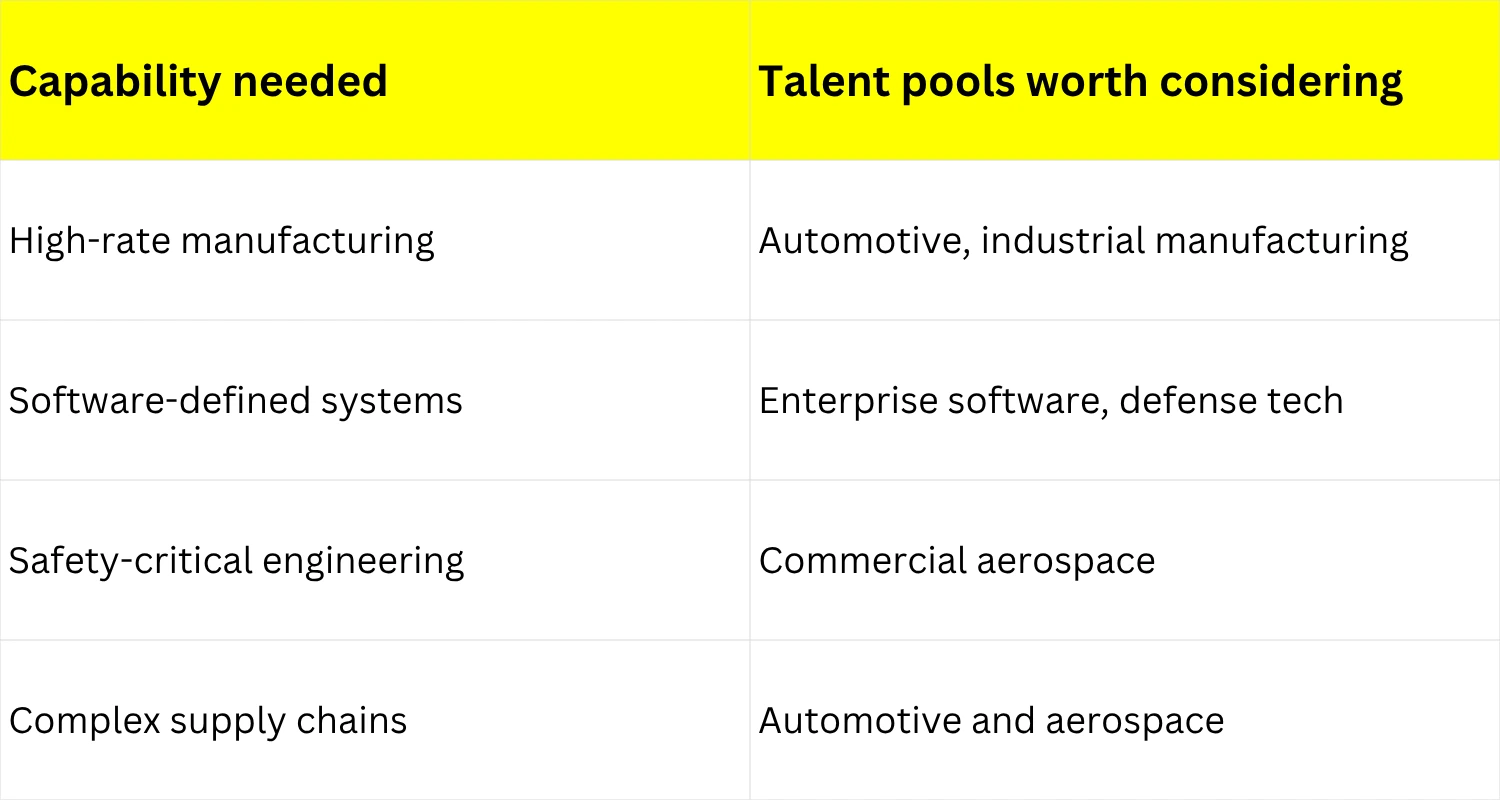
This is a useful map for figuring out which roles suit which backgrounds. It isn't a guarantee that any of these strengths will hold up once the executive is inside a defense organization.
Think in Capabilities
The table above only narrows the search. A board still has to do the real assessment candidate by candidate. A sharper approach flips the question: instead of asking which industry a candidate came from, ask which capability the role requires, then look at which talent pools tend to produce it. High-rate manufacturing discipline, for example, might come from automotive, industrial manufacturing, or another adjacent sector entirely.
Boards that define the capability first usually widen the pool without lowering the bar. Boards that start from an industry label tend to narrow the search before they've identified the skill the role needs in the first place.
Experience Doesn't Automatically Transfer
That's because defense has operating realities most outside executives haven't dealt with before: government customers, export controls, security clearances, longer procurement cycles, and a bar for reliability that doesn't compare to a missed product launch or a delayed vehicle line. Those realities change how a leader has to operate.
Great executives succeed in this environment because they adapt what they've learned elsewhere instead of repeating it. Running defense engineering the way a software leader ran a product team means colliding head-on with export control and security requirements that never came up before. Hitting defense production targets the way an automotive plant hits its numbers looks similar on paper, but the customer on the other end values reliability over almost everything else, speed included.
The Four Layers of Transferability
Boards evaluating a cross-industry candidate are really testing four things, and each one sits on top of the last rather than getting checked off on its own.
1. Technical Capability
The baseline test: does the skill that made this executive successful elsewhere hold up against what the defense role requires?
2. Operating Environment
A candidate can clear the first layer and still fail here. Government customers and export controls demand a leader who has already operated inside a compliance-first culture. Learning it on the job is rarely fast enough to matter.
3. Leadership Style
Skill without credibility rarely survives contact with an engineering organization that doesn't yet trust the new leader. Earning that trust with technical teams who've spent careers inside defense is a separate test from technical fit, and it's where a lot of strong resumes stall.
4. Mission Mindset
Often the hardest layer to demonstrate. Strong cross-industry leaders hold innovation and reliability at the same time, and they understand the mission behind what the customer is buying.
Each layer sits on top of the one below it. Technical excellence doesn't count for much if a candidate can't operate inside defense's rules, and clearing that bar doesn't count for much either if the organization hasn't extended real trust yet.
The full podcast below expands on these leadership challenges and the broader trends shaping aerospace and defense hiring.
What Boards Should Look for During Interviews
The interview is where boards determine whether a candidate's experience will transfer into a defense environment. Ask the candidate to walk through how they'd adapt a past success to a regulated defense environment. Push on how they've built credibility inside an organization whose culture and pace were unfamiliar to them, and listen for specifics rather than a general claim that they're a fast learner. Watch how they talk about balancing speed with operational discipline: whether they treat it as a real tension to manage or wave it away as a non-issue.
Concrete evidence carries more weight than a good interview answer. Look for a candidate who has influenced engineers or technical staff outside their own discipline, led inside a highly regulated environment, built trust with skeptical or slow-moving stakeholders, and introduced a new operating method without disrupting delivery. A candidate who can point to real instances of all four is a different proposition than one who can only describe how they'd handle it.
Candidates who can demonstrate those capabilities through real examples deserve closer consideration, regardless of which industry they come from. One who can't is a risk no matter how recognizable their previous employer was.
Is the Organization Ready for This Hire?
Even a strong cross-industry executive can struggle if the organization hasn't decided what it's asking them to change.
Before extending an offer, boards should test their own readiness with the same rigor they apply to the candidate:
- Does this executive have real authority, or a title without the decision rights to use it?
- Is the organization willing to operate differently, or does it want the appearance of change without the disruption that comes with it?
Where the answer to either question is unclear, the mismatch that follows won't really be about the candidate at all.
Cross-Industry Hiring Is Becoming a Competitive Advantage
The companies that win this next phase of growth won't necessarily be the ones with the deepest bench of defense veterans. They'll be the ones that assess cross-industry leaders with greater precision, identifying which capabilities strengthen execution while respecting the realities of defense. Boards that continue hiring primarily on industry familiarity risk overlooking leaders who can create meaningful value.
That same assessment discipline shapes Christian & Timbers' executive searches across aerospace and defense. Rather than treating cross-industry experience as an advantage or a liability on its own, the firm evaluates how well a candidate's capabilities transfer into the operating realities of defense. That approach has guided searches for VP of AI, VP of Engineering, Chief Digital Officer, general manager, and program leadership roles across aerospace and defense, defense technology, autonomy, physical AI, manufacturing, robotics, commercial aerospace, and adjacent industrial sectors. The firm's reach into passive talent across those markets matters less than its ability to determine whether an executive's experience will hold up inside a defense customer environment.
Frequently Asked Questions About Assessing Cross-Industry Leaders in Aerospace and Defense
- Does a strong tech or automotive background disqualify a candidate from A&D roles?
No. It signals real strengths in speed, product thinking, production discipline, or team-building. What matters is whether that strength transfers into a defense customer environment with export controls and longer sales cycles, and that has to be assessed directly rather than assumed.
- How should boards evaluate an executive with no direct defense experience?
By assessing transferable capability across the four layers of transferability: technical capability, operating environment, leadership style, and mission mindset.
- Which A&D roles see the most cross-industry hiring right now?
VP of AI and Data, VP of Digital Manufacturing, Chief Digital Officer, Head of Autonomy, and general manager or program leadership roles tied to new production capacity or green-field platforms.
- Does rigorous transferability assessment slow down hiring in an already talent-short market?
It shouldn't, and skipping it usually costs more than it saves. Industry research on unfilled technical roles puts the cost of a vacant engineering seat at well over $30,000 a month in lost output, and a bad cross-industry hire carries that same cost while also setting a program back once they're removed. A focused assessment adds structure to the interview process rather than additional rounds of it.
- How long should boards expect a cross-industry executive to take to ramp up?
There's no universal number. Research on executive transitions, including the widely cited work behind The First 90 Days, puts full integration for director-level-and-above hires at roughly six to twelve months even inside a familiar industry. Add an unfamiliar regulatory environment and a technical team that hasn't yet extended trust, and boards should expect the upper end of that range or slightly beyond it. Boards that expect immediate full effectiveness are setting the hire up to look like it failed.