


A VP of AI candidate can give an excellent answer on model selection and still tell you very little about whether they can build a deployment organization.
The harder evidence sits in their track record. Ask which customer deployments they remained responsible for after launch and how they handled requirements that changed in production. Then look at the team behind that work and what the candidate continued to own as the function grew.
This experience matters when the VP of AI mandate includes deploying AI inside customer environments.
Key Takeaways
- Model expertise and AI strategy experience are common screening criteria in VP of AI searches. For customer-facing mandates, deployment experience adds a screening criterion these searches often miss.
- Internal implementation and product-embedded AI work can look like customer deployment experience on a resume, though the two demand different things from a candidate.
- Christian & Timbers' research shows 40% of Palantir's enterprise clients stay for engineer access rather than the software, and 70% of large enterprises are already building or planning internal FDE teams.
- Deployment experience belongs in the search criteria when the mandate calls for it, regardless of what the candidate's current title says.
- Five areas of evidence can surface deployment experience that a resume alone may not show.
The Missing Requirement
For customer-facing mandates, the overlooked requirement is customer deployment leadership: experience building or leading the function responsible for putting AI into production inside customer environments.
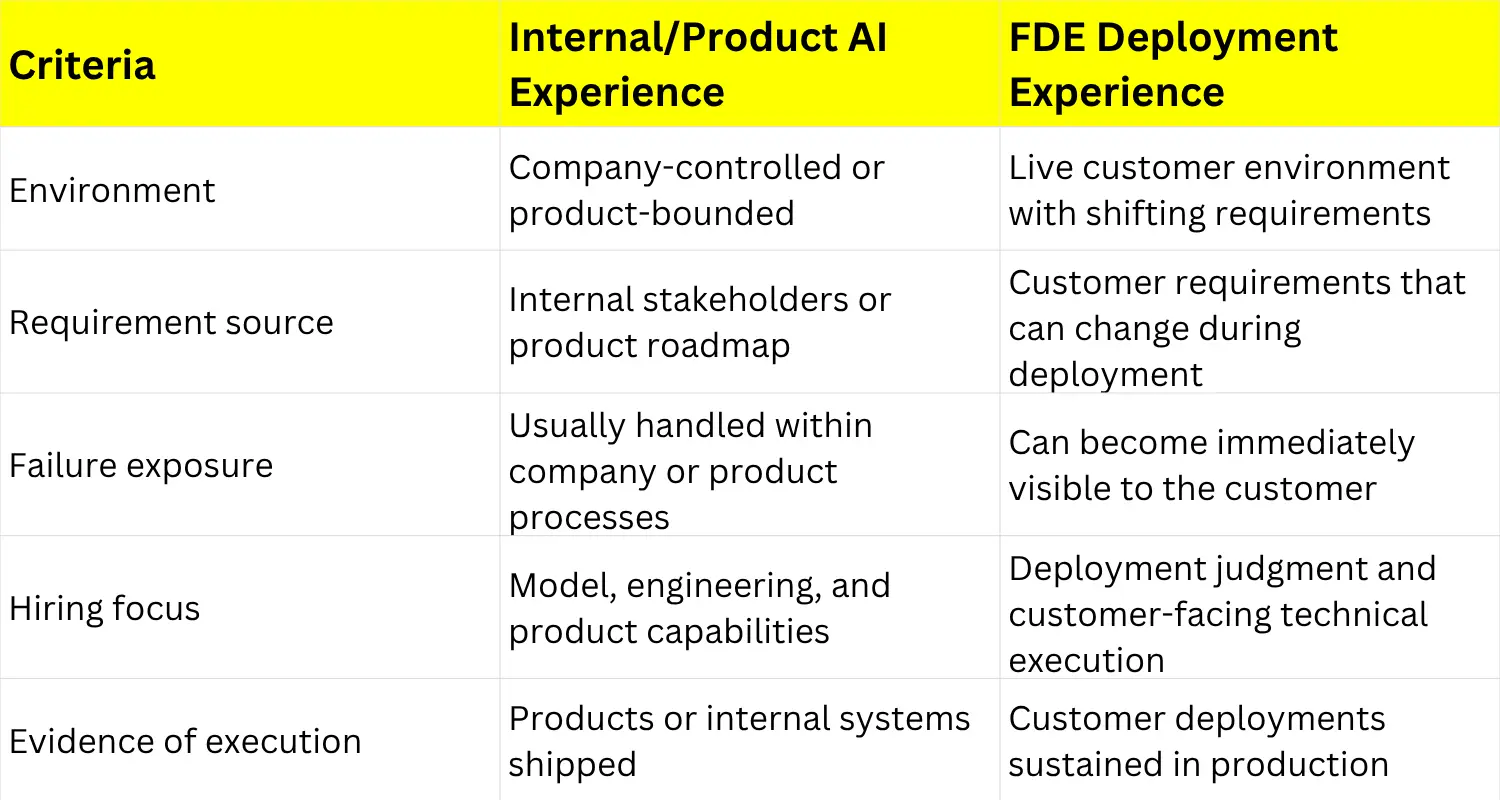
Two adjacent backgrounds often get mistaken for that experience: building AI tools for the company's own operations, where requirements come from internal stakeholders inside an environment the company already controls, and embedding AI into an existing product suite, where deployment happens within product boundaries the company defines and controls.
Sitting inside a customer's environment changes the work. The requirement moves on the customer's schedule instead of the company's, and a failure in the deployed system shows up in front of the person paying for it. This shift is already underway. C&T's AI-Native Builder Report found that 70% of large enterprises are building or planning internal FDE teams, moving deployment capability from a handful of pilot engineers to a standing function. Someone has to know how to build and scale it.
Internal/Product AI Experience vs. FDE Deployment Experience
Why This Distinction Now Shapes the Whole Search
Access to leading models is becoming less differentiated. GPT, Claude, Gemini: enterprise buyers have access to powerful models from multiple providers now. What remains hard to acquire is the talent capable of turning that access into production systems inside customer environments.
The Palantir retention data and the pace at which large enterprises are standing up internal FDE teams aren't isolated data points. Together, they show companies putting more weight on deployment capability. For a VP of AI expected to build that capability, experience leading a deployment team becomes directly relevant to the mandate.
Whether that requirement applies depends on the mandate. A VP of AI hired for internal transformation or product integration should be evaluated against a different deployment profile.
The Cost of Starting With the Wrong Search Criteria
The cost of getting the specification wrong is already high. Christian & Timbers' 2026 Corporate AI Compensation Study, which draws on Lightcast's analysis of more than 100 million job postings, found that senior GenAI-specialized roles average 54 or more days to fill, one of the longest fill times of any technical category. VP of AI base salary starts around $300K at companies with 2,000 to 5,000 employees and can reach $1.05M at companies with more than 100,000 employees, with total compensation reaching past $7M once equity is included. For a role that already takes time to fill and can carry seven-figure compensation, discovering late in the search that deployment leadership was part of the mandate is an expensive reset.
Define the Mandate Before You Build the Candidate Profile
The work starts before the first interview. If the VP of AI mandate centers on improving internal workflows or integrating AI into an existing product suite, deep forward deployed experience may add little to the search.
The profile changes when the mandate includes building AI systems for individual customers or taking deployments from pilot into production across multiple accounts. For those searches, deployment leadership belongs in the candidate specification from the start. Adding it after the shortlist exists means the search was built against the wrong evidence.
Five Things to Screen For
Labels like "customer-focused" or "hands-on" reveal little on their own. These five areas ask for observable evidence.
Deployment ownership
A named deployment inside a paying customer's environment that the candidate owned end to end, not a demo or a pilot that never went live. Find out what stayed their responsibility after the system went live, beyond what they built before it shipped.
Customer-facing technical work
Proof the candidate sat with the customer while requirements moved, rather than receiving specs secondhand through sales or product. Ask how a specific requirement changed mid-deployment and what they did about it.
Measurable production outcomes
A result tied to the deployment the customer could confirm: adoption inside their workflow, a renewal, a retained account, a cost or time figure with a number attached. Have them name the number the customer would cite to justify the deployment's cost.
Team-building experience
Who they hired onto a forward deployed or applied AI function, and what specifically made that hire work. Push past credentials: ask what they screened for and how the team changed as deployments scaled. A VP-level search should also test for scale. Leading a handful of engineers through a few deployments is a different job from building the hiring model and operating structure a function needs to run dozens of engagements at once.
Handling deployment constraints
An account of a system failing or underperforming with a customer watching, and the process the candidate's team used to fix it under that pressure. Press on what broke on their last deployment, and whether they or the customer noticed first.
Where VP of AI Searches Go Wrong
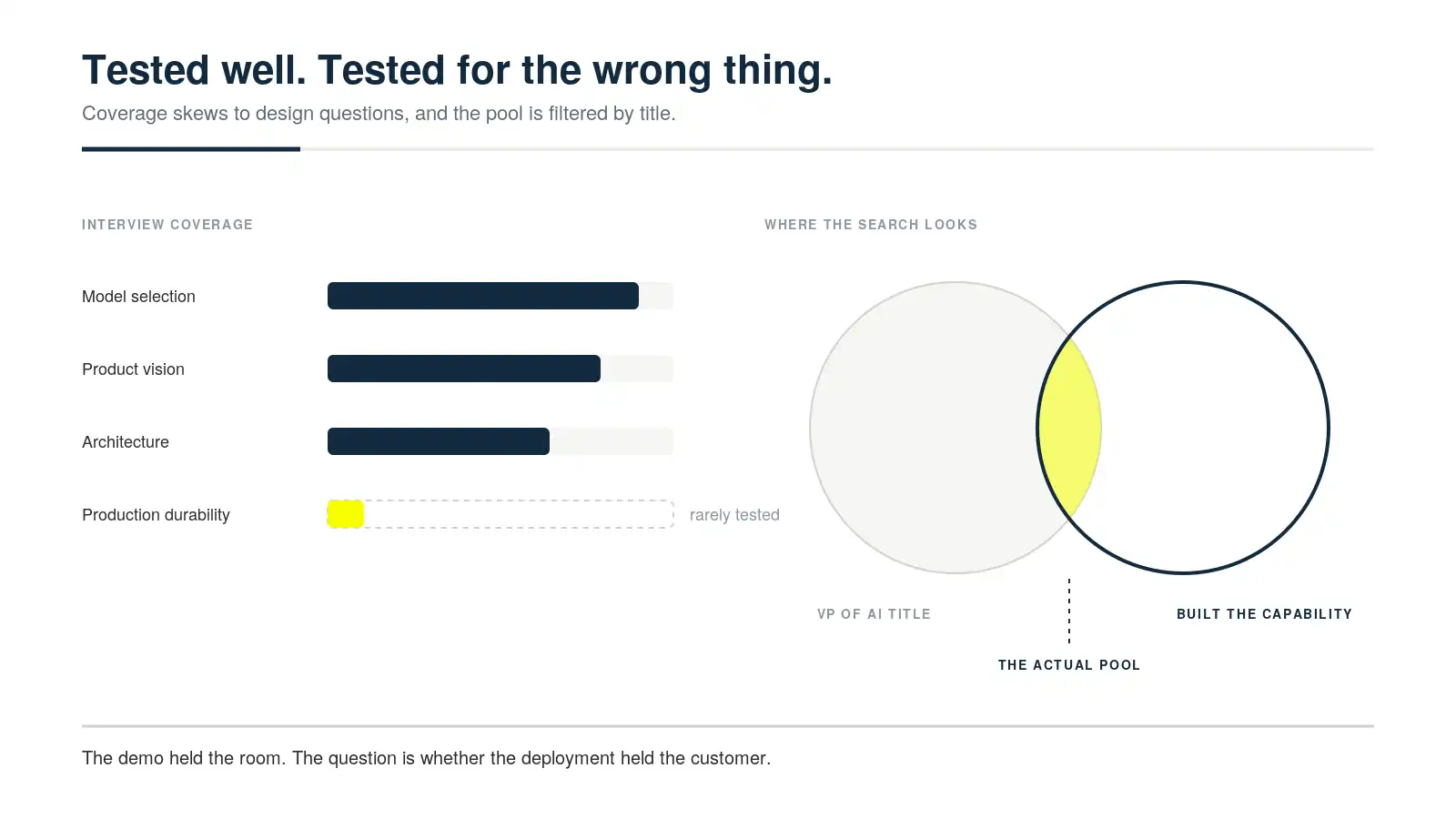
Interview time skews toward model selection and product vision, sometimes architecture decisions too. Reasonable questions, and a strong internal or product leader can answer them well. What the interview rarely tests is whether a deployment held once a paying customer depended on it, as opposed to whether a demo impressed the room.
The gap often becomes visible when the company decides to build a forward deployed function and discovers that the executive responsible for AI has never built one.
A second blind spot comes from the title itself. The strongest candidate for a customer-deployment mandate may not currently hold the VP of AI title. Relevant experience often sits inside forward deployed engineering or applied AI. Searching for title matches alone can narrow the pool around candidates who look right on an org chart while passing over people who have already built the capability the company needs.
The C&T Perspective
Christian & Timbers' approach to AI executive search weighs deployment track record alongside model and strategy fluency when a VP of AI, Head of AI, or VP of AI Transformation mandate calls for it. C&T's Elite FDE Scarcity Study, drawn from interviews with more than 250 C-suite executives across 180 companies, found that fewer than one in five companies report meaningful AI ROI and roughly one percent have deployed AI systems worth more than $100 million.
For customer-deployment mandates, the search starts with defining what the executive will be expected to own, then evaluating candidates against evidence of deployment leadership rather than title or AI fluency alone. The scarcity of talent that can put AI into production is exactly why this distinction matters.
Hiring a VP of AI or building an AI leadership team? Meet the Christian & Timbers team.

Questions to Answer Before Hiring a VP of AI
- How do we know which type of VP of AI we need?
Start with the mandate. Titles are a poor proxy for it. A role built around internal workflows or product integration needs a different profile than a role built around deploying AI inside customer accounts. Define which one you're hiring for before the search begins, and the rest of the specification follows from there.
- Does every VP of AI need forward deployed engineering experience?
No. This applies to mandates built around converting models into deployed customer value. Companies focused on internal transformation or product integration have a different, equally legitimate set of criteria to hire against.
- How does internal or product-based AI experience differ from customer deployment?
Internal and product work both happen inside boundaries the company or product team set in advance. Customer deployment requires absorbing a requirement that shifts on the customer's timeline and owning what happens when a live system fails in front of them. The hiring judgment involved overlaps less than it appears to on paper.
- What if the strongest candidate has never held the VP of AI title before?
It isn't necessarily disqualifying. Relevant experience often sits inside forward deployed engineering or another customer-facing technical role that never carried the VP of AI label. Evaluate the deployment evidence itself rather than the title on the resume.
- How should a board test for this in a VP of AI interview?
Ask for a specific deployment inside a customer's environment and follow it through production. What changed after launch, and what stayed the candidate's responsibility afterward, reveal more than any credential.