



Companies are moving beyond pilots and building dedicated deployment teams to turn AI investment into measurable business outcomes.
Key Takeaways
- Enterprise AI has moved beyond experimentation, pushing companies to build permanent Forward Deployed Engineering teams.
- Demand for FDEs is projected to grow approximately 2,100% by the end of 2026 as enterprise deployment accelerates.
- Organizations are replacing small AI pilot teams with deployment organizations built to scale AI across the business.
- Building an effective FDE team requires a different organizational model and hiring strategy than traditional software engineering.
For most of the past two years, enterprise AI meant experimentation. Companies launched pilots and tested foundation models, looking for a use case worth scaling. A small team of engineers was usually enough to run the exercise.
The priorities have changed. Today, CEOs are asking a different question: how do we run AI across the business instead of inside one successful pilot?
In response, organizations are standing up dedicated Forward Deployed Engineering teams responsible for turning AI investment into operational systems that produce measurable business outcomes.
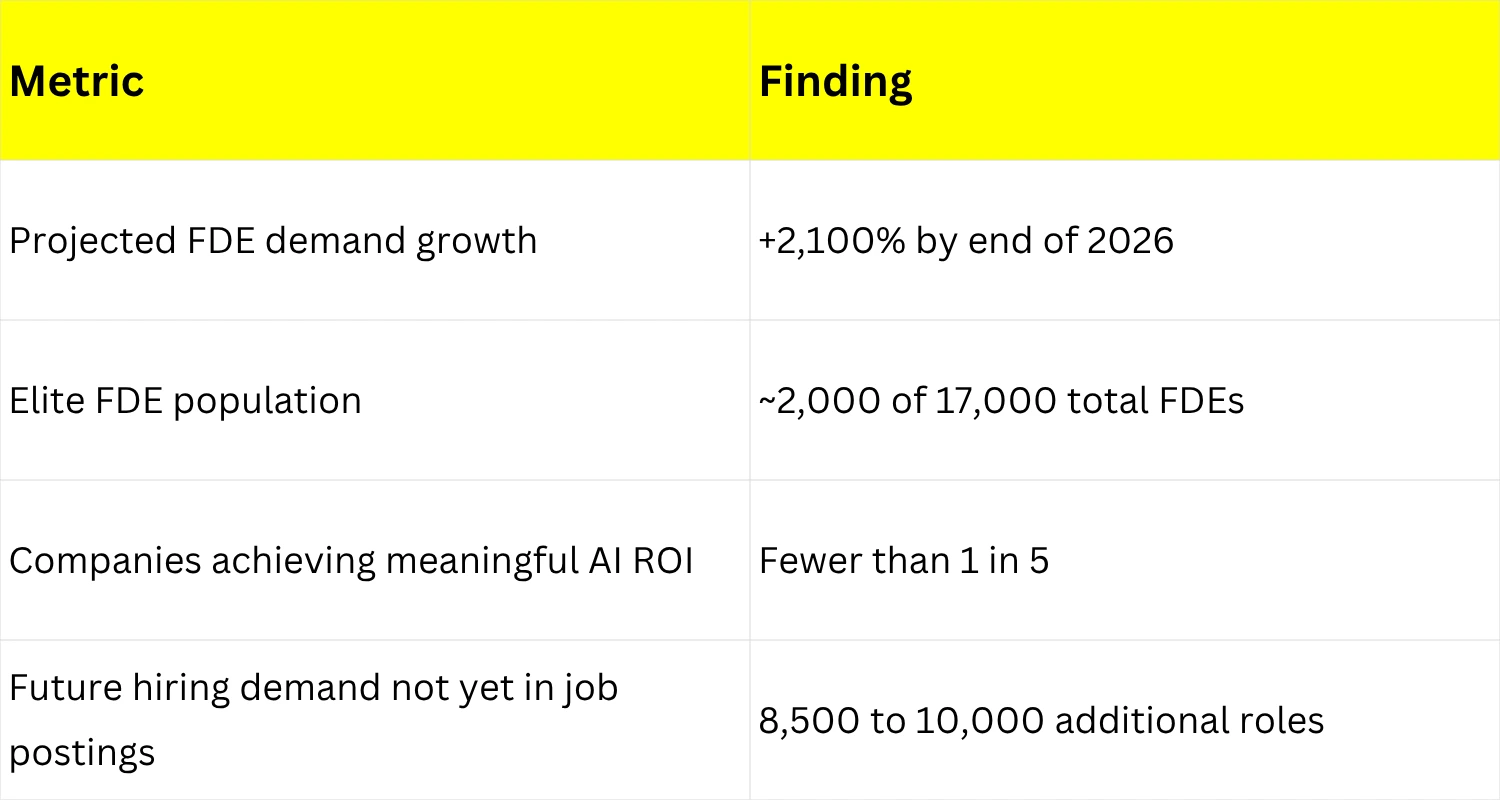
Our latest research at Christian & Timbers found this shift is moving faster than most organizations realize. We project demand for Forward Deployed Engineers will increase approximately 2,100% by the end of 2026, as Microsoft, AWS, OpenAI, Anthropic, and other AI leaders race to expand enterprise deployment organizations. At the same time, companies are moving from pilot teams of two or three engineers to permanent deployment organizations of 20 to more than 100 people.
Enterprises have stopped asking whether to deploy AI. The open question now is whether they can build a team capable of making it work.
Enterprise AI by the Numbers
The figures below are drawn from Christian & Timbers' report, America's Most Wanted Enterprise AI Talent. The full report explores the data, methodology, and market trends shaping the next generation of enterprise AI deployment.
Enterprise AI Has Moved Beyond the Pilot Stage
Experimentation defined the last two years for a simple reason: nobody yet knew which use cases would hold up outside a demo. Boards have run out of patience with that reasoning. They want the AI budget line to show up as a number in the earnings report, backed by results the team can point to.
A recent MIT study of 300 public AI deployments found 95% of generative AI pilots deliver no measurable impact on the P&L. The number lines up with what we're hearing directly from executives: fewer than one in five companies in our own study report achieving meaningful AI ROI.
Christian & Timbers' research suggests the gap is driven in large part by deployment talent. While the United States has roughly 17,000 Forward Deployed Engineers, we estimate only about 2,000 qualify as elite, having repeatedly deployed enterprise AI into production and delivered measurable business outcomes. As enterprises build permanent deployment organizations, they're competing for that much smaller pool of proven talent.
That matches what MIT found across the broader market too: pilots that stall usually have a working model behind them, with no team built to carry it into production.
Enterprise AI Reached an Inflection Point
Most large enterprises have already piloted AI widely. 88% now use it in at least one business function, according to McKinsey's latest research, up from 78% a year earlier. Identifying a plausible use case rarely takes much effort anymore. What most organizations haven't solved is turning one into something that runs without a dedicated team hand-holding it: the same research found most companies are still working through the move from pilot to scaled deployment, with only about a third reporting they've begun scaling AI programs at all. That's the gap Forward Deployed Engineering teams exist to close, taking a use case past the team that proved it and into every business unit that needs the same capability.
Boards have noticed the shift too. Hearing about an experiment that worked in one division isn't enough for them anymore. They want to know how the same result gets repeated across the company, on a timeline that shows up in a quarterly filing.
That's changed where competitive advantage comes from now. Access to a frontier model used to separate the companies moving fast from the companies standing still. Every serious competitor now has access to the same frontier models, so that edge is gone. What separates them now is how fast and how consistently they can deploy what they've licensed. That's the bridge between the pilot era and the deployment era, and it's why Forward Deployed Engineering teams have gone from a nice-to-have to a board-level priority in the span of a year.
Forward Deployed Engineering is becoming for enterprise AI what site reliability engineering became for cloud infrastructure: a permanent organizational capability rather than a temporary project team.
Why Companies Are Suddenly Building Forward Deployed Engineering Teams
AI has stopped being a project with a start and end date and has become part of how the business runs day-to-day, which changes who needs to be in the room. Instead of a data science team working in isolation, companies now need engineers embedded directly with customers and business units, close enough to see where a workflow breaks in practice.
Traditional software teams build products. Forward Deployed Engineering teams build adoption. Their job isn't limited to writing code. It includes sitting inside the business and working through the operational problems that come with real deployment, carrying a system from proof of concept into something the business runs on every day.
That embedding is harder than it sounds. Real deployments have to work inside legacy systems and satisfy governance and security requirements that a demo never has to touch, all while fitting into processes that predate the AI initiative by a decade or more. Getting that right isn't a task for a two-person pilot squad. It's why the organizational model itself is changing: companies that used to stand up temporary project teams for each AI initiative are now building permanent deployment organizations designed to take on the next one, and the one after that, without starting from zero.
The Market Signals Are Hard to Ignore
The largest AI companies are making the same bet at once, and the scale of the commitments is hard to dismiss as noise. Microsoft launched its Frontier Company in July with a $2.5 billion investment and 6,000 engineers and industry specialists to be embedded directly with enterprise customers. Two days earlier, AWS committed $1 billion to its own Forward Deployed Engineering organization, built to compress deployment timelines from months to days.
OpenAI raised roughly $4 billion for a new venture known as The Deployment Company, valued near $10 billion. Anthropic launched Ode, a $1.5 billion joint venture with Blackstone, Hellman & Friedman, and Goldman Sachs built to embed engineers inside mid-sized enterprises.
The timing is what stands out most. Every one of these companies expanded deployment services within months of each other, arriving independently at the same conclusion: enterprise AI adoption is now constrained less by model capability and more by deployment capacity. Christian & Timbers' research estimates these initiatives alone represent 8,500 to 10,000 additional hiring needs that haven't yet shown up in public job postings, adding pressure to a talent pool that was already stretched thin.
Building an FDE Team Requires a Different Hiring Strategy
This isn't simply another engineering hire. A deployment team needs engineers who can hold technical depth and business judgment at the same time, people who can sit across from a skeptical VP of Engineering, a VP of AI, a wary Head of AI, or a Chief Product and Technology Officer and translate a business problem into a system that survives contact with real customer data.
Organizational structure matters just as much as who gets hired, and most companies haven't settled it yet:
- Does it make more sense for FDEs to report into engineering, or into the business unit they're embedded with?
- Would centralizing the team compound knowledge across deployments faster than sitting close to product, where it moves at the product team's speed?
- Is aligning to individual business units worth trading some consistency for proximity to the customer?
There's no universal answer, but companies that treat this as a hiring question alone, without settling where the team sits and who it answers to, tend to end up with strong individual engineers and no coherent organization around them.
Most companies still run this hiring process the way they'd hire for a traditional software engineering role, screening for language familiarity and system design instead of the judgment that separates a deployment that ships from one that survives.
What Enterprise Leaders Should Do Next
The organizations moving fastest right now aren't the ones with the biggest AI budget. They're the ones whose leadership has stopped treating AI as a series of projects and started treating it as a capability the business needs permanently, the same way it needs finance or IT. That reframing changes who owns deployment once a pilot succeeds and whether that person has the authority to change how the business operates. It also determines whether the capacity being built will outlast whoever is currently running point on AI.
Executive teams that work through those questions now, before the next wave of hiring competition hits, will be the ones with a real organization in place when the rest of the market catches up.
Christian & Timbers Is Tracking the Shift in Real Time
We've spent the past six months studying how enterprise AI hiring is evolving, building on years of placing the leadership now standing up these teams. The full findings are available in our report, America's Most Wanted Enterprise AI Talent. The research included interviews with more than 250 C-suite executives across 180 companies and conversations with more than 300 Forward Deployed and Applied AI engineers. We also mapped the U.S. Forward Deployed Engineer market directly.
That six-month study sits on top of work we were already doing. Christian & Timbers has spent recent years placing VPs of Engineering, VPs of AI, Heads of AI, and Chief AI Officers for enterprises building exactly the kind of deployment capability this article describes, which is part of why these findings track so closely with what we're seeing in live searches right now.
Because the research paired executive and engineer interviews with direct market mapping, it captured both hiring demand and talent supply, giving a clearer view of where enterprise AI organizations are heading than either data source could offer alone.
That work points to one conclusion. Enterprises are moving past isolated AI initiatives and investing in permanent deployment capability, in a market where demand is accelerating and experienced talent remains scarce.
Enterprise AI is entering the same phase cloud computing entered a decade ago. Early experimentation is giving way to permanent organizational capability. The companies that build that capability first won't simply deploy more AI. They'll build the institutional knowledge to keep deploying it long after any single project ends.

Frequently Asked Questions
- Why are companies building Forward Deployed Engineering teams now?
Enterprise AI has reached a stage where organizations are moving beyond pilots and focusing on scaling AI across multiple business functions. That shift requires dedicated deployment capability rather than temporary project teams.
- What does a Forward Deployed Engineering team do?
Forward Deployed Engineering teams work directly with business stakeholders to deploy AI into production and integrate it with existing systems, delivering measurable operational outcomes rather than isolated demonstrations.
- Why can't existing engineering teams handle AI deployments?
Software engineering teams are typically organized around building and shipping product. Owning deployment inside a live business, end-to-end, is a different job. Forward Deployed Engineering teams combine technical depth with business integration and production ownership, working directly with the customer rather than handing off a spec.
- How large are Forward Deployed Engineering teams becoming?
Christian & Timbers' research shows organizations expanding from AI pilot teams of two or three engineers to permanent deployment organizations ranging from 20 to more than 100 people.
- Why is hiring Forward Deployed Engineers becoming more competitive?
Christian & Timbers projects demand for Forward Deployed Engineers will increase approximately 2,100% by the end of 2026 while major AI companies continue investing heavily in enterprise deployment organizations, increasing competition for experienced talent.
- Who should a Forward Deployed Engineering team report to?
There's no single right answer. Some organizations keep FDE teams centralized under engineering so knowledge compounds across deployments. Others place them closer to product or align them directly to business units, trading some consistency for proximity to the customer. What matters most is that the reporting line is a deliberate choice.