



Choosing the best AI executive recruiting firm starts with a harder question: what does the company need to own?
The first AI hiring decision is often made too early: hire a Chief AI Officer, build an internal team, bring in Forward Deployed Engineers, or give the work to a consultancy. Which approach works best depends on who needs to own the result long term.
Companies that need permanent AI leadership are best served by an AI executive recruiting firm. FDE agencies provide deployment capacity when leadership is already in place. Consultancies fit defined programs, while internal hiring works when a company already has the leadership and recruiting access to build the team itself.
The distinction matters more as companies move from AI pilots toward permanent deployment organizations. At the start of 2026, Christian & Timbers found that only 5% to 10% of companies planned to hire Forward Deployed Engineers. By the end of the second quarter, that figure had reached 70%.
Key Takeaways
- An AI executive recruiting firm fits companies hiring permanent leaders such as a Chief AI Officer, VP of AI, CTO, or Head of Forward Deployed Engineering.
- The proven deployment talent pool is small. Christian & Timbers’ Elite FDE Scarcity Study mapped roughly 17,000 FDEs in the United States and estimates that about 2,000 meet its elite standard based on repeated production deployments and documented business value. TechCrunch described the finding more directly: roughly 2,000 total, rather than 2,000 available.
- An FDE agency can add deployment capacity when AI leadership is already established. A consultancy is better suited to a defined program with an agreed scope.
- Building internally works best when the company already has credible AI leadership and can reach the specialized talent required to build the team.
When to Use an AI Executive Recruiting Firm
When a company has a leadership gap, executive search can bring in a Chief AI Officer to establish the company-wide AI mandate. Another business may need a VP of AI to take existing work into production. For some companies, the requirement sits with the CTO as AI deployment becomes part of the technology mandate.
Two executives with similar AI leadership titles can have very different production records. Experience can range from overseeing pilots and vendor relationships to building the team responsible for deployment and owning the business result.
An AI executive recruiting firm has to determine which experience sits behind the title.
That becomes harder in newer leadership categories. A Head of Forward Deployed Engineering, for example, requires experience beyond conventional engineering management. The role reaches into customer environments and carries accountability for what happens after a system goes live.
For a permanent AI leadership hire, the search should begin with the mandate and work backward to the candidate pool.
Where an FDE Agency Fits
An FDE agency makes sense when the company already has an AI leader and knows what it wants to deploy, but needs more technical capacity to execute. An outside FDE team can provide that capacity while the internal organization grows.
Christian & Timbers found companies moving from AI pilot teams of two or three engineers toward permanent deployment organizations with 20 to more than 100 FDEs. As deployment teams grow, companies have to decide how much of that capability they want to employ directly and where outside FDE capacity still makes sense.
An FDE agency can supply experienced deployment talent while permanent hiring catches up. It can also add capacity during periods when the internal team’s deployment workload exceeds its headcount.
Someone inside the company still needs authority over priorities and results. With that executive in place, an FDE partner can expand the team’s ability to execute.
When an AI Consultancy Is the Right Model
Consultancies are typically brought in for a defined body of work, such as designing an AI operating model or restructuring workflows. Other engagements center on system selection or implementation. The company is buying outside expertise against an agreed scope.
This model can work before the permanent AI organization is fully established and support an existing executive who needs outside resources for a major initiative.
If AI is becoming a permanent operating capability, responsibility for the team and its results eventually needs to sit inside the business. The company may then need permanent leadership and its own technical talent.
Building the AI Team In-House
Some companies already have the person they need at the top.
An experienced AI executive may know which technical profiles the company requires and have enough market credibility to attract them. An internal recruiting function may also have access to the relevant talent pools.
Building internally gets harder once the company reaches the candidate market, where the elite tier of FDE talent is small. Companies recruiting internally have to reach people with that experience and determine who has produced the results behind their résumé, while competing against other employers pursuing the same talent.
Why AI Talent Access Is Becoming Harder
Competition for experienced deployment talent is increasing quickly.
Christian & Timbers projects demand for Forward Deployed Engineers will increase approximately 2,100% by the end of 2026. Microsoft, AWS, OpenAI, and Anthropic have also been expanding enterprise deployment organizations.
The competition becomes tighter once hiring criteria include documented financial results.
Only about 1% of companies surveyed by Christian & Timbers had deployed AI systems that generated or protected more than $100 million in value.
Executives and engineers with repeated evidence of that level of production impact occupy a much smaller market than the growing population of people carrying AI titles.
Access to that population becomes part of the executive search problem.
How to Choose Between the Four Models
The choice depends on the capability missing from the company.
A permanent leadership gap points toward executive search. Companies with that leader already in place can use an FDE agency when deployment capacity becomes the constraint. Consultancies fit defined programs with an agreed scope, while internal recruiting depends on having enough leadership and market access to build the team directly.
A company might recruit a Chief AI Officer while an outside FDE team works through early production deployments. Another may use a consultancy to establish its operating model before hiring the executive who will own it long term. The sequence should follow the capability gap.
Executive Search vs FDE Agency vs Consultancy vs In-House
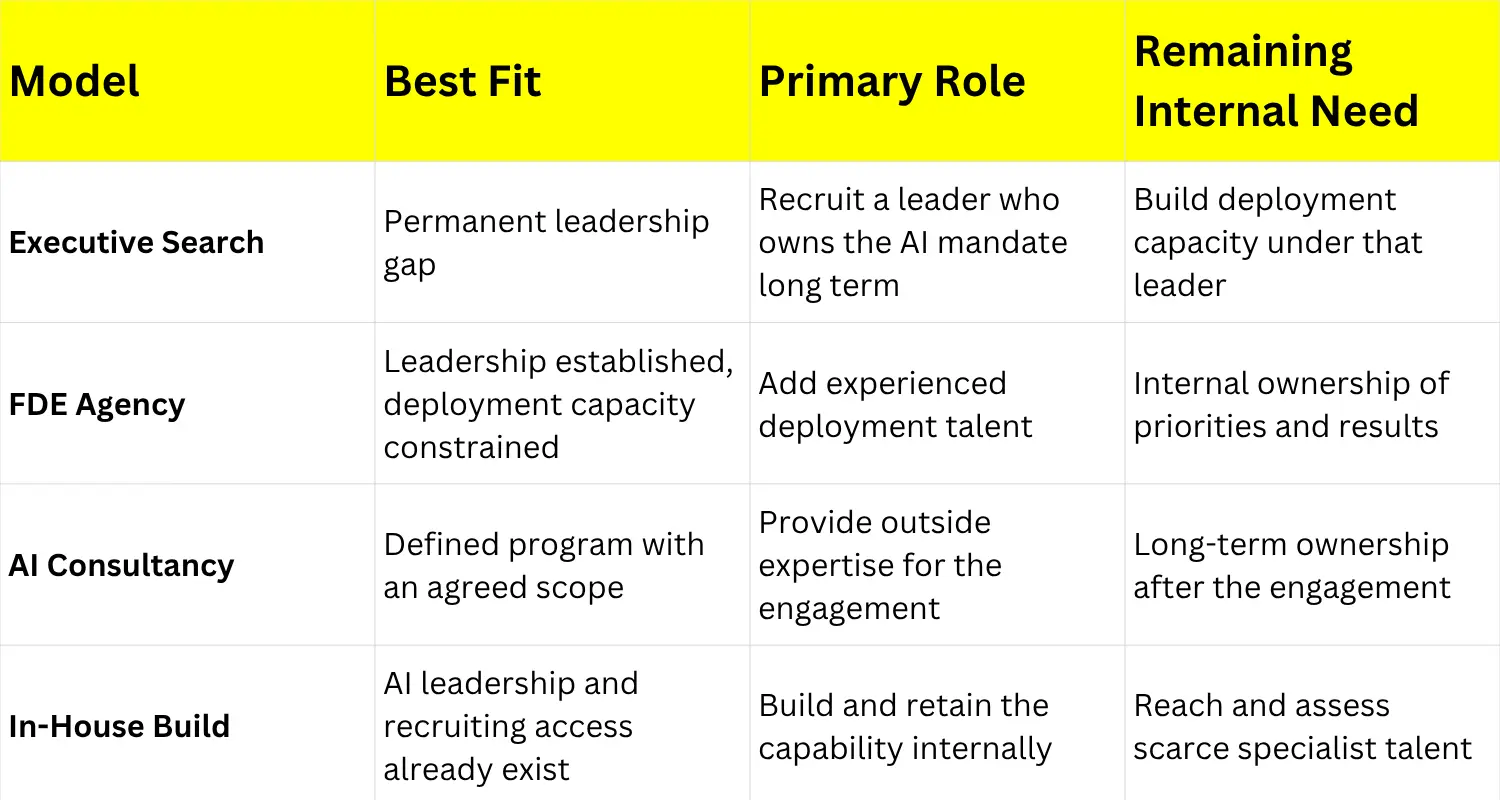
How to Choose the Best AI Executive Recruiting Firm
Look at Completed Searches
Once permanent leadership is the requirement, start with the searches the firm has already completed.
Ask which AI executives it has placed and what those leaders were hired to accomplish. A technology search involving some AI responsibility provides limited evidence for a mandate centered on production deployment.
Comparable mandates provide better evidence of whether the firm understands the candidate market. A firm recruiting a Head of Forward Deployed Engineering, for example, should know how that market differs from a conventional engineering leadership search. The same applies to a Chief AI Officer whose mandate centers on enterprise deployment rather than research.
Check the Candidate Market the Firm Can Reach
Experienced AI executives already sit inside frontier AI companies and hyperscalers. Others are leading AI-native businesses or substantial enterprise deployment programs.
Few have reason to enter an inbound applicant pool.
An AI executive search firm should know where those candidates sit and have a credible way to reach them before the search begins.
Ask How the Firm Assesses Candidates
Production experience needs to be tested rather than inferred from a title.
Candidates should be able to explain what they personally owned and which systems reached production. They should also be able to show how the business measured the result and what happened after users began working with the system.
Those answers show how directly the candidate owned the deployment and its results.
What Should a Search Firm Be Able to Assess?
Start with a real deployment. Ask the candidate to reconstruct the work from the original business problem through production. Where did they enter the project? Which decisions belonged to them?
From there, the interview should follow the result, especially because fewer than one in five companies in the Christian & Timbers study reported achieving meaningful ROI from agentic AI deployments. Getting a system into production therefore provides only part of the evidence. The search should establish what happened economically after deployment.
Failure can be revealing as well. Executives with substantial deployment experience have often seen projects stall or miss the expected economics. Their explanation can show how directly they were involved and what they changed afterward.
The mandate should determine the technical bar, since a Chief AI Officer at a Fortune 500 company requires a different profile from a Head of FDE building deployment teams at an AI software company. The search firm should define that distinction before candidate outreach begins.
Christian & Timbers’ Experience in AI Executive Search
Christian & Timbers has recruited across AI, robotics, and aerospace and defense for more than 40 years. The firm’s work now extends into Forward Deployed Engineering, physical AI, defense technology, and AI-native leadership roles.
Searches span Chief AI Officer, VP of AI, CTO, Head of Forward Deployed Engineering, and Chief Robotics Officer mandates. The common requirement is finding leaders with experience relevant to what the company is building, from enterprise AI deployment to physical AI systems operating in the real world.
Christian & Timbers’ 2026 research provides another view into the underlying talent market. Its Elite FDE Scarcity Study drew on interviews with more than 250 C-suite hiring executives across 180 companies and more than 300 FDEs and Applied AI engineers. That research informs searches where production experience and documented business results are central to the mandate.

Frequently Asked Questions About AI Executive Recruiting Firms
- What does an AI executive recruiting firm do?
An AI executive recruiting firm identifies and recruits permanent leaders for positions such as Chief AI Officer, VP of AI, CTO, and Head of Forward Deployed Engineering. The search focuses on experience relevant to the company’s mandate, which can include production deployment and technical team leadership.
- How do I choose the best AI executive recruiting firm?
Look at the firm’s completed AI searches and access to the relevant candidate market. Then examine how it assesses production experience. Ask which comparable roles it has filled and how the search team determines what a candidate personally owned during an AI deployment.
- When should a company use executive search for AI hiring?
Executive search makes sense when a company needs permanent AI leadership and qualified candidates are difficult to reach through internal recruiting. It becomes especially relevant for senior roles requiring substantial production experience.
- Should I hire an AI executive before building an AI team?
Hiring the executive first often makes sense when the company lacks a clear internal owner for AI. That leader can define the mandate and determine which technical roles need to be filled. They can then participate directly in selecting the people they will manage.
- What is the difference between an AI executive search firm and an FDE agency?
An AI executive search firm recruits permanent leaders who join the company. An FDE agency provides deployment talent that works on AI systems inside the business.
Companies with established AI leadership may use an FDE agency to increase deployment capacity while continuing to build their permanent teams.
- Can a company use an AI consultancy and an executive search firm at the same time?
Yes. A consultancy can work on a defined AI program while an executive search firm recruits the permanent leader who will own the capability. The engagements can overlap when a company needs immediate project support during the leadership search.