


Key Takeaways
- Hyundai appointed Milan Kovac, the former Tesla vice president who ran the Optimus humanoid program, into an advisory and board role at Boston Dynamics. It is the clearest signal yet that physical AI leadership talent moves between rivals the way star engineers used to.
- Robotics and physical AI startups raised $27.6 billion in 2025, according to PitchBook, up 101% from $13.7 billion the year before. Humanoid platforms captured an outsized share: Apptronik, Figure AI, AI2 Robotics, and Agility Robotics each closed nine-figure-or-larger rounds or moved toward a public listing this year.
- Open physical AI roles grew from 40 postings in January to more than 800 in June, as of mid-July 2026. Chief Robotics Officer and Director of Autonomy searches still average 114 days to fill, well above the market norm for senior technology hires.
- Leadership hiring has not kept pace with funding or engineering growth. Boards are responding by poaching proven operators from name-brand rivals rather than promoting from within, since the pool of executives who have already run hardware and AI together stays small no matter how fast the money moves.
The most telling hire in physical AI this year did not come with a funding announcement attached. Hyundai Motor Group brought on Milan Kovac, who left Tesla in mid-2025 after leading Optimus engineering and factory pilot operations, as a group adviser and outside director at Boston Dynamics. The appointment landed days after Boston Dynamics unveiled its electric Atlas humanoid at CES 2026 and outlined plans to build annual production capacity for 30,000 Atlas robots by 2028, with more than 25,000 of those units earmarked for Hyundai's own manufacturing operations. That is a smaller, more concrete target than Tesla's own roadmap for Optimus, which pairs a roughly 1-million-unit-a-year line at Fremont with a long-term, still-undated ambition of 10 million units a year at a dedicated Giga Texas facility.
Kovac's move matters more than the specifics of either roadmap. It shows that the executives who know how to take a humanoid robot from a demo stage to a production line are still a small enough group that Hyundai went and got one from its most direct competitor. Boards are not just hiring for robotics expertise. They are hiring away the handful of people who have already lived through the hardest part of this industry's learning curve.
The capital arrived before the leadership bench did
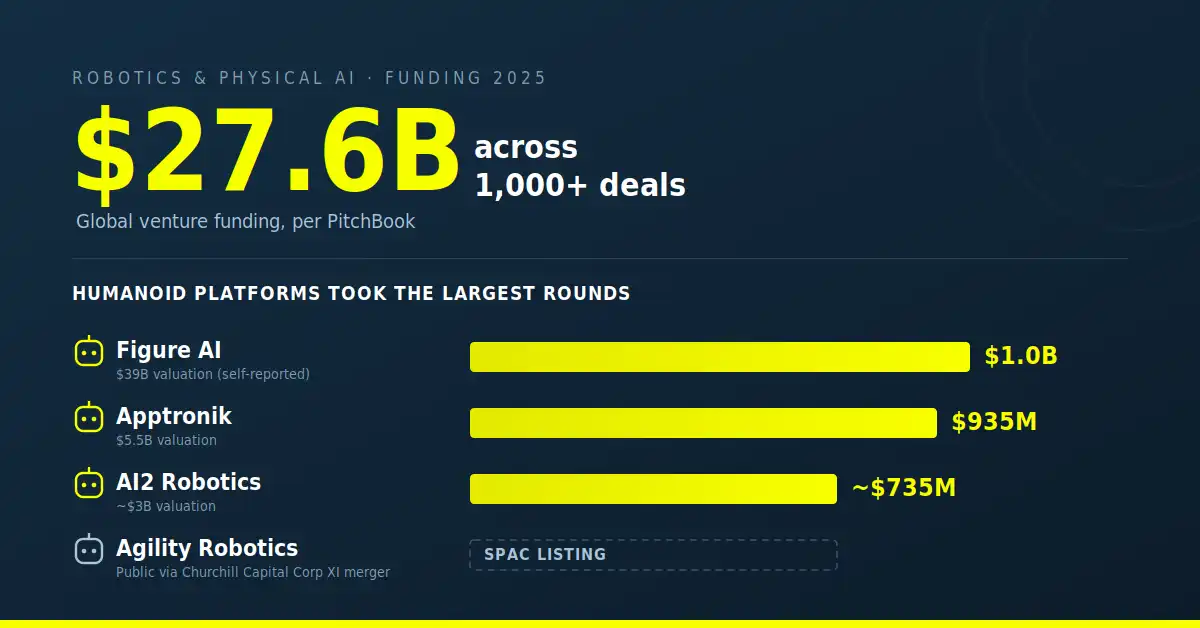
Robotics and physical AI startups raised $27.6 billion across more than 1,000 deals in 2025, according to PitchBook, and the pace has continued into 2026. Humanoid platforms captured a disproportionate share of it. Apptronik closed a $935 million round at a $5.5 billion valuation, Figure AI self-reported a $1 billion Series C at a $39 billion valuation, AI2 Robotics raised roughly $735 million at nearly $3 billion, and Agility Robotics is heading toward a public listing through a merger with Churchill Capital Corp XI.
Money moving that fast tends to outrun the org chart. A company can close a nine-figure round in a matter of weeks. Finding someone qualified to run the hardware program and the AI research behind it takes considerably longer, and whoever gets that job also inherits the manufacturing buildout the round was raised to fund. That gap matters because engineering headcount and leadership headcount solve different problems. Once a company moves from a research prototype toward manufacturing and commercial deployment, it needs executives who have already scaled that kind of operation elsewhere, and no amount of additional engineering hiring closes that particular gap on its own.
The hiring data backs that up
Open physical AI roles across robotics, autonomy, perception, and controls grew from 40 postings in January to more than 800 in June, according to job market tracker physicalai.jobs, as of its mid-July 2026 snapshot. Shield AI, Waymo, Amazon Robotics, and Zoox lead the current list of companies with the most open roles. But that growth is concentrated in engineering, not leadership. Chief Robotics Officer searches for humanoid platforms and Director of Autonomy roles at defense robotics programs average 114 days to fill, because the pool of executives who have run hardware and AI together, and survived the transition from prototype to shipping product, stays small no matter how fast funding grows.
What boards are paying for
Compensation reflects that scarcity. The average Chief Technology Officer with AI skills earns a base salary around $218,000, according to Payscale, but that median obscures how far the top of the range has moved. As cited in Christian & Timbers' 2026 corporate AI compensation study, Lightcast's 2025 labor market data and the JobsPikr AI Salary Benchmark 2026 both point to AI-native technical executives commanding roughly a 67% premium over traditional software engineering leadership roles, a gap driven less by the AI label itself than by how few candidates can carry board-level accountability for AI systems that touch physical operations. Robotics leadership sits at the sharpest edge of that premium, since it adds hardware risk and manufacturing timelines on top of everything a software-only CTO search already has to solve.
The build-out pattern
Diligent Robotics and Realbotix arrived at the same leadership gap from different corners of the robotics industry, and each one closed it the same way: by bringing in operators who had already lived through the move from lab to production somewhere else. OpenAI's robotics group shows the same pattern playing out inside a very different kind of company.
Diligent offers the clearest version of that pattern. The healthcare robotics company brought in Rashed Haq as Chief Technology Officer and Todd Brugger as Chief Operating Officer, both arriving from Cruise, GM's shuttered self-driving subsidiary, where Haq had led AI and robotics and Brugger ran operations. The company had already deployed roughly 100 of its hospital robots and needed a leadership team built for scaled deployment rather than pilot programs.
Realbotix followed a similar path. The company added a Chief Operating Officer from Agility Robotics and a Chief Financial Officer with public-company reporting experience, then promoted a longtime technical contributor to Head of Robotics to run the shift from prototype to production hardware. Each hire closed a distinct leadership gap rather than adding another name to an already crowded engineering team.
Even the foundation model labs feel this pull. OpenAI has kept hiring toward robotics through 2026, posting for full-stack hardware, ops, systems, and machine learning engineers to help the company program and manufacture robots. That hiring push continued even after Caitlin Kalinowski, the former Meta hardware executive who led OpenAI's robotics and hardware group, resigned in March over concerns about the speed and guardrails around the company's Pentagon work, and even after OpenAI said at the time it had no plans to immediately name a replacement for her role. A leadership departure that would stall hiring at most companies barely slowed one of the best-resourced robotics efforts in the industry, which is its own signal about how much runway this build-out still has left.
Why this search is harder than a standard technology hire
A physical AI leadership mandate rarely maps onto a single job description. Boards want someone who understands mechanical and electrical systems well enough to catch a bad hardware bet before it burns through a manufacturing run, and who is fluent enough in the AI research behind perception and control to run that side of the organization too.
Governance raises the bar further. Agility Robotics' path toward a public listing means its leadership team now needs board-readiness layered on top of technical depth, the same disclosure discipline and forecasting rigor public investors expect from any manufacturer, applied to a category still working out its own safety standards. That is a different mandate than the one facing a Series A robotics startup, even when both companies describe the opening the same way on a job board.
None of that is solved with a bigger applicant pool or a faster hiring process. It gets solved by knowing which small number of people in the world have already done the job somewhere else and reaching them before a competitor does, which is closer to what a retained executive search does than what a standard recruiting funnel does.
Christian & Timbers has spent the past year building coverage across this intersection of AI, robotics, physical AI, and manufacturing leadership. We run searches for CTO, Chief Robotics Officer, VP of Engineering, and VP of AI Transformation mandates, from early-stage humanoid platforms to public manufacturers integrating autonomy into existing operations. The candidates who move this market are rarely posting that they're open to work. They're the ones a rival just tried to hire first.

Frequently Asked Questions
- Does every physical AI company need a Chief Robotics Officer?
Not always. Early-stage companies often route that scope through a technical co-founder or a VP of Engineering with a strong AI background. The title tends to show up once a company is running hardware and AI teams at real headcount and needs one executive who can speak for both in front of the board.
- What makes a physical AI leadership search different from a standard CTO search?
The candidate has to be credible on hardware and AI research at the same time, with enough software depth to connect the two. The search also has to account for company stage. A pre-revenue humanoid startup needs a different profile than a company approaching a public listing with audit committees and disclosure requirements attached.
- Why do these searches take longer than typical technology hires?
The pool is small. Executives who have shipped physical AI products past the prototype stage are limited in number and already well compensated, and more than one company is usually recruiting them at the same time. Chief Robotics Officer and Director of Autonomy roles routinely take longer than the market average to fill for that reason.
- What should a board expect to pay for this kind of hire?
AI-native technical executives already command a premium over traditional software leadership roles, and robotics adds hardware risk on top of that. Companies that treat the search as a standard CTO hire, rather than a distinct mandate with its own comparable set, tend to lose candidates to competitors who priced the role correctly the first time.