



The fastest way to decide between a CISO and a Cyber CRO is to map the decision to your maturity and regulatory exposure. Early-stage and growth tech companies usually start with a CISO or vCISO to build controls and meet customer audits. Once cyber becomes a board-level enterprise risk, especially under SEC, DORA, or M&A scrutiny, a Cyber CRO becomes essential. In complex environments, both roles are complementary and often required.
This comparison clarifies scope, reporting lines, and when to hire each leader. It includes compensation benchmarks, emerging governance trends, and a side-by-side matrix you can share with your board. If you are evaluating ciso recruiters, use the hiring checklist to align your search with stage, risk, and regulatory objectives.
Key Takeaways
- CISOs now operate as business-aligned executives, and over 60% no longer report to the CIO, reflecting elevated scope and visibility IBM.
- CISO pay is highly competitive, with median total compensation around USD 386,000 and upper ranges at USD 585,000 or more before bonuses Splunk.
- Startups often add a CISO between seed and Series C, and many use a vCISO to control costs when full-time roles start near USD 300,000 in salary Zeren GRSee.
Core Responsibilities of a CISO
A Chief Information Security Officer owns the security program and leads teams that design, operate, and improve technical and governance controls. NIST defines the CISO as the senior official charged with carrying out security responsibilities for the organization NIST. Core work spans strategy, policies, security architecture, incident response, and compliance with SOC 2, ISO 27001, PCI-DSS, or HIPAA.
Reporting structures are shifting as the role gains enterprise impact. More than 60 percent of CISOs no longer report to the CIO, with growing ties to the CEO, COO, or CTO IBM. Surveys show roughly a third still report to the CIO and about one-fifth to the CTO ISC2.
AI is adding another requirement to the role. Speaking with CNBC, Christian & Timbers President JC Christian said technical experience with AI security and its risks has become nonnegotiable for companies hiring CISOs. CNBC also reported that security chiefs are spending more time in board meetings and conversations with CEOs as AI expands their responsibilities.
Compensation reflects market scarcity and scope. In large markets, median CISO total compensation is around USD 386,000, and top ranges reach USD 585,000 or more before bonuses Splunk. Full-time CISOs in North America commonly start near USD 300,000 in salary alone GRSee.
Ideal profiles blend technical depth with business acumen. Many CISOs now pair advanced business education with technical credentials to translate risk into decisions on cost, velocity, and customer impact ECCU. Tenure matters for board trust, and many CISOs remain in role for several years, sustaining relationships and continuity Kaspersky.
When startups prioritize a CISO
Cloud-native SaaS companies selling to enterprises often add a CISO between seed and Series C to pass security diligence and win deals Zeren. Many early-stage firms adopt a vCISO to achieve SOC 2 or ISO 27001 readiness while avoiding the immediate cost of a full-time executive, since foundational compliance work can be heavy and full-time CISOs often start near USD 300,000 in salary GRSee.
What is a Cyber CRO and How is the Role Different?
A Cyber Chief Risk Officer brings an enterprise risk lens to cyber, integrating technology exposure into risk appetite, enterprise risk registers, and capital allocation. CROs are chartered to oversee major categories of risk for the organization, with board-level accountability for governance Corporate Governance Institute. A Cyber CRO applies those Enterprise Risk Management (ERM) methods to cyber, focusing on quantification, scenario analysis, regulatory reporting, and cross-functional alignment.
Emerging practice places the Cyber CRO at the junction of security, IT, legal, finance, and business units. The role synthesizes technical risk data into enterprise language, often in financial terms, and ensures compliance with evolving governance expectations EC-Council SAFE Security. Risk consultancies highlight that CRO and CISO partnership is central to cyber readiness and governance Aon.
The role is gaining traction in high-stakes environments. NASA created a Chief Cyber Risk Officer to integrate cyber into mission-critical risk frameworks alongside safety and program performance. Global financial services firms are establishing similar roles to meet stringent regulatory oversight. While definitions vary, the unifying trait is enterprise ownership of cyber risk rather than operation of technical controls.
Ideal Cyber CRO profile
Successful Cyber CROs come from enterprise risk and governance, not just security operations. They are fluent in risk quantification, stress testing, regulatory interpretation, and board communication. They coordinate with the CISO and business leaders to set risk appetite, prioritize mitigations, and tie cyber investment to business outcomes SAFE Security EC-Council.
CISO vs Cyber CRO: Responsibilities, Skills, and Value Compared
These roles are complementary. The CISO owns the cybersecurity program and technical controls. The Cyber CRO integrates cyber into enterprise risk management and synthesizes exposure into business decisions. Advisory research underscores that CISO and CRO partnership links technical detail to enterprise risk posture for boards and regulators Aon SAFE Security EC-Council.
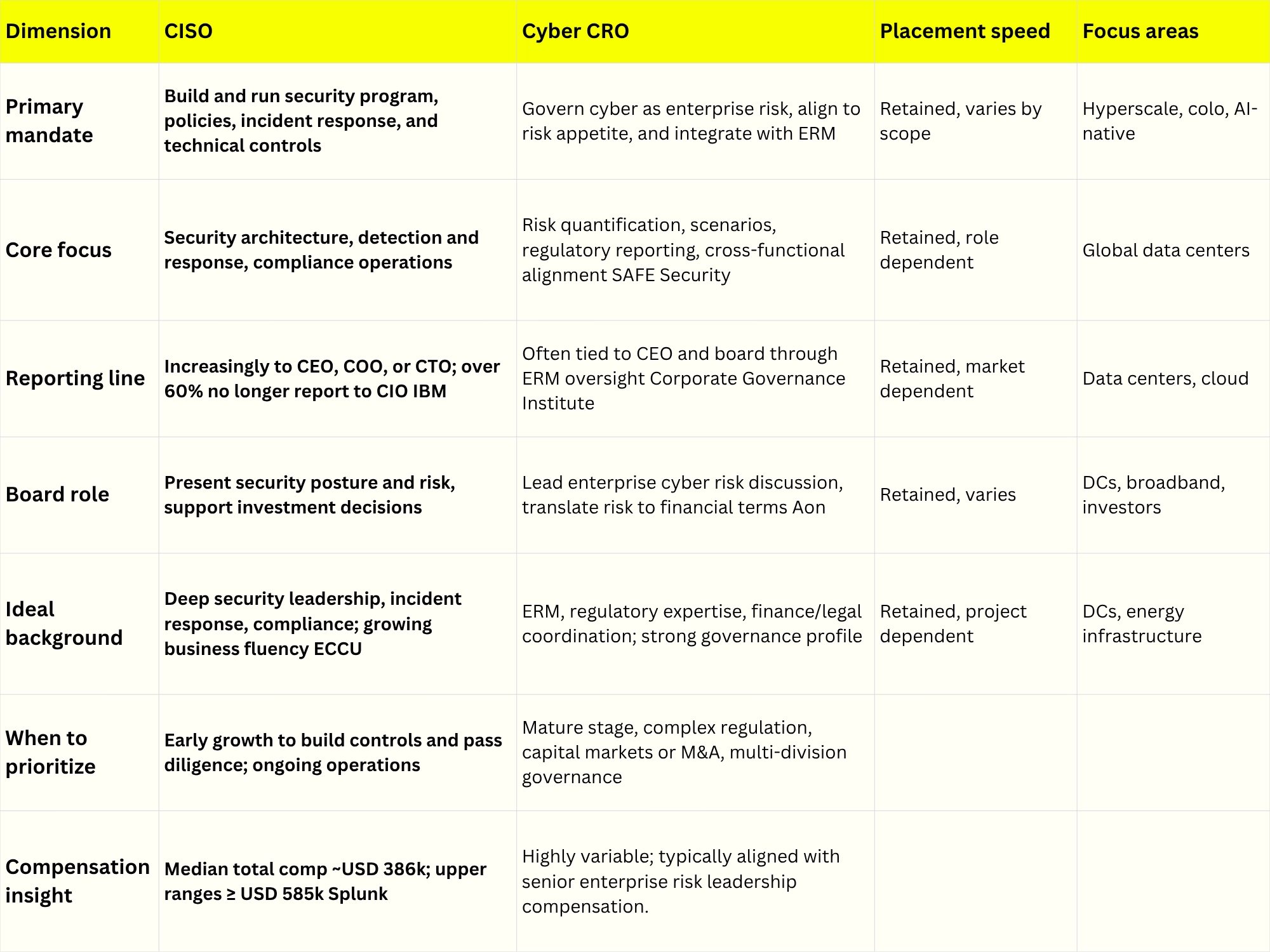
In practice, the CISO provides technical risk input while the Cyber CRO drives enterprise risk synthesis and reporting. Both should coordinate on governance frameworks and investment priorities Aon.
Framework for Choosing Between a CISO and Cyber CRO
Match the hire to your stage, buyers, and regulatory exposure. Many small and mid-sized organizations historically lacked a formal CISO, but enterprise sales and audits are pulling the role earlier in the lifecycle Zeren. If you handle sensitive data or sell into regulated industries, a CISO between seed and Series C is common Zeren.
Balance cost and speed. Full-time CISOs in North America commonly start near USD 300,000 in salary, which leads many startups to adopt a vCISO for SOC 2 or ISO 27001 readiness GRSee. Early-stage compliance often includes tasks that do not directly create competitive advantage, so fractional leadership can be practical GRSee.
As complexity grows, consider a Cyber CRO. Boards are treating cyber as enterprise risk under evolving SEC disclosure rules and European frameworks like DORA and NIS2. Firms entering capital markets, pursuing M&A, or operating under multiple regulators benefit from enterprise risk integration that a Cyber CRO leads Aon Corporate Governance Institute.
A quick assessment checklist
- Security maturity: Do you have a documented security strategy, incident runbooks, and audit-ready controls? If not, start with a CISO or vCISO GRSee.
- Buyer and regulator demands: Are customers or regulators requiring ISO 27001, SOC 2, PCI-DSS, or HIPAA evidence? CISOs lead operational readiness.
- Enterprise risk needs: Do you need quantified risk, risk appetite alignment, and board-ready reporting across business units? Add a Cyber CRO Aon.
- Executive bandwidth: Who will own board communication and cross-functional risk governance? CISOs and Cyber CROs should coordinate, with clear charters.
- Cost and timing: Consider the salary floor for full-time CISOs and the option to phase with a vCISO while building toward a permanent hire GRSee.
How Does Christian & Timbers Approach Security Leadership Recruiting?
Security leadership is a constrained market. Specialized executive recruiters help organizations land the right leader with the right charter at the right time. Christian & Timbers focuses on aligning leadership capabilities with growth stage and regulatory reality, spanning CISO and emerging Cyber CRO searches to support AI-driven and cloud-native businesses.
Our approach blends AI-enabled market mapping with rigorous assessment and board-caliber referencing, maintaining confidentiality and speed with discipline. This consultative model helps founders, boards, and investors decide whether to prioritize a CISO, a Cyber CRO, or both, then compete for scarce talent. Learn more about our executive search capabilities for CRO mandates on our site Christian & Timbers.

FAQs: CISO vs Cyber CRO
Q: Which role should report to the CEO or the board? A: Cyber CROs typically tie into CEO and board oversight as part of enterprise risk management Corporate Governance Institute. CISOs are shifting upward, with more than 60 percent no longer reporting to the CIO IBM. Many still report to the CIO or CTO ISC2. Both roles should brief the board.
Q: Can one person hold both positions? A: Sometimes during transitions, yes. In mature firms, the CISO owns the security program while the Cyber CRO integrates cyber into enterprise risk. They are co-dependent partners rather than one role Aon.
Q: How do compensation and demand differ? A: CISO compensation is well documented, with median total compensation around USD 386,000 and upper ranges at USD 585,000 or more before bonuses Splunk. Full-time salaries often start near USD 300,000 in North America GRSee. Cyber CRO pay varies by firm and scope, with limited broad-market data in this brief.
Q: Do ciso recruiters also place Cyber CROs? A: Yes. Specialized executive recruiters handle both CISO and Cyber CRO searches, matching charters to stage and risk profile. Christian & Timbers supports these mandates across tech and AI-native companies.
Conclusion
Treat the CISO vs Cyber CRO choice as a sequencing decision tied to stage, buyers, and regulation. CISOs build and run the security program, increasingly reporting outside the CIO and commanding top-tier compensation IBM Splunk. Cyber CROs elevate cyber into enterprise risk, aligning exposure to risk appetite and board governance Corporate Governance Institute Aon.
Next steps: assess your security maturity, regulatory drivers, and board expectations. If you need audit-ready controls and incident leadership, prioritize a CISO or vCISO. If you must quantify and govern cyber as enterprise risk, add a Cyber CRO. For a confidential discussion on charter design and candidate mapping, contact Christian & Timbers. We help tech firms and investors secure security leaders who deliver measurable risk reduction and stakeholder confidence.