


Most LLM pilots do not make it to production. The primary blockers are integration, governance, and missing LLMOps, not model capability. In 2026, selecting a partner with proven production deployments, retrieval-augmented generation expertise, and compliance-by-design is the fastest path to measurable ROI.
This guide compares 17 LLM consulting firms across tiers, highlights the capabilities that matter in production, and provides decision frameworks you can apply immediately. We cite current research on failure rates and governance maturity, and we explain how to evaluate partners on RAG architecture depth, fine-tuning, and operational readiness. Deployed Labs appears as a specialized, production-first option within this landscape.
Key Takeaways
- 95% of generative AI pilots fail to deliver rapid revenue gains, underscoring the need for integration and governance strength Fortune on MIT research
- Specialized vendor partnerships succeed twice as often as internal builds, improving odds of production success Fortune on MIT research
- Only 1 in 5 companies have mature governance for agentic AI, so compliance-by-design is a must Deloitte State of AI
Why Choosing the Right LLM Consulting Partner Matters More in 2026
Production success is the dividing line. 95% of generative AI pilots fail to translate into rapid revenue gains, primarily due to integration and governance gaps rather than model access Fortune on MIT research. Only 5% achieve rapid acceleration, and vendor partnerships succeed twice as often as internal builds Fortune on MIT research.
2026 is about operational AI, not lab demos. Workers’ access to AI rose by 50% in 2025, and the share of companies with at least 40% of AI projects in production is expected to double within months, driving urgency for robust LLMOps and governance Deloitte State of AI. Buyers often miss three capabilities that determine outcomes: integration depth, governance maturity, and an LLMOps stack for monitoring and control.
Choosing poorly wastes months and significant budget with little impact. Many teams also experience AI fatigue when prototypes stall. Research indicates specialized partners improve success odds through production-grade architectures and governed workflows Fortune on MIT research, while general tools often show modest time savings, with over half reporting under 25% BCG.
How We Evaluated These LLM Consulting Companies
We scored firms on five production-critical dimensions: 1) custom LLM build capability, 2) RAG and retrieval architecture depth, 3) fine-tuning and reinforcement learning from human feedback, 4) industry compliance readiness, and 5) LLMOps maturity. RAG connects models to enterprise data and depends on semantic chunking and hybrid search to boost accuracy Orkes RAG best practices. LLMOps covers evaluation, monitoring, guardrails, and incident response.
We prioritized evidence of shipping production systems, documented deployments, and explicit governance approaches. We used technical signals such as routing, agentic workflow design, and platform fluency. Deployed Labs, for example, foregrounds evaluation, routing, governance, and deployment readiness in its delivery model Deployed Labs. We did not focus on general management consultancies for detailed technical analysis when hands-on engineering depth is the deciding factor for production.
We also considered sector fit. Regulated industries need partners with audit trails and policy controls as only 1 in 5 companies report mature governance frameworks for agentic AI Deloitte State of AI.
Definitions you can use during vendor review
RAG, retrieval-augmented generation, augments prompts with relevant enterprise data via vector search and retrievers. Fine-tuning adapts a base model to your data. RLHF aligns outputs to human preference. LLMOps applies production software discipline to models, including evaluation, routing, monitoring, versioning, and rollback. These choices shape accuracy, latency, and governance outcomes Orkes RAG best practices.
Quick Comparison: 17 Top LLM Consulting Companies at a Glance
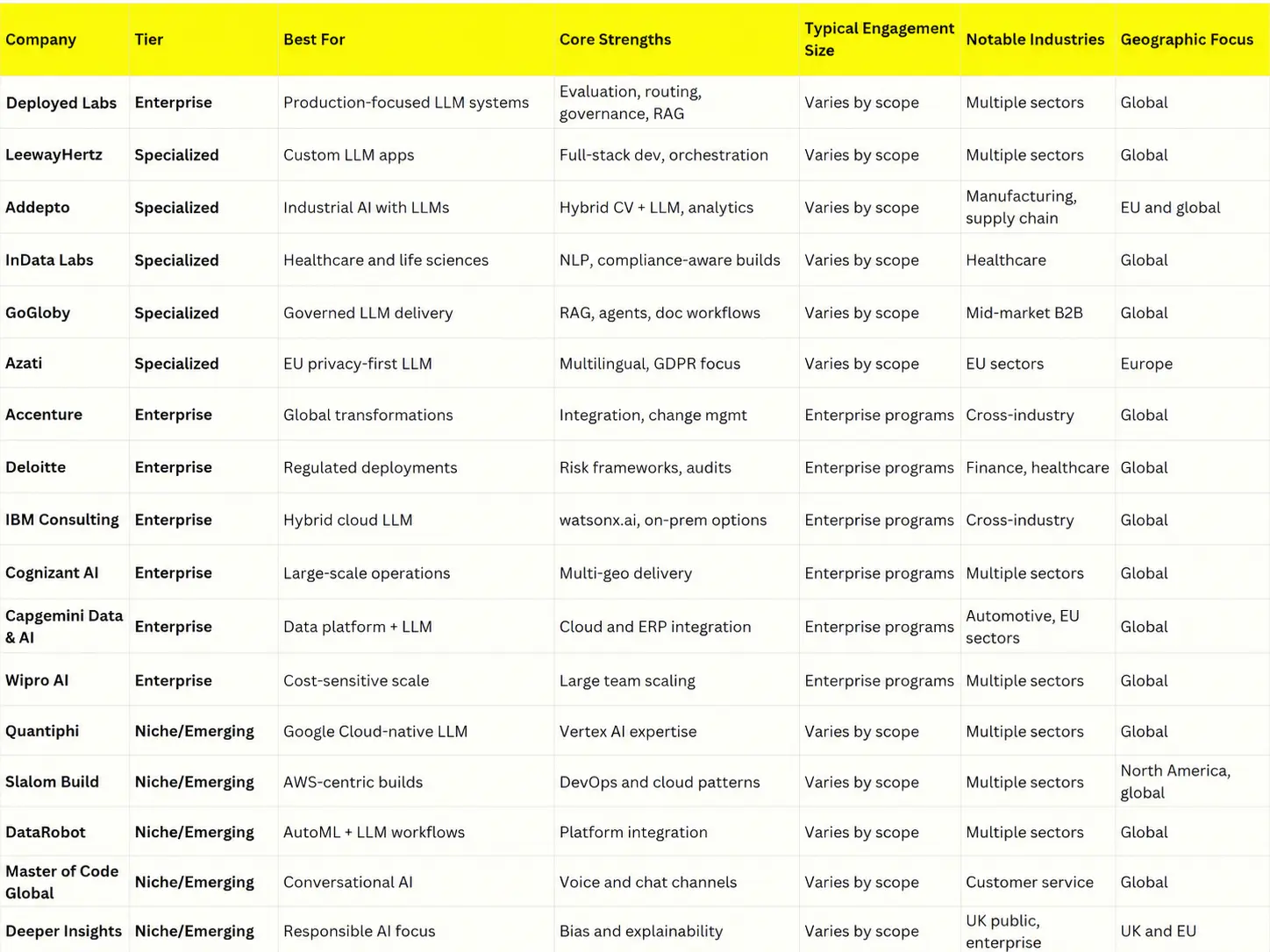
The tiers reflect market structure observed across current research and provider positioning. Enterprise consultancies bring scale and change management, while specialized boutiques emphasize deep RAG, fine-tuning, and LLMOps.
Specialized AI Engineering Firms: Deep Technical Expertise
Specialized boutiques excel when accuracy, retrieval, and governance drive outcomes. Only 38% of surveyed professionals deploy specialized GenAI tools, yet these tools deliver greater time savings and accuracy than general-purpose options BCG. Deployed Labs exemplifies a production-first approach that embeds evaluation and guardrails early Deployed Labs.
1) Deployed Labs
.webp)
Best for: production-focused LLM systems with governance from day one. Core strengths: evaluation and routing, RAG for enterprise knowledge, compliance-ready access controls, and observability. Ideal client: B2B organizations that need reliable, auditable AI in real workflows. Differentiator: workflow-first design with embedded governance and LLMOps maturity for agentic and multimodal use cases Deployed Labs.
Deployed Labs deploys AI agents across:
- Finance and insurance
- Supply chain and operations
- HR and workforce
- Legal
- Sales/GTM
- General enterprise operations

2) LeewayHertz
Best for: custom LLM application development. Core strengths: full-stack product build, multi-model orchestration, and enterprise delivery practices. Ideal client: teams seeking tailored apps over generic tools. Differentiator: breadth across application layers with model-agnostic integration LeewayHertz.
3) Addepto
Best for: industrial and manufacturing workflows augmented by LLMs. Core strengths: analytics and applied AI engineering with domain-aware solutions. Ideal client: operations-focused teams with data-rich processes. Differentiator: combining data platforms with LLM interfaces for decision support Addepto.
4) InData Labs
Best for: healthcare and life sciences deployments. Core strengths: NLP and data processing for regulated data. Ideal client: healthcare organizations that need privacy-aware LLMs. Differentiator: emphasis on compliance-sensitive architectures aligned to sector constraints InData Labs overview.
5) GoGloby
Best for: governed LLM delivery with strong engineering talent. Core strengths: RAG systems, agentic workflows, document automations. Ideal client: mid-market companies needing disciplined production delivery. Differentiator: curated engineering and production discipline GoGloby.
6) Azati
Best for: EU-focused, privacy-first LLM builds. Core strengths: multilingual, GDPR-aware architectures. Ideal client: European organizations with strict data residency. Differentiator: regulatory alignment for EU contexts.
Enterprise Technology Consultancies: Scale and Integration
Global consultancies fit multi-function transformations, where change management and cross-department integration dominate. Worker access to AI rose 50% in 2025, and production footprints are set to expand, which raises the bar on governance and oversight Deloitte State of AI. IBM promotes watsonx.ai as an integrated studio to move from experimentation to production IBM watsonx.ai. PwC’s AI factory operationalizes reusable patterns at scale PwC.
7) Accenture Applied Intelligence
Best for: global enterprise transformations that include LLM components. Core strengths: legacy integration, change management, enablement. Ideal client: complex organizations with cross-function programs. Differentiator: scale and program orchestration.
8) Deloitte AI Institute
Best for: regulated industry implementations. Core strengths: risk frameworks, audit trails, compliance documentation. Ideal client: financial services, healthcare, public sector. Differentiator: governance maturity, with only 1 in 5 companies reporting mature frameworks overall, heightening Deloitte’s value in oversight Deloitte State of AI.
9) IBM Consulting, watsonx Practice
Best for: hybrid cloud and on-prem LLM deployment. Core strengths: watsonx.ai stack, mainframe and enterprise integration. Ideal client: enterprises needing controlled environments. Differentiator: infrastructure options for regulated or sovereignty needs IBM watsonx.ai.
10) Cognizant AI
Best for: large-scale operations with multi-geo delivery. Core strengths: standardized delivery at scale. Ideal client: global enterprises seeking cost-effective rollout. Differentiator: global workforce and delivery footprint.
11) Capgemini Data & AI
Best for: European enterprises modernizing data platforms with LLM layers. Core strengths: cloud migration and ERP integration. Ideal client: firms aligning SAP and data cloud with LLM use cases. Differentiator: strong EU presence and industry programs.
12) Wipro AI
Best for: cost-sensitive enterprise projects. Core strengths: scale and offshore delivery models. Ideal client: enterprises needing rapid team ramp-up. Differentiator: price-to-scale flexibility.
Niche and Emerging LLM Specialists
Niche players fill gaps in verticals where regulatory and workflow constraints shape architecture choices. Providers that publish concrete RAG and evaluation practices tend to accelerate reliability. Orkes documents production-scale RAG patterns such as semantic chunking and hybrid search, which reduce hallucination risk Orkes RAG best practices.
13) Quantiphi
Best for: Google Cloud-native LLM implementations. Core strengths: Vertex AI and data ecosystem fluency. Ideal client: GCP-first enterprises. Differentiator: tight alignment to Google tooling.
14) Slalom Build
Best for: AWS-centric LLM architectures. Core strengths: DevOps maturity and cloud reference patterns. Ideal client: teams standardizing on AWS. Differentiator: well-architected practices applied to LLM systems.
15) DataRobot
Best for: AutoML and LLM hybrid workflows. Core strengths: platform integration, MLOps. Ideal client: analytics-led teams. Differentiator: business-user accessibility layered on governed pipelines.
16) Master of Code Global
Best for: conversational AI and chatbot deployments. Core strengths: voice and text channels, omnichannel. Ideal client: customer service operations. Differentiator: focus on CX automation.
17) Deeper Insights
Best for: UK market with responsible AI focus. Core strengths: bias detection and explainability. Ideal client: organizations prioritizing ethical oversight. Differentiator: responsible AI practices aligned to governance gaps in the market Deloitte State of AI.
What Services Should Your LLM Consulting Partner Provide?
A complete partner covers strategy through operations. Strategy and use case identification must tie to measurable outcomes, not experiments. Model and architecture selection should weigh RAG versus fine-tuning, prompt strategies, and hybrid approaches based on governance constraints and data quality Orkes RAG best practices.
Data preparation and pipelines decide success. Retrieval design, semantic chunking, contextual headers, and hybrid search materially affect accuracy and reliability Orkes RAG best practices. Deployment and LLMOps require monitoring, evaluation, guardrails, and incident response. Only 1 in 5 companies report mature governance for agentic AI, so compliance-by-design, audit trails, and access controls are essential Deloitte State of AI.
Warning signs
Red flags include vendors that only do slideware strategy or quick demos with no plan for data pipelines, governance, or evaluation. Partners should show concrete RAG patterns, test plans, and a path from POC to production with monitoring and rollback Orkes RAG best practices.
How to Choose the Right LLM Consulting Company for Your Needs
Use structured decisions, not brand familiarity. Specialized tools tend to outperform general tools on time savings and accuracy BCG. Vendor partnerships also succeed twice as often as internal builds, so partner selection meaningfully affects outcomes Fortune on MIT research.
Decision framework 1: Match firm type to context
- Specialized boutique: speed, deep engineering, workflow-first builds
- Enterprise consultancy: scale, change management, cross-function coordination
- Deployed Labs: production-first for governed LLM systems with evaluation, routing, and compliance from day one Deployed Labs
Decision framework 2: Align to use case complexity
- Simple Q&A or FAQ chatbot: prompt engineering plus light RAG
- Multi-agent RAG system: advanced retrieval, routing, evaluation, guardrails
- Custom model training: data readiness, fine-tuning, RLHF, and strong LLMOps
Decision framework 3: Industry and deployment alignment
- Regulated verticals: evidence of HIPAA, SOC2, audit trails
- Deployment model: cloud-only, hybrid, on-prem, or sovereign cloud requirements
- Evidence: production references, technical blogs, open-source, and documented evaluation methods
Common Mistakes When Selecting an LLM Development Partner
Five recurring pitfalls stall programs:
- Choosing based on model access instead of engineering capability, since any firm can call a model API.
- Underestimating integration complexity with enterprise data and workflows.
- Ignoring governance and compliance upfront, which is hard to retrofit.
- Confusing a POC demo with production readiness.
- Overlooking LLMOps and ongoing support.
These errors mirror research findings that 95% of pilots fail to deliver rapid gains due to integration and governance gaps Fortune on MIT research. Deployed Labs reduces this risk with a production-first method centered on evaluation, routing, governance, and deployment readiness Deployed Labs.
LLM Consulting vs. Other AI Service Providers: Understanding the Landscape
Model providers build foundation models; consulting firms integrate and customize them for your workflows. Tooling vendors offer gateways and libraries; consultants architect systems that include data pipelines, retrieval, evaluation, and guardrails. Security specialists test and harden; full-stack partners embed security and governance from design.
You may choose multiple partners for specific layers, or a single accountable partner to reduce integration tax. Deployed Labs covers evaluation, routing, governance, and deployment readiness as an end-to-end stance Deployed Labs.
Industry-Specific LLM Consulting Considerations
Healthcare and life sciences require HIPAA alignment, protected health information handling, clinical NLP, and an auditable trail, as outlined by Momentum’s healthcare compliance overview Momentum. Financial services emphasize SOC2 controls, explainability, fraud analytics, and regulator-ready logs Softweb Solutions. Legal and professional services require confidentiality and privilege protection.
Specialized tools tailored to legal, finance, and tax workflows outperform general tools on time savings and accuracy, so domain-aware partners matter BCG. Deployed Labs adapts retrieval scope, access controls, and evaluation criteria to each sector’s regulatory and operational constraints Deployed Labs.
Cost Considerations: What to Expect When Hiring an LLM Consulting Firm
Engagement models typically include fixed-price phases for discovery, time-and-materials for build, retainer-based operations, and outcome-tied pilots. Hidden costs commonly include inference and API usage, data labeling, retrieval optimization, monitoring, and compliance reviews. Define success in advance, then track efficiency gains, revenue impact, and risk reduction rather than hype metrics Ronin Consulting.
Pricing varies by firm tier and scope. Enterprise consultancies often engage as part of broader transformation programs, while boutiques structure focused workstreams. Ask vendors to map costs to the evaluation and monitoring they will operate post launch.
Questions to Ask Before Hiring an LLM Consulting Partner
Technical
- How do you choose RAG vs fine-tuning for our data and constraints?
- How do you handle model drift and evaluation?
- What is your LLMOps stack, including monitoring and rollback?
- What retrieval patterns do you use, such as semantic chunking and hybrid search? Orkes RAG best practices
Process
- How do you move from POC to production?
- What is your typical engagement timeline?
- How do you manage scope changes?
Experience
- Can you show three production systems in our industry?
- What is your production success rate?
- Can we speak with references?
Governance
- How do you ensure compliance and auditability?
- What guardrails and access controls do you implement?
- Given only 1 in 5 firms have mature agentic governance, what specific controls do you bring? Deloitte State of AI
Partnership
- What happens after deployment?
- Do you operate ongoing evaluation and incident response?
- How do you train our team?
The Future of LLM Consulting: Trends to Watch in 2026 and Beyond
Consulting is shifting from model-centric to system-centric delivery that orchestrates multiple models, retrieval strategies, and agents. Deloitte reports AI access jumped 50% in 2025, and production footprints are expected to double quickly, which will increase demand for robust LLMOps and clear governance Deloitte State of AI.
BCG observes momentum toward specialized tools tailored to specific domains rather than one-size-fits-all systems BCG. Expect growing vertical specialization, right-sized models for tasks, and stronger compliance as a core capability. Deployed Labs invests in evaluation-first architectures, retrieval optimization, and governed agent workflows that align with these trends Deployed Labs.
Frequently Asked Questions About LLM Consulting Companies
What is the difference between RAG and fine-tuning?
Retrieval-augmented generation (RAG) augments prompts with relevant enterprise data using vector search and retrievers, allowing the model to access up-to-date information without retraining. Fine-tuning adapts a base model to your specific data, making it more specialized but requiring more data preparation and oversight.
How much does LLM consulting cost?
Costs vary depending on the firm, engagement scope, and complexity. Engagement models often include fixed-price discovery, time-and-materials builds, retainers for ongoing operations, and outcome-based pilots. Hidden costs may include API usage, data labeling, retrieval optimization, monitoring, and compliance reviews Ronin Consulting.
What are the most important criteria when selecting an LLM consulting partner?
Key criteria include proven production deployments, expertise in RAG and LLMOps, governance maturity, and a documented track record in your industry. Look for partners that provide evaluation, monitoring, and compliance-by-design.
Why do most LLM pilots fail to reach production?
95% of generative AI pilots fail to deliver rapid revenue gains, primarily due to integration and governance gaps rather than model capability. Specialized vendor partnerships succeed twice as often as internal builds Fortune on MIT research.
Conclusion
Your partner choice determines whether you cross the GenAI divide. Prioritize technical depth in RAG and evaluation, a documented production track record, sector-specific governance expertise, and an operating model that includes LLMOps. Research indicates specialized partnerships succeed twice as often as internal builds, and that most pilots fail due to integration and governance gaps rather than models Fortune on MIT research.
Next steps: define success metrics tied to ROI pillars, build a scorecard around retrieval, evaluation, governance, and deployment model fit, request detailed proposals, then run a technical deep-dive and reference checks. Deployed Labs can lead a production-readiness assessment that reviews your data, retrieval strategy, governance controls, and LLMOps, then deliver a custom roadmap to reach production reliably Deployed Labs.