



Forward Deployed Engineer has become one of the fastest-growing titles in enterprise AI, and one of the most misused. Plenty of job postings labeled FDE are really describing solutions architecture work: figuring out how the technology should fit a customer's environment. What separates the two is what happens once that answer isn't enough, and the company still needs the thing to run.
Key Takeaways
- Production ownership is what separates the two roles: a solutions architect designs how the technology should fit; an FDE stays on the hook until it's running that way.
- The roles overlap in technical depth and customer exposure, so job title alone is a weak hiring signal.
- Because the boundary varies by company, hiring teams should define the work the role will own before deciding which title to recruit for.
- Christian & Timbers mapped more than 17,000 U.S. FDEs, but approximately 2,000 showed repeated evidence of delivering measurable enterprise AI outcomes.
What Does a Forward Deployed Engineer Do?
A Forward Deployed Engineer works close to the environment where the technology has to produce an outcome. FDEs embed directly inside enterprise environments to build production AI systems, and that skill set now shows up on internal enterprise teams as well as customer-facing ones.
That can mean embedding with an external customer's technical organization or working inside a business unit. In either case, the work extends past recommending an architecture or demonstrating what a product could do. The FDE has to make the system work against real data, existing infrastructure, security requirements, changing business requirements, and the operational problems that surface once a deployment reaches production.
That production ownership is the clearest dividing line between an FDE and adjacent technical roles. It also explains why the title has become important so quickly. Demand for FDEs is projected to grow roughly 2,100% by the end of 2026, according to Christian & Timbers' Elite FDE Scarcity Study, as companies move from AI pilot teams of two or three engineers toward permanent deployment organizations of 20 to more than 100 people.
What Does a Solutions Architect Do?
A solutions architect's job is translation: turning business and technical requirements into a design for how a product or platform should fit inside a customer's environment. That typically means technical discovery, architecture design, integration planning, and flagging constraints before or during implementation.
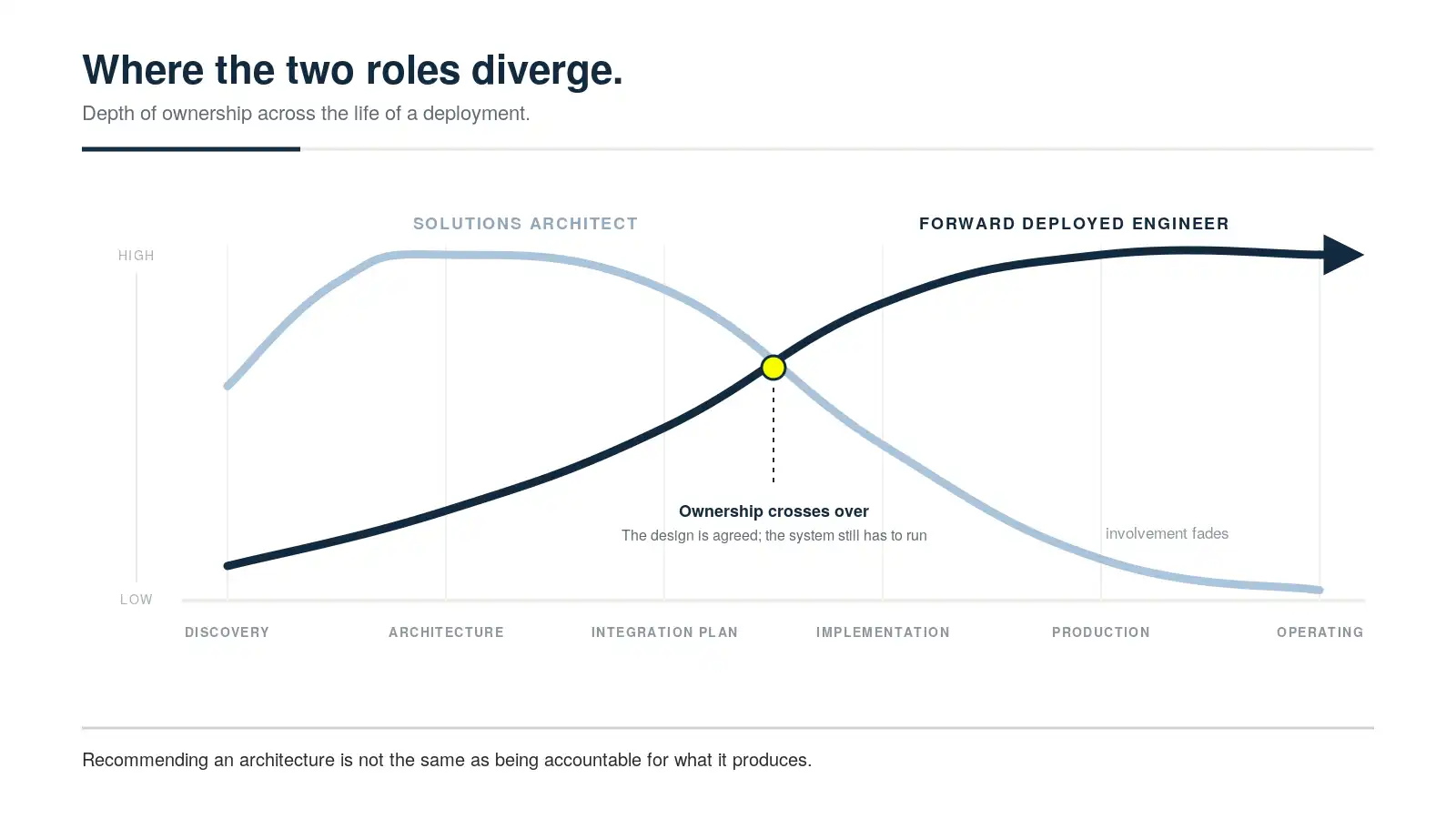
Some solutions architects remain involved well into implementation, which is one reason the role can overlap with forward deployed engineering. The difference becomes clearer when looking at what each person ultimately owns.
Forward Deployed Engineer vs. Solutions Architect: The Core Difference
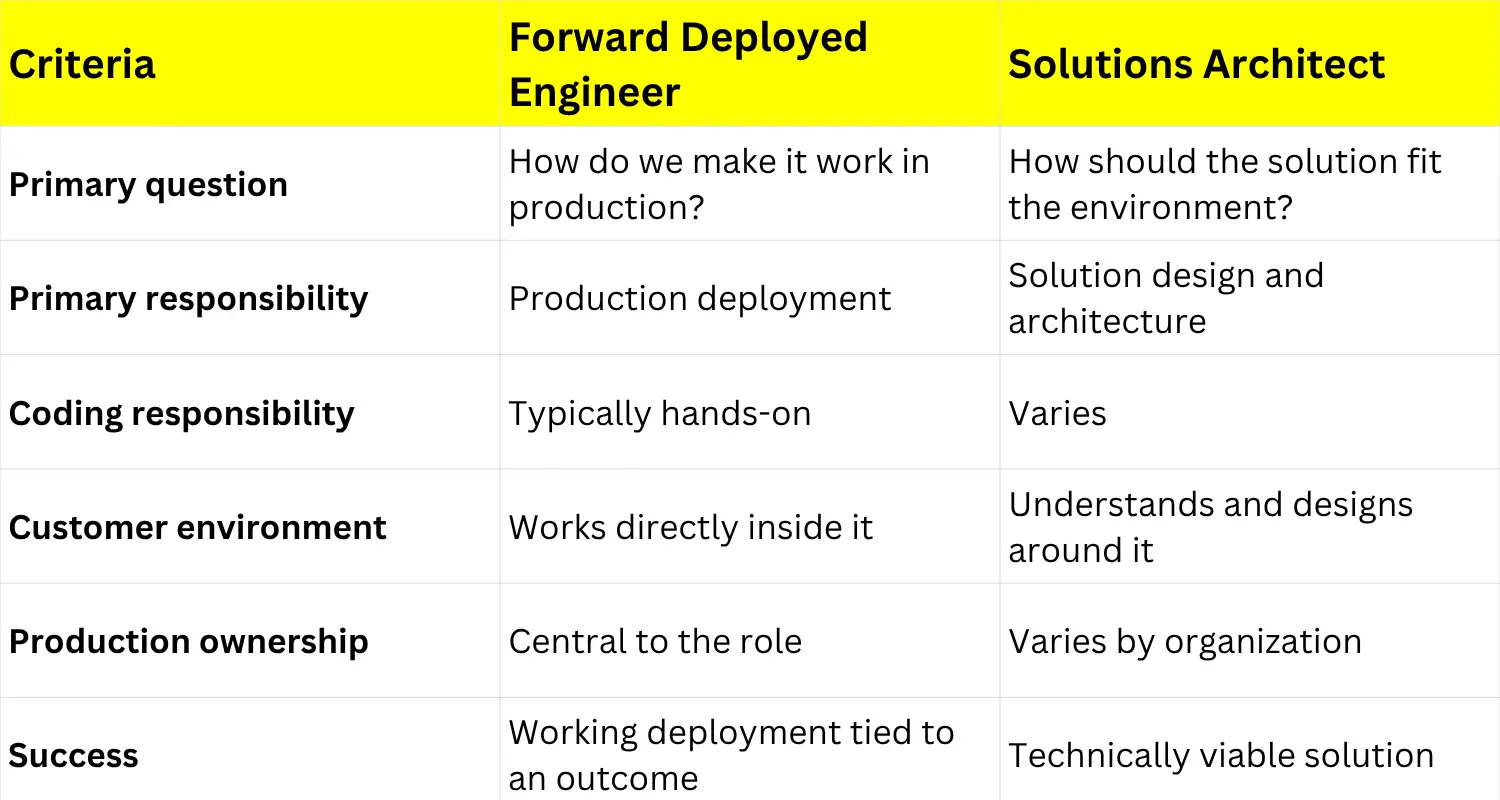
A solutions architect typically answers: how should this technology fit into the customer's existing environment?
An FDE is more likely to be accountable for: can we make it work there?
Where the Roles Overlap
The two roles share more than the titles suggest. Both require technical depth, direct customer interaction, architectural judgment, and enough exposure to the client's actual systems to know when a design won't survive contact with them. In many organizations, both stay involved through some stage of implementation.
The boundary between the two isn't fixed. It shifts with how each company has organized its deployment work, so the job title alone won't tell a hiring team where the line sits.
FDE vs. Solutions Architect: Side-by-Side Comparison
When Should You Hire an FDE Instead of a Solutions Architect?
A company probably needs an FDE when the person will be expected to write or modify production code, work directly with live enterprise systems, solve implementation problems as requirements change, and remain accountable after the architecture has been approved.
If the mandate centers on understanding requirements, designing the integration, establishing technical feasibility, and guiding the customer toward an implementation approach, the company is more likely looking for a solutions architect.
Why the Difference Matters More in Enterprise AI
Christian & Timbers mapped more than 17,000 U.S. FDEs and found approximately 2,000 capable of consistently delivering enterprise AI ROI. The same research found fewer than one in five companies studied are achieving meaningful AI ROI, while enterprises are moving from two- to three-person pilot teams toward permanent deployment organizations of 20 to more than 100 FDEs.
That gap is why distinguishing architecture talent from deployment talent matters right now. As companies build larger deployment organizations, hiring teams need to know whether a mandate calls for someone who can design the path to implementation or someone who has repeatedly carried systems through production.
What Hiring Teams Should Look For
The hardest part of an FDE vs. solutions architect search is that strong candidates can look similar on paper. Both may have enterprise customers, complex integrations, architecture work, and even some production experience in their backgrounds.
The distinction appears in what they personally owned. A solutions architect may have designed the path to implementation. For an FDE, that means being able to explain what they built, the problems that surfaced in production, how they adapted the system in response, and the measurable outcome the deployment ultimately produced.
For hiring teams, that deployment record matters more than the title.

Frequently Asked Questions
- What's the strongest signal that a candidate can do FDE work, not just talk about it?
Look for individual ownership in how they describe past projects. Candidates who default to "we shipped" or "the team built" are often harder to evaluate than candidates who can say precisely what they scoped, wrote, and maintained themselves. The stories worth trusting come with a number attached: what changed, and by how much.
- Should every Forward Deployed Engineer requisition be interviewed the same way?
No. FDE has splintered into different jobs wearing one title. An integration specialist may need a different interview loop from a product-embedded engineer, even when both positions are called FDE. Before opening the search, hiring teams should decide which version of the role they need, the same question this article raises about solutions architects.
- Is a strong architecture background a red flag for an FDE candidate?
Not on its own. A capable FDE usually needs the same architectural judgment a solutions architect brings. The question is what happened after the design was approved. A candidate who can only describe the plan, not what got built, what broke once it hit production, and how they fixed it, is showing an architecture skill set rather than a deployment one.
- Why do technically strong engineers still fail FDE interviews?
Technical depth alone does not reveal how someone handles an ambiguous deployment problem. A useful FDE interview should test how a candidate works through incomplete requirements, changing constraints, and customer trade-offs rather than relying primarily on algorithmic exercises.
- Does the FDE title mean the same thing at every company?
No, and that's worth stating plainly to hiring managers who assume otherwise. What counts as an FDE at a firm like Palantir can look nothing like the role at an early-stage startup. A competitor's job posting won't tell you what an FDE should do inside your company. Start with the work the role will own.
For the full market data and analysis of the elite FDE talent pool, download Christian & Timbers' Elite FDE Scarcity Study.