



You choose a product recruiting partner by verifying role calibration skill, US market access to passive talent, and evidence of rigorous assessment that links product decisions to business outcomes. For executives, retained search with a transparent process, scorecarding, and board-level alignment limits mis-hire risk and shortens time to hire. Contingency staffing fits mid-level roles.
This decision guide defines product management recruiting services, when to use them, how to evaluate providers, and what a strong assessment looks like. It includes role coverage, a hiring decision checklist, and Christian & Timbers’ seven-step process. Our approach connects product mandates to strategy, organization design, and measurable outcomes, with an average placement time of 72 days in the United States market (Executive Search Guide).
Key Takeaways
- Product leadership hiring is high-stakes, and mis-hires can waste well over $240,000 when all costs are tallied (Apollo Technical).
- Demand for CPTOs rose over 110%, reflecting the need to unify product and engineering for AI roadmaps (Business Wire).
- Efficient, partner-led retained search can compress timelines, with Christian & Timbers averaging 72 days to placement (Executive Search Guide).
What Are Product Management Recruiting Services?
Concise definition: Product management recruiting services help companies identify, assess, and hire product professionals whose experience matches the company’s product strategy, stage, and operating model.
Product management recruiting services help companies identify, assess, and hire product professionals whose experience matches the company’s product strategy, stage, and operating model. Specialized firms distinguish between contingency staffing for mid-level PMs and retained executive search for VP, CPO, and CPTO mandates, where deep market mapping and scorecarded assessment matter.
Scope typically includes role calibration, US market mapping, targeted outreach to passive talent, multi-stage assessment, interview advisory, references, offer support, and post-hire follow-up. Retained search aligns leadership on mandate, decision rights, KPIs, and org design before sourcing, which improves decision quality and accelerates closing (Executive Search Guide).
A search partner adds the most value for confidential replacements, first product leadership hires, AI-led transformations, and hard-to-reach passive talent. In 2026, product leadership is a central profit engine, so evaluating commercial acumen and multi-year roadmap ownership is essential, not optional (CPO Executive Search Firms).
Why Does Product Management Hiring Require Specialized Expertise?
Titles mask differences. A Head of Product at a Series B SaaS firm may own discovery, pricing, and data science integration, while an enterprise VP may focus on portfolio governance and partner ecosystems. The right partner distinguishes product sense, customer discovery, technical fluency, commercial judgment, and people leadership rather than chasing keywords.
Over-indexing on vertical subject matter expertise shrinks the pool and ignores transferability. Industry knowledge can be learned, while strategic product judgment is harder to teach. Mis-hiring is costly and cultural; 85% of HR professionals report morale damage from bad hires (INOP). Direct costs can exceed $240,000, even before opportunity costs (Apollo Technical).
Example: A growth-stage B2B SaaS Head of Product must drive ARR through pricing tests, activation, and retention analytics. An enterprise consumer VP may prioritize platform scale, privacy compliance, and multi-market launches. Treating these as equivalent profiles leads to mismatched expectations and stalled roadmaps.
Product Roles Christian & Timbers Can Help Companies Hire
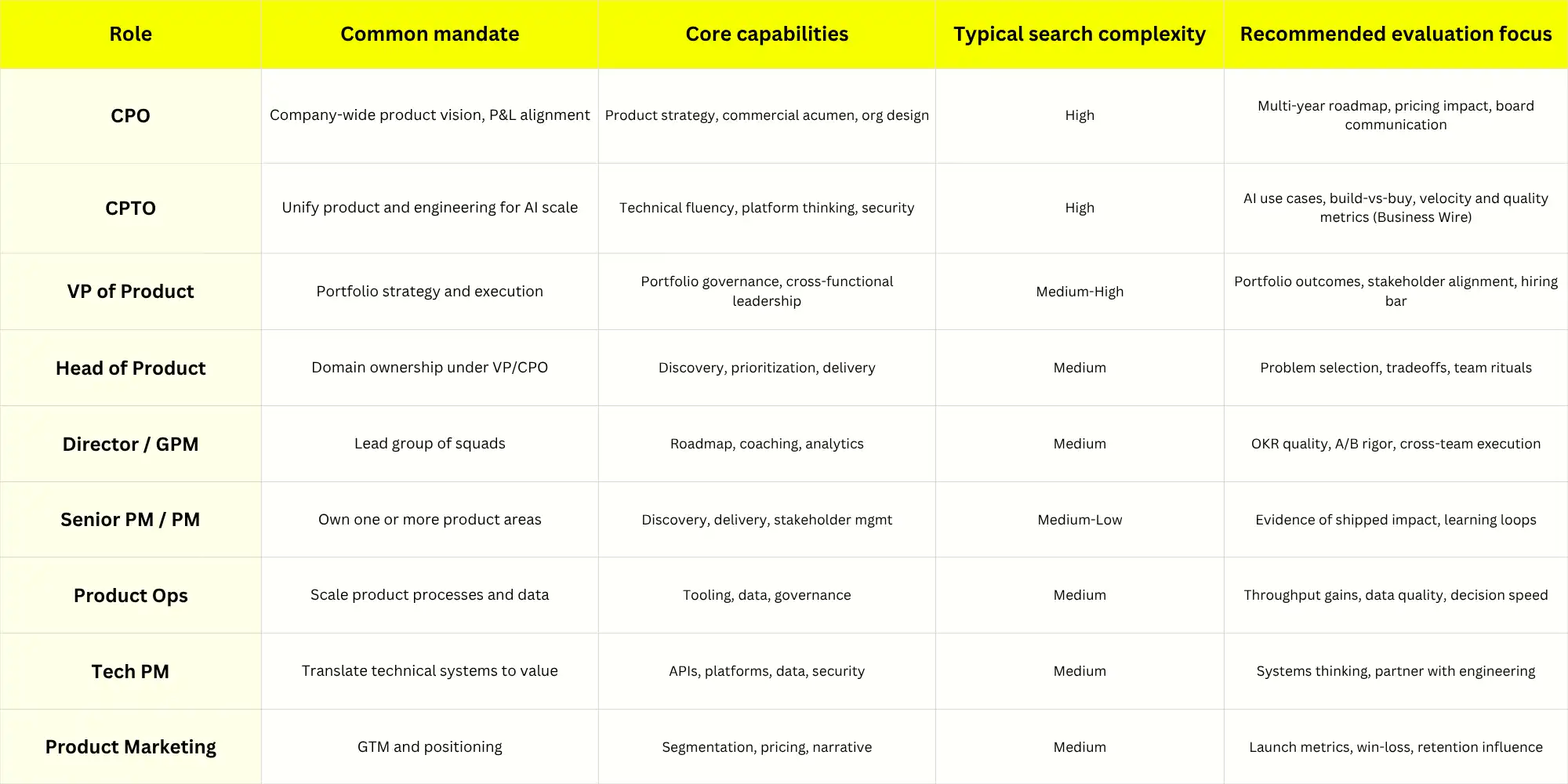
We recruit United States product leaders and builders across growth stages. Executive roles require distinct mandates and evaluation lenses. The CPTO role is expanding quickly to unify product strategy and engineering execution, with demand up 110% and projected presence in half of software companies by 2029. US base salaries often range from $350,000 to $650,000 for CPTOs (Business Wire).
The following table summarizes typical mandates and how to assess them. Use it to align stakeholders before sourcing.
Role Coverage and Evaluation Focus
When Should You Use Product Management Recruiting Services?
Use retained search when the risk of delay or a mis-hire exceeds fees. Clear triggers include first product leadership hires, confidential replacements, post-funding scale, new market entries, AI-led transformations, and scarce US talent needs. Founders spending more than 30% of time on product is a strong signal to hire a dedicated leader (How to Hire a CPO).
Top executive talent is usually passive, so access and trust matter. A disciplined retained process with calibrated scorecards, passive outreach, and reference rigor improves quality and speed. Christian & Timbers averages 72 days to placement for executive searches (Executive Search Guide).
Quick Decision Framework
- Use internal recruiting if the role is mid-level, the profile is clear, and qualified inbound exists.
- Use a specialist if the role is executive, confidential, or strategic, stakeholder alignment is incomplete, or you need access to passive leaders.
- Escalate to retained search if a founder is over the 30% product-time threshold or the search has stalled for 8 to 12 weeks (How to Hire a CPO).
How to Evaluate a Product Management Recruiting Firm
Center your evaluation on five pillars: product specialization, assessment rigor, search model fit, access to passive talent, and US presence. Ask for case-anchored evidence, not marketing claims. Seek role calibration artifacts that define mandate, decision rights, stage, customer, and KPIs before sourcing (Executive Search Guide).
Understand economics and commitment. Median executive cost-per-hire is often cited around $15,000 and averages can reach $35,879, excluding mis-hire fallout (InterviewCost, SHRM proxy; HireTruffle). Retained search fees typically range from 25% to 33% of first-year cash, with partner time and dedicated research included (Executive Search Guide).
A Buyer’s Checklist
- Proof of recent US product leadership searches, plus named case studies with outcomes.
- On-paper scorecarding method that tests decisions and results, not just terminology.
- Passive-talent access via research, referrals, calibrated outreach, and discreet backchanneling.
- Transparent weekly reporting, stakeholder alignment, and post-placement support.
- Clear fees, guarantee, and confidentiality practices in writing.
Christian & Timbers' Product Management Recruiting Process
Our partner-led process links the product mandate to strategy, organization design, and value creation. It is built around OnPoint Scorecarding and typically delivers executive placements in 72 days in the US market (Executive Search Guide).
Seven Steps, Inputs, and Deliverables
- Leadership and business alignment: CEO, CPO, CTO, and board goals. Deliverable: OnPoint draft scorecard.
- Role calibration: mandate, scope, reporting, KPIs, compensation. Deliverable: Approved brief and candidate narrative.
- Market mapping: US target companies and talent pools. Deliverable: Longlist with rationale.
- Targeted outreach: active and passive candidates. Deliverable: Interested, qualified slate.
- Structured assessment: judgment, customer depth, technical fluency, execution, and commercial impact. Deliverable: Evidence-based profiles.
- Stakeholder alignment and closing: interviews, references, offer support. Deliverable: Accepted offer.
- Post-placement follow-up: onboarding and alignment. Deliverable: 30-60-90 integration support.
Evidence: SiTime appointed a CDO and CFO through C&T, growing revenue from $202.7M to $326.7M and increasing market cap into the $6-$8B range (SiTime case study). In aerospace, an AI-native CTO hire in ten weeks reduced certification prep time by 40% and cut manufacturing costs by 5-15% (Aerospace AI CTO case).
What Does a Strong Product Candidate Assessment Include?
Great assessments probe evidence, not slogans. We test how candidates choose problems, validate assumptions, make tradeoffs, and move the business. For executives, we include C-level panels to gauge executive presence and cross-functional trust (CPO Executive Search Firms).
Sample Scorecard: Evidence and Red Flags
- Product judgment: Evidence: A decision that dropped a feature to raise retention, with cohort proof. Red flag: Brand-new frameworks with no shipped impact.
- Customer and market: Evidence: Synthesis of interviews plus A/B tests that changed pricing. Red flag: Persona theater without data (ProductPlan).
- Execution: Evidence: Clear priority stack, risk burndown, and iteration speed. Red flag: Roadmap recency bias.
- Technical and analytical fluency: Evidence: Partnering with engineering on APIs, data quality, or ML guardrails. Red flag: Shallow metrics.
- Commercial impact: Evidence: ARR movement, margin lift, or churn reduction with attribution. Red flag: Vanity metrics.
- Leadership: Evidence: Conflict resolved with design and sales, and talent upgraded. Red flag: Title inflation without scope.
Invite senior executives to final rounds to validate presence and judgment in real situations (CPO Executive Search Firms).
Questions to Ask Before Hiring a Recruiting Partner
Use these questions to separate process from proof. Ask for artifacts, case links, and how the firm handles tradeoffs, confidentiality, and backchannel references. Expect a bespoke strategy document and transparent weekly reporting, not canned slides (Executive Search Guide).
Eight Buyer Questions and How Christian & Timbers Answers
- How many comparable US product searches have you completed? Answer: Thousands of executive mandates over decades, including CPTOs and CPOs, with public case studies.
- Who leads research and assessment? Answer: Partner-led, with OnPoint Scorecarding and specialist researchers.
- How do you define the profile before sourcing? Answer: Week-1 leadership alignment and a bespoke scorecard (Executive Search Guide).
- How do you evaluate product judgment and business impact? Answer: Evidence-based interviews, backchanneling, and financial attribution where possible.
- How do you access passive talent? Answer: Market mapping, calibrated outreach, and referral networks that seldom respond to job ads.
- What reporting cadence should we expect? Answer: Weekly pipeline, feedback, and decision checkpoints.
- What are the fees and guarantee? Answer: Retained model, typically 25% to 33% of first-year cash, with defined replacement terms (Executive Search Guide).
- How do you support closing and onboarding? Answer: Offer strategy, start-date planning, and 30-60-90 follow-up.
Common Product Management Recruiting Mistakes
Avoid generic job descriptions that skip mandate, KPIs, and decision rights. Do not overweight logos or titles. A VP title at a 50-person startup can map to a Director at scale, while a Senior PM at a hyper-growth firm may outperform a small-company VP.
Do not conflate product leadership with project management or product ownership. Secure stakeholder alignment before market outreach to avoid stalls and candidate withdrawals. Deep reference checks reduce mis-hire risk that can exceed $240,000 in wasted costs (Apollo Technical).

Frequently Asked Questions About Product Management Recruiting Services
Q: What is the difference between product management recruiting and executive search? A: Product recruiting spans PM to CPO. Contingency firms often focus on mid-level roles. Retained executive search handles confidential, strategic mandates, with deeper calibration, passive outreach, and board alignment, which improves decision quality and closing (Executive Search Guide).
Q: How long does a product management search take? A: Retained executive product searches often run 12 to 16 weeks. Christian & Timbers averages 72 days to placement, driven by partner-led calibration and targeted outreach in US markets (Executive Search Guide).
Q: How much do product management recruiting services cost? A: Retained fees typically range from 25% to 33% of first-year cash compensation. That investment mitigates mis-hire waste that can exceed $240,000 when you add lost productivity and turnover costs (Executive Search Guide; Apollo Technical).
Q: Should a startup hire a recruiter for its first product leader? A: Often yes, once the founder spends over 30% of time on product. External calibration clarifies mandate, success metrics, and operating model, and improves access to passive leaders who can build the function (How to Hire a CPO).
Q: Can one firm hire both PMs and product executives? A: Yes, if they show evidence of role calibration across levels and a clear retained model for executives. Look for case studies and a scorecard method that tests decisions and outcomes, not just terminology (CPO Executive Search Firms).
Q: What should be in a product candidate scorecard? A: Product judgment, customer and market insight, execution, technical and analytical fluency, commercial impact, and leadership. Define evidence per competency and agree on red flags before interviews (CPO Executive Search Firms).
Q: How are product managers assessed during a search? A: Use structured interviews with scenario work, data reviews, and backchannel references. Probe A/B testing depth, cohort outcomes, and tradeoffs under constraints. Invite executives to evaluate presence and alignment (ProductPlan; CPO Executive Search Firms).
Q: PM vs TPM vs Product Owner vs Product Ops? A: PMs own problems, outcomes, and roadmaps. TPMs translate complex systems to customer value. Product Owners focus on backlog within agile teams. Product Ops scales processes, data, and tooling to improve throughput and decision quality.
Find the Right Product Management Recruiting Partner in 2026
Search quality rises with crisp role definition, passive market access, rigorous assessment, and stakeholder alignment. Product leadership sits at the center of growth, AI deployment, and retention, so the mandate requires commercial, technical, and organizational fluency (CPO Executive Search Firms).
Christian & Timbers is a strategic partner for US product leadership searches. Our OnPoint Scorecarding, market mapping, and partner-led process connect hiring to enterprise value, with a 72-day average placement time. Explore our approach, then schedule a confidential consultation (Executive Search Guide; How to Hire a CPO).
Author: JC Christian, Managing Partner, Christian & Timbers Expert Reviewer: Tim Christian, Chairman, Christian & Timbers Last reviewed: 2026
Conclusion
Hiring a great product leader is a business decision, not a title match. Define the mandate, align stakeholders, and measure candidates on judgment, customer and market depth, technical fluency, execution, commercial impact, and leadership. For executive roles, a retained, partner-led model with scorecarding, passive outreach, and reference rigor reduces risk and time to hire.
If you need a CPO, CPTO, VP, or Head of Product in the United States, we can help. Review our process and case studies, then schedule a confidential consultation to scope your search and align the brief (Executive Search Guide; SiTime case study).