

General Motors created its first Chief AI Officer role in March 2025. By November, that person was gone. I am not going to speculate on what happened inside GM specifically. But when a company creates a new C-suite AI role and the first person in it leaves within months, one of the first questions I ask is whether the mandate, authority structure, and execution expectations were fully defined before the search began.
Automotive AI leadership searches have a compounding version of that problem. In every other sector I cover in this series, the primary question boards ask about an AI leader is whether they have shipped agents into production. In automotive, that question is necessary but not sufficient. The follow-up is whether those systems operated under safety constraints where a failure mode was not a missed SLA but a vehicle making a wrong decision at speed. That additional bar is what makes these searches the hardest ones in the series.
The Architecture Has Already Changed
The vehicle that most OEMs are building today is structurally different from what was on the road five years ago. The legacy approach distributed electronic control units across the vehicle, each built by a different supplier, each running its own software. A modern mid-range vehicle might have contained a hundred of those independent computers.
Tesla began centralizing that architecture in 2012. Rivian built from a centralized architecture from the start. RJ Scaringe argued in May 2026 that only those two companies had fully broken from the fragmented, supplier-driven software model that still defines most vehicles on the road. Whether or not that framing holds, the market pressure it reflects is real. Every major OEM is now running some version of an SDV program, and every one of those programs requires technology leadership that can operate in a different engineering environment than the one that produced the cars currently in their showrooms.
The global automotive software market was valued at around $36 billion in 2025 and is projected to reach $113 billion by 2034. Software-defined vehicle programs are expanding considerably faster, with estimates placing SDV growth between 25% and 30% annually. That market trajectory is producing a specific kind of executive search: boards that need to compete for software leadership against Tesla, Waymo, and the consumer technology companies that are now building in-vehicle AI systems.
Why the CTO Role Has Changed in Automotive
Five years ago, an automotive CTO could succeed by managing supplier relationships, overseeing electronics integration programs, and keeping complex hardware development schedules on track. The vehicle was fundamentally a hardware product with embedded software. That is no longer the case.
The software stack now plays a larger role in vehicle differentiation than it did a decade ago. Features are delivered after the car leaves the factory. Revenue is generated through subscriptions and OTA updates. The AI systems governing perception, decision-making, and driver assistance are updated continuously rather than locked at production. That shift changes what boards need in a technology leader entirely. The CTO who managed a successful infotainment program and the one who shipped a production ADAS system with a continuous learning loop are not the same hire, even if both have spent their careers in automotive.
What GM's Mandate Problem Tells the Industry
GM's technology organization is substantial. Dave Richardson had held the SVP of Software and Services Engineering role. Sterling Anderson is Chief Product Officer. The company is actively working on what it calls an "eyes-off" driving system targeting 2028. These are real programs with real engineering depth. The departure occurred inside an organization with significant AI ambition and engineering capability.
The departure highlights a challenge many organizations face when creating AI leadership mandates. The title can be defined quickly. The authority, ownership structure, and execution expectations often take longer to align. When those elements are not established before a search begins, the role is often created before the supporting structure is fully in place, making execution difficult even for highly qualified leaders.
BMW's approach has been different. The company selected AWS as its cloud provider for the automated driving platform underpinning the Neue Klasse vehicles' ADAS, a commitment announced in 2023 and now in production. It reflects a technology leadership team that had made specific architectural decisions and was willing to be publicly accountable for them.
The Two Searches That Are Actually Happening
When I look at what automotive companies are actively searching for in 2026, it breaks into two distinct mandates that require different profiles almost entirely.
The AI-native builders who succeed in automotive look different from the profiles that succeed in logistics or retail. In those sectors, the differentiator is production deployment experience with agentic workflows. In automotive, the differentiator is safety-critical deployment: having shipped AI systems where the consequences of failure affect vehicle behavior at speed. That constraint filters the candidate pool down to a much smaller group, and most of them are not visible through conventional search channels.
Demand for this profile already outstrips available supply across markets. In automotive, where the safety-critical constraint filters the pool further, the gap is more acute still.
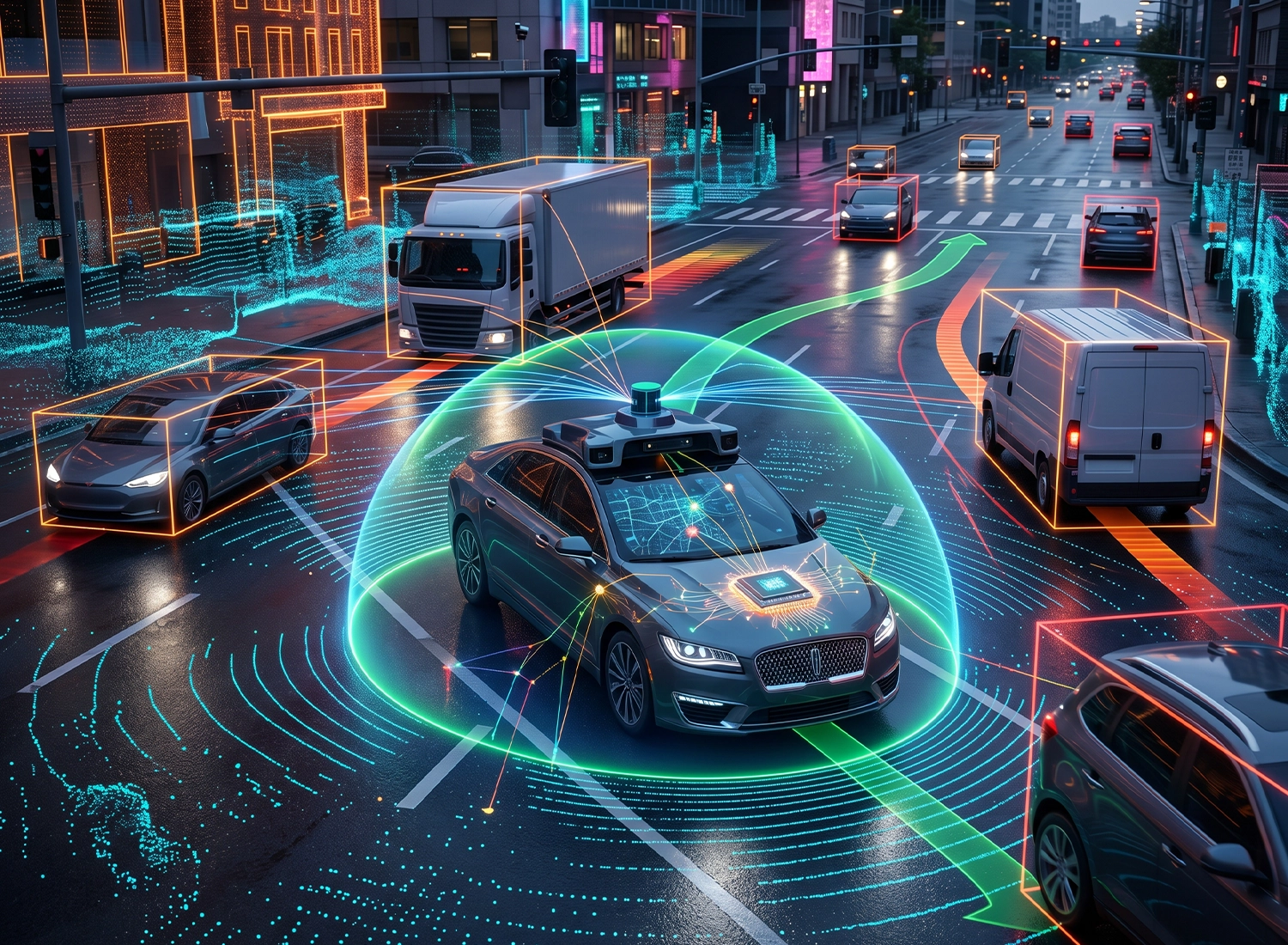
The ADAS and autonomy leader is responsible for AI systems that affect vehicle behavior, perception, and decision-making at the edge. The technical bar here is unlike anything else in the C-suite search universe. The candidate needs to have shipped production AI systems under safety constraints, with exposure to functional safety standards, validation pipelines for neural network models in regulated environments, and the discipline of knowing when a model is not ready for production regardless of benchmark performance. Waymo's fleet reached over 1,500 vehicles in 2025. Tesla's FSD system is accumulating the equivalent of over 500 years of continuous driving data per day from its global fleet. The candidates who understand how to build and operate at that scale are identifiable, but most of them are not available through a conventional retained search process.
The software platform mandate is a different search entirely. This is the person building the vehicle operating environment: the OTA update infrastructure, the centralized compute architecture, the developer platform that internal teams and third-party applications use to deliver features after the vehicle has already been sold. Ford's Chief EV and Digital Systems Officer Doug Field leads this mandate, overseeing the integration of AI into both digital and physical operations with a focus on connected vehicles and manufacturing processes. The candidates here often come from consumer technology or enterprise SaaS, and the challenge is finding someone who can work within automotive's regulatory and supplier complexity without losing the software velocity mindset that makes them valuable.
Some OEMs and Tier 1 suppliers are also bringing in Forward Deployed Engineers to accelerate specific AI deployments. The model is increasingly being used alongside traditional CTO and AI leadership hires, with organizations treating it as a complementary capability.
These two mandates are sometimes collapsed into a single CTO search. That is almost always a mistake. In the largest automotive organizations, these leaders increasingly report directly to the CEO, Chief Product Officer, or software organization head rather than operating through traditional engineering hierarchies. The reporting structure matters because SDV programs cut across product, software, operations, supplier management, and regulatory compliance simultaneously. The competencies overlap in some areas and diverge sharply in others, and the organizational structures they require are different.
The Regulatory Constraint Is Not a Soft Factor
One of the consistent errors I see in automotive AI leadership searches is treating regulatory compliance as a background condition rather than a core competency.
The EU's UNECE regulations include R155 for cybersecurity and R156 specifically for OTA updates. NHTSA has its own guidelines. Chinese GB standards are a third regime. A vehicle sold in multiple markets has to be designed for compliance across all three from the beginning, because retrofitting multi-market regulatory requirements after the architecture is set is expensive in a way that tends to surface mid-program and create exactly the kind of crisis that gets technology executives removed.
The automotive AI CTO who can operate in this environment is not someone who has built AI systems quickly in a permissive regulatory context and is now learning automotive constraints. They have built in constrained environments before. They understand that ISO 26262 compliance is not a checkbox exercise but an architectural discipline that has to be embedded into how teams work from the start of a program.
This requirement narrows the candidate pool. The strongest candidates typically come from autonomous vehicle programs, advanced ADAS organizations, aerospace systems, or safety-critical robotics environments. Traditional automotive sourcing channels rarely surface those profiles, which is one reason these searches take longer than boards expect and cannot rely on standard industry networks.
A WEF survey of 1,010 C-suite executives in October 2025 found that 94% face AI-critical skill shortages, with a third reporting gaps exceeding 40% in essential roles. In automotive, where regulatory and safety requirements narrow the qualified pool further, that shortage is more acute than the headline figure suggests.
What Boards Are Getting Wrong
The most common mistake I see is a search brief that describes the output without defining the organizational conditions that will allow someone to deliver it. A board will say they want a CTO who can accelerate the SDV transition. That is the output. The questions that determine whether a candidate can deliver it are different:
- What decisions does this person own independently?
- What is the budget authority?
- Who do they need to move to implement an architectural change?
- What happens when a supplier relationship conflicts with a software timeline?
We see this repeatedly across AI-native leadership searches. Organizations describe the candidate they want as AI-forward, AI-enabled, or AI-fluent. The automotive companies making the most progress are usually hiring leaders with direct accountability for production AI systems operating in safety-critical environments. The distinction matters because understanding the technology is not the same as having carried accountability for deploying it under those constraints.
A related mistake is treating automotive AI leadership as a transfer from consumer technology. The candidates who have built at scale in consumer technology bring software velocity and product instinct. But the person who built a recommendation algorithm or an ad targeting system has not managed the validation requirements for a system that affects vehicle safety. That gap is bridgeable, but it requires specific experience in the gap itself, not just confidence that the skills will transfer.
Automotive programs also run on timelines that are long relative to software cycles. An SDV platform decision made today will be in production vehicles in three to four years. The CTO you hire needs to operate with that time horizon in mind, which means the search for that person should not be optimized for how quickly you can fill the seat.
How Compensation Has Changed
Automotive companies are competing for the same talent pool as autonomous vehicle firms, AI infrastructure companies, and robotics organizations, while also carrying regulatory and product lifecycle requirements that narrow the qualified candidate pool further. That combination is pushing compensation higher and faster than general AI leadership benchmarks suggest. Christian & Timbers' 2026 Corporate AI Compensation Study found that 72% of employers globally report difficulty filling AI roles, while 94% of C-suite executives report AI-critical skill shortages.
At public companies with 10,000 to 50,000 employees, an AI-Native CTO or CIO carries a base salary of $551,000 to $1.12 million with annualized equity reaching $7.475 million. VP of AI Engineering roles at that scale run $330,000 to $783,000 in base. Additional benchmarks for CTO, Chief AI Officer, VP of AI Engineering, SVP AI, and Head of AI are available in C&T's 2026 AI Compensation Study.
Conclusion
Automotive AI leadership searches are harder than most boards anticipate because the time horizon is unforgiving. A wrong hire in logistics surfaces within months, when the agent deployments do not materialize. A wrong hire in automotive can take three years to become visible, by which point the SDV program has drifted, the engineering team has fragmented, and the window for competitive positioning has narrowed. Getting the mandate right before the search begins matters more in this sector than in almost any other.
If you are evaluating an automotive AI leadership search, the first question is not who to hire. It is whether the mandate is structured to succeed. Reporting relationships, authority, ownership boundaries, and the distinction between ADAS and software platform leadership all influence the outcome long before candidates enter the process. Christian & Timbers has conducted more than 200 AI-native executive searches and advises boards on how to define those mandates before a search begins.

Frequently Asked Questions
- Do OEMs need separate leaders for ADAS and software platform?
At most large OEMs, yes. The ADAS mandate requires deep safety-critical AI deployment experience. The software platform mandate requires product engineering instincts and software velocity. Combining both into a single CTO role usually means the board gets a candidate who is strong in one area and thin in the other. Organizations that have separated these mandates tend to move faster on both.
- Where do the strongest automotive AI CTO candidates come from?
The best ADAS candidates tend to come from autonomous vehicle programs, Tier 1 suppliers with deep ADAS engineering organizations, or aerospace and defense backgrounds where safety-critical AI has been in production longest. Software platform candidates more often come from consumer technology or enterprise SaaS, with the filtering question being whether they have worked inside hardware-constrained, regulated environments before.
- How does ISO 26262 experience affect the search?
It narrows the pool substantially and is one of the most commonly underweighted requirements in automotive AI leadership briefs. Candidates who understand functional safety as an architectural discipline rather than a compliance process are a different profile from those who have only encountered it as a documentation requirement. Boards that do not screen for this distinction often end up with a leader whose team has to learn it mid-program.
- Are Forward Deployed Engineers relevant for automotive AI programs?
For contained programs with a defined scope, yes. OEMs and Tier 1 suppliers are beginning to bring in FDEs from frontier labs and Palantir to accelerate specific deployments without opening a full CTO search. These engagements are most common when an organization needs to move a specific AI initiative into production quickly but does not yet require a permanent executive leadership hire.
- How do I choose the right forward deployed engineer recruiters for automotive and mobility programs?
Automotive and mobility programs require FDE recruiters with access to candidates who have built in hardware-constrained, safety-adjacent environments. The Palantir and frontier lab alumni pools are the primary sourcing targets, but filtering for candidates who can operate within automotive's regulatory and supplier complexity requires a search firm that understands both profiles.